NEWS →

SAMIA HENNI is a historian and an exhibition maker of the built, destroyed, and imagined environments. Her work addresses questions of colonization, wars, resource extraction, deserts, forced displacement, and gender dynamics.

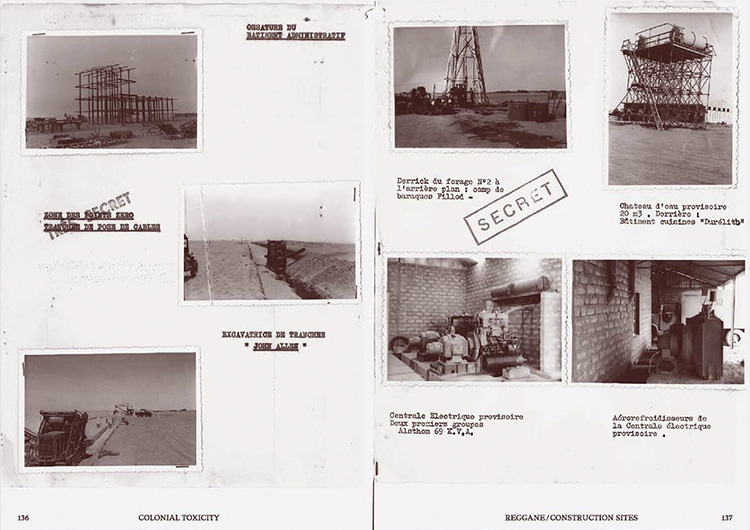
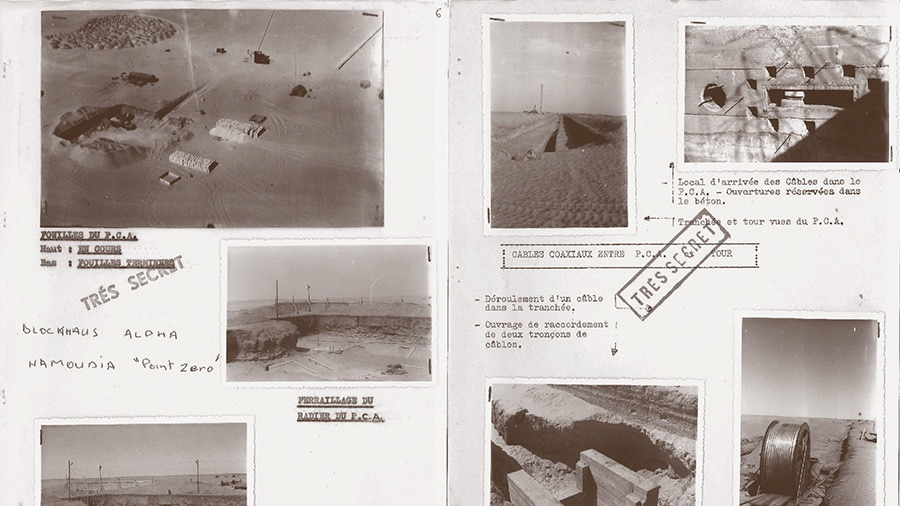
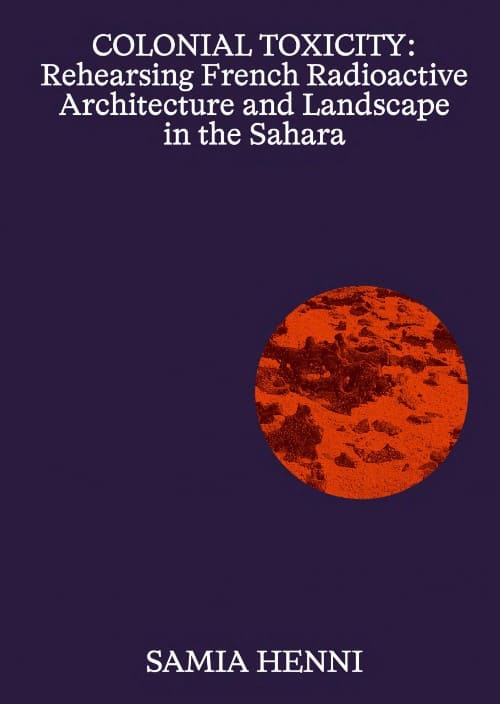
Samia is the author of Colonial Toxicity: Rehearsing French Radioactive Architecture in the Sahara Colonial Toxicity (If I Can't Dance, Framer Framed, edition fink, 2024), which investigates France's nuclear weapons program conducted between 1960 and 1966 in the Algerian desert. During those years, the French colonial regime detonated four atmospheric atomic bombs, thirteen underground nuclear bombs, and conducted other nuclear experiments in the Algerian Sahara. This secret, still-classified programme occurred during and after the Algerian War (1954-1962). Meticulously culled together from numerous sources, this publication's wealth of materials documenting the violent history of France's activities in the Algerian desert offers a rich repository for all those concerned with histories of nuclear weapons and engaged at the intersections of spatial, social, and environmental justice, as well as anticolonial archival practices.
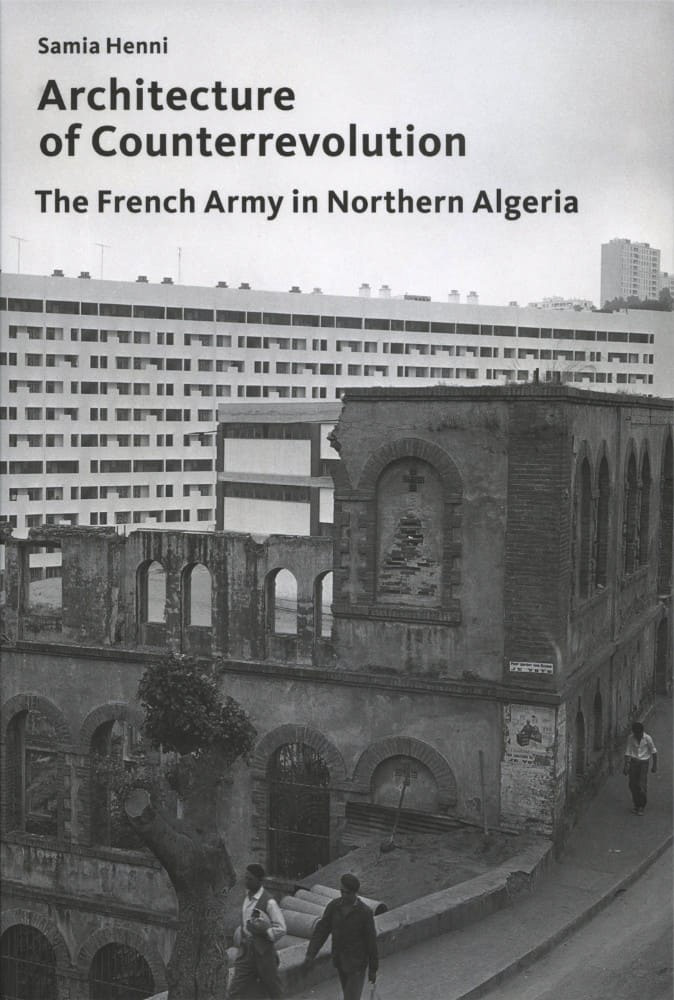
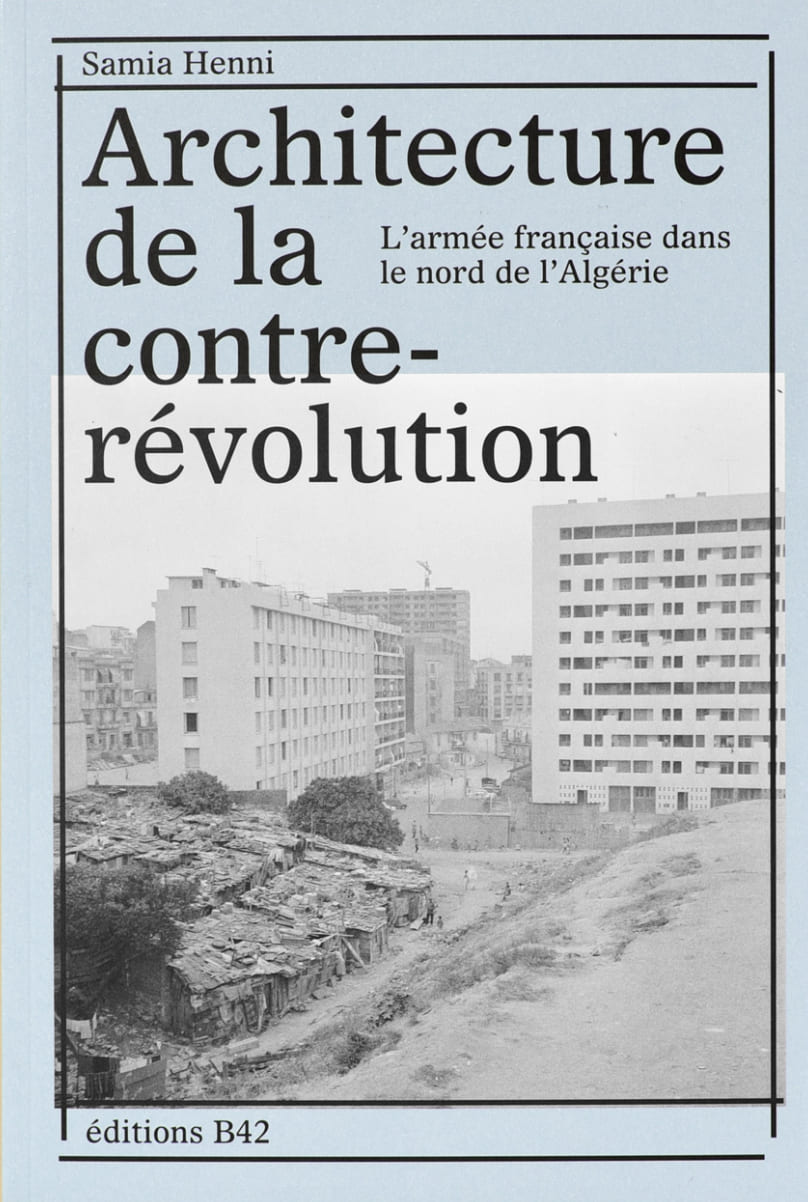
She is also the author of the multi-award-winning Architecture of Counterrevolution: The French Army in Northern Algeria Architecture of Counterrevolution (EN, gta Verlag, 2017, 202), which was translated into French as Architecture de la contre-révolution : L'armée francaise dans le nord de l'Algérie Architecture de la contre-révolution (Edition B42, 2019). The book examines French colonial territorial transformations and spatial counterinsurgency measures in Algeria under colonial rule, especially during the Algerian Revolution (1954-1962). It received numerous prestigious awards, including the 2020 Spiro Kostof Book Award by the Society of Architectural Historians, the 2018 Silver Book Award by the Festival International du Livre d'Art et du Film (FILAF), and the 2018 Best Book Award in Theory of Art by the FILAF. The French translation was part of the 2019 Architecture Books Selection by L'Architecture d'Aujourd'hui and has received extensive media coverage, including Mediapart and Le Monde.
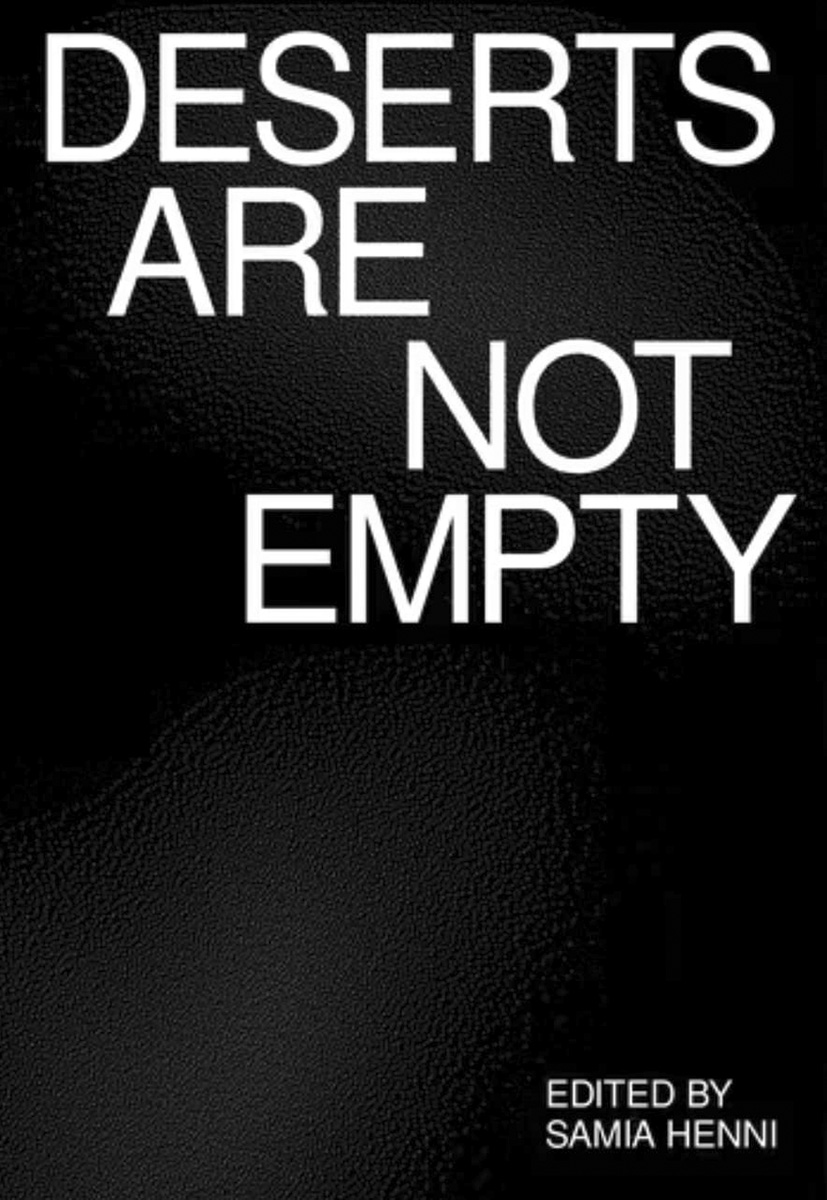
She is the editor of two awarded manuscripts. Deserts Are Not Empty Deserts Are Not Empty (Columbia Books in Architecture and the City, 2022) that questions colonial tendencies and remaps the representations, theories, histories, and stories of arid lands. The volume brings together poems in original languages, conversations with collectives, and essays by scholars and professionals from the fields of architecture, architectural history and theory, curatorial studies, comparative literature, film studies, landscape architecture, and photography. These different approaches and diverse voices draw on a framework of decoloniality to unsettle and unlearn the desert, opening up possibilities to see, think, imagine it otherwise. The manuscript includes contributions from Saphiya Abu Al-Maati, Menna Agha, Asaiel Al Saeed, Aseel AlYaqoub, Yousef Awaad Hussein, Ariella Aisha Azoulay, Danika Cooper, Brahim El Guabli, Timothy Hyde, Jill Jarvis, Bongani Kona, Dalal Musaed Alsayer, Observatoire des armements, Francisco E. Robles, Paulo Tavares, Alla Vronskaya, and XqSu.

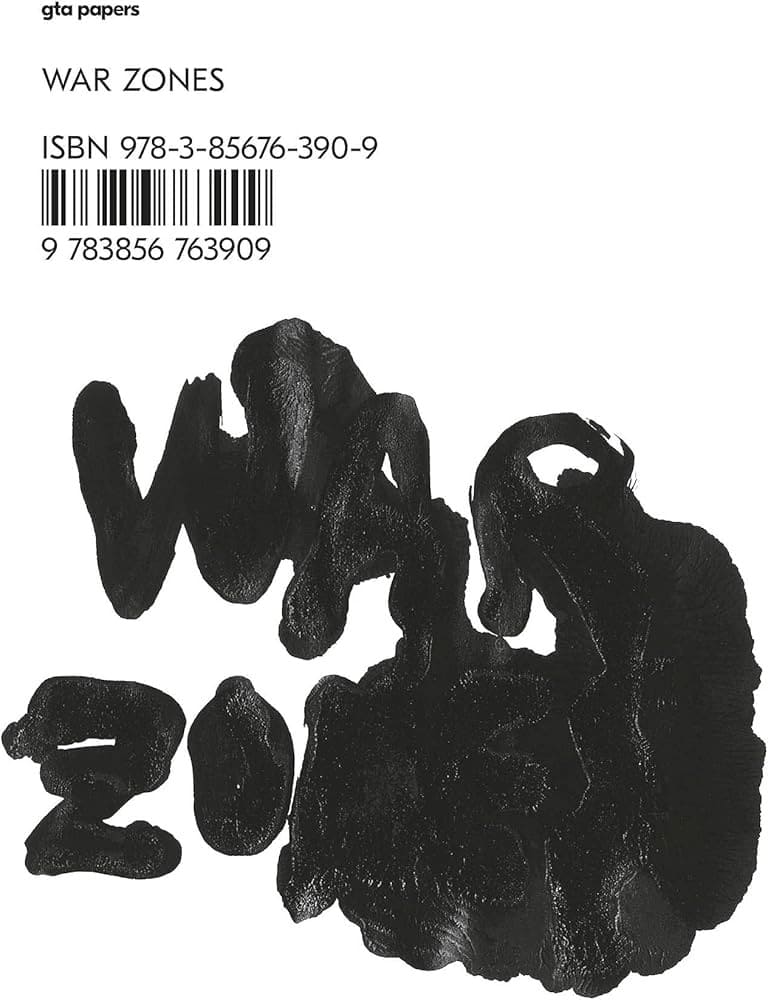
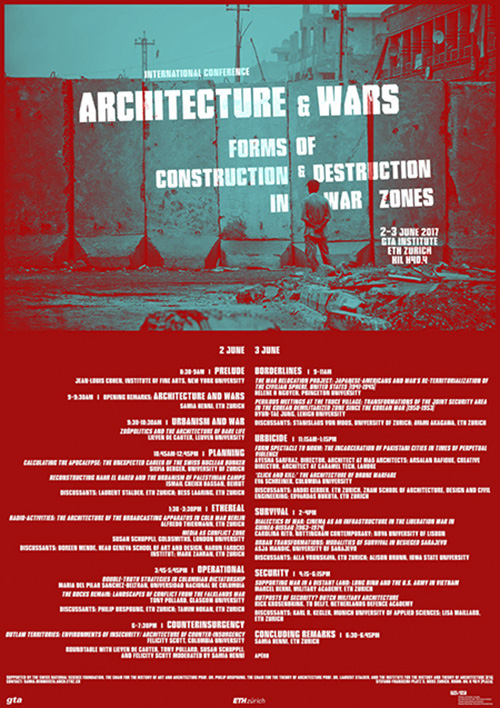
The second volume that Samia edited is War Zones War Zones : gta papers n. 2 (gta Verlag, 2018). The book exposes the design of the militarization of cities since World War II, specifically after the events of September 11, 2001. The volume includes contributions from Nora Akawi, Silvia Berger Ziauddin, Jean-Louis Cohen, Ismae'l Sheikh Hassan, Léopold Lambert, Asja Mandic, Eva Schreiner, Felicity D. Scott, Stanislav von Moos, Alfredo Thiermann, and Daniel Weiss.

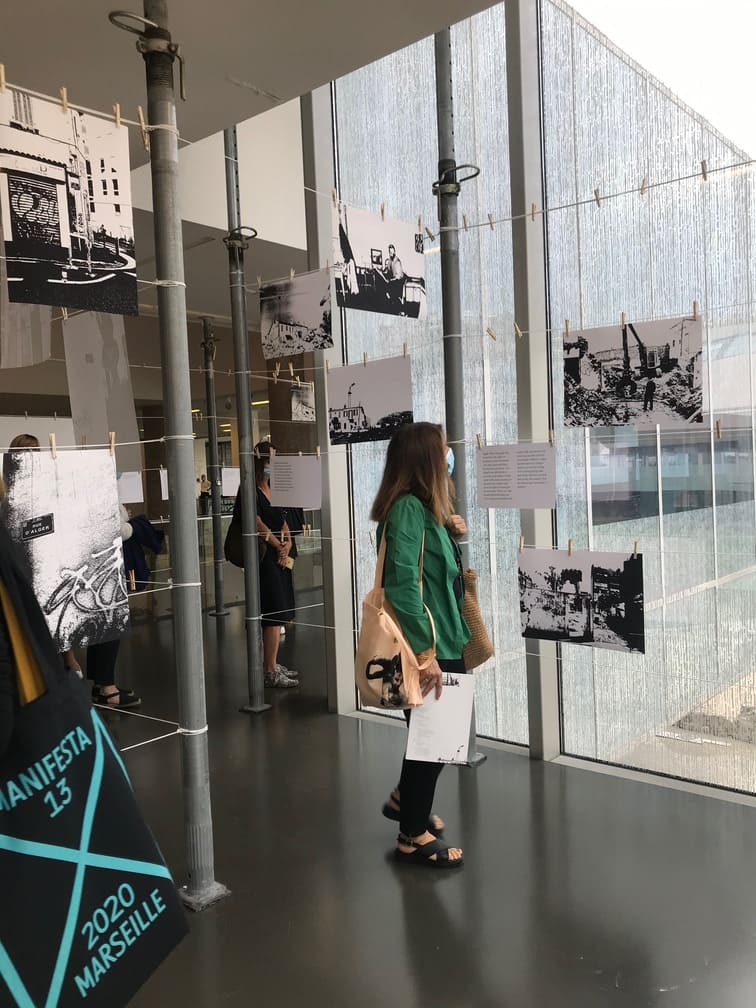
Along with her writing and editing practices, Samia's work unfolds in a series of exhibitions, including the most recent traveling exhibtion Perfroming Colonial ToxicityPerfroming Colonial Toxicity, in collaboration with If I Can't Dance I Dont't Want to be Part of Your Revolution and Framer Framed, which was held between 8 October 2023 and 14 January 2024 at Framer Framed in Amsterdam. Samia also participated in the exhibition Traits d'union.s curated by Alya Sebti, Katerina Chuchalina and Stefan Kalmarat at Manifesta 13 in Marseille (August-November 2020) with two installations: Housing Pharmacology Housing Pharmacology at the Museum of Marseille History and Right to Housing Right to Housing at Grobet-Labadié Museum in Marseille. Both installations expose and juxtapose the remedy and/or poison that the presence or absence of dwellings engender in Marseille's neighbourhoods. She has participated in other shows, including at the Twelve Gates Arts in Philadelphia, the Kunsthal Aarhus, the Museum of Yugoslav History in Belgrade, the Canadian Centre for Architecture in Montreal, and the Chung-Shan Creative Hub in Taipei.

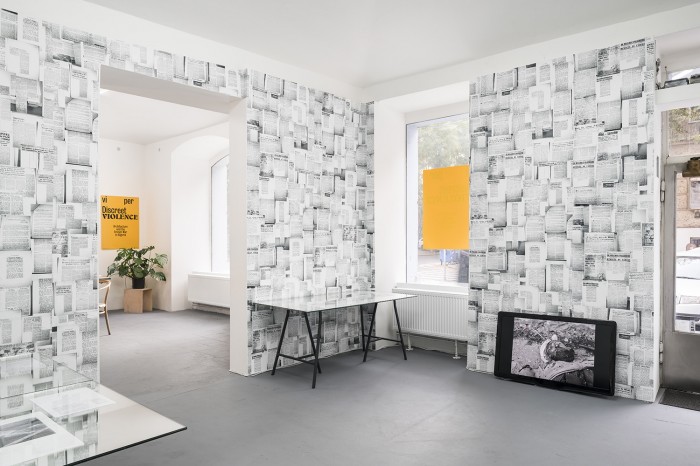
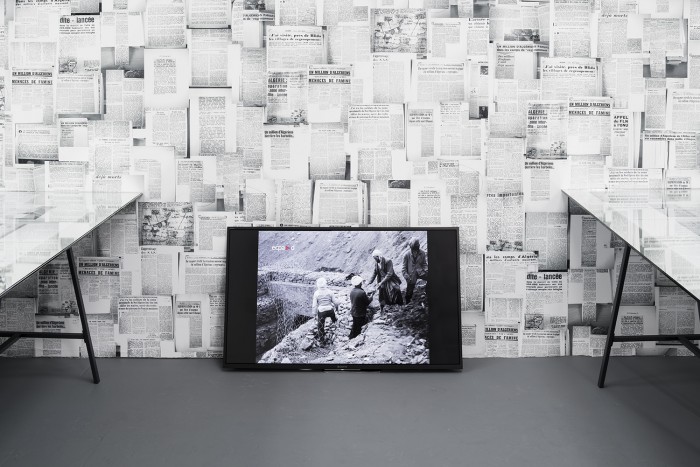
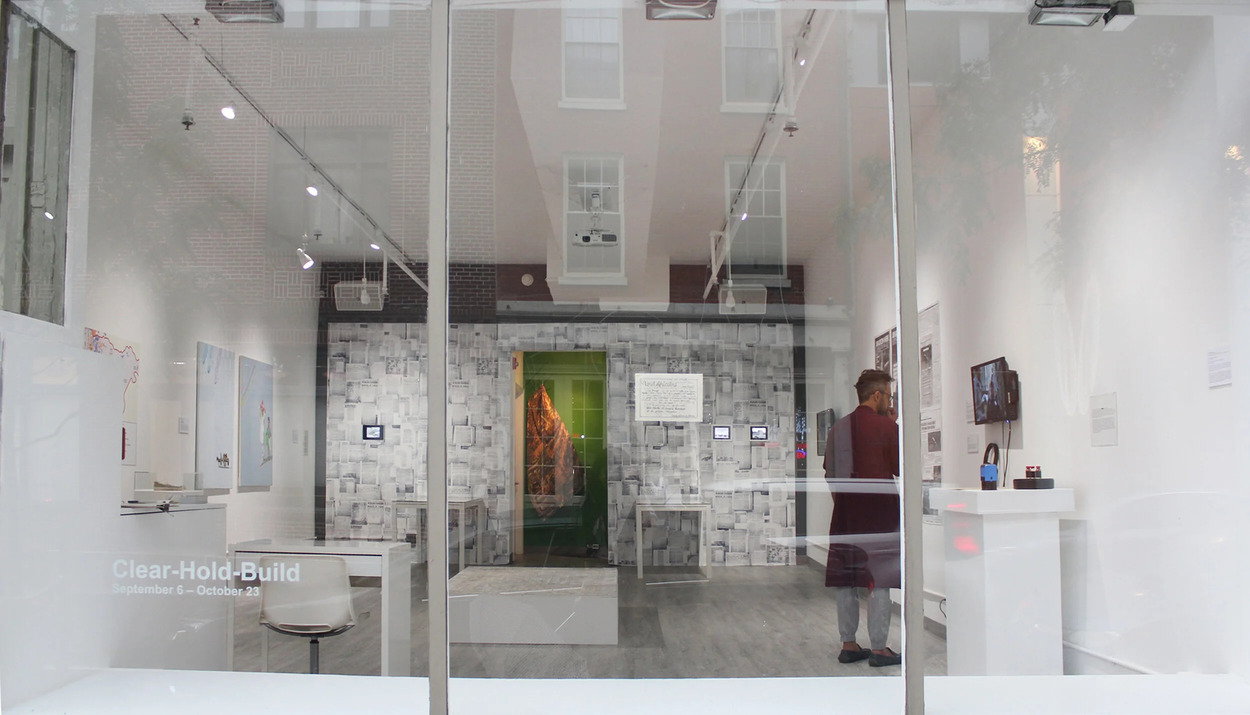
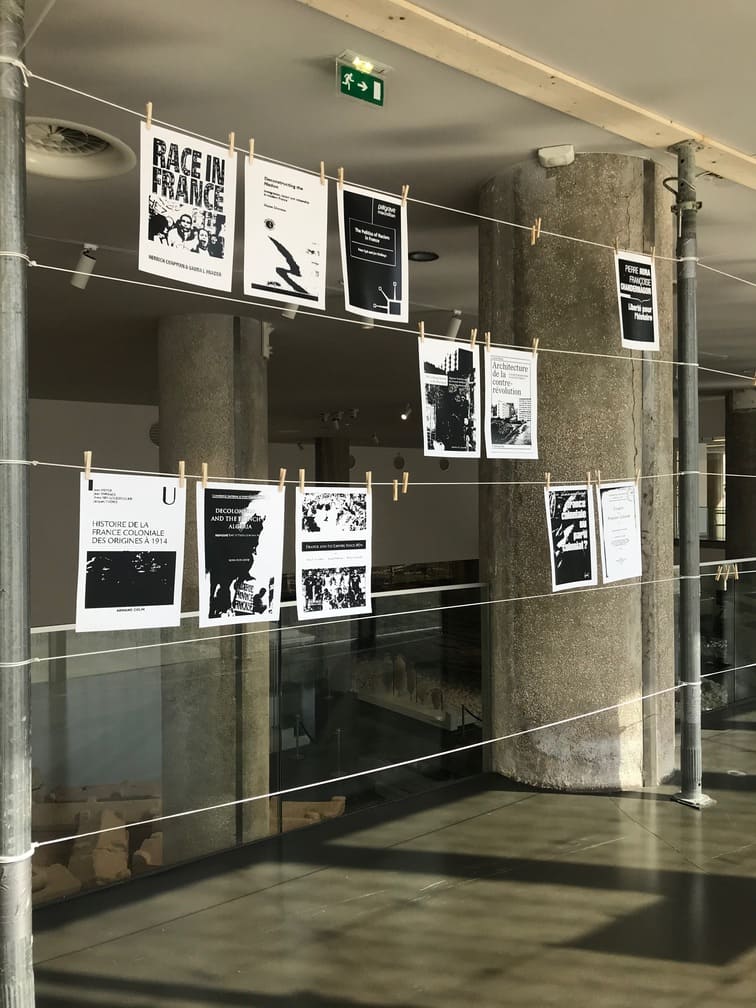
Her exhibition Discreet Violence: Architecture and the French War in Algeria Discreet Violence deconstructed French propaganda audio visual records and displayed how the French army forcibly relocated thousands of Algerians in Algeria's rural areas during the Algerian Revolution. The exhibition was first shown at the gta Exhibitions, ETH Zurich, and then it traveled to the New Institute in Rottedam, the Archive Kabinett in Berlin, The Graduate School of Architecture, University of Johannesburg, La Colonie in Paris, the VI PER Gallery in Prague, and AAP Exhibitions at Cornell University, and the Twelve Gates Arts in Philadelphia. She is the co-organizer of the gta Films at the gta Institute, an exhibition that dissects the production and use of motion picture as a way of documenting, teaching, promoting, and understanding architecture.

Currently, she teaches at McGill University's Peter Guo-hua Fu School of Architecture, and co-chairs of the University Seminar "Beyond France" at Columbia University. She was an invited visiting professor (2023-24) at the Institute for the History and Theory of Architecture (gta), ETH Zurich; the inaugural Albert Hirschman Chair (2021-22) for Identity Passions Between Europe and the Mediterranean at the Institute for Advanced Study in Marseille; an invited visiting professor (Fall 2021) at the Institute of Art History at the University of Zurich; and a invited Geddes Fellow (Spring 2021) at Edinburgh School of Architecture and Landscape Architecture, Edinburgh University.

Samia received her Ph.D. (with distinction, ETH Medal) in the history and theory of architecture from the gta Institute, ETH Zurich, Switzerland. She taught at Princeton University's School of Architecture, the University of Zurich, ETH Zurich, the Geneva University of Art and Design, Cornell University's Department of Architecture. She was a Research Associate at Curatorial/Knowledge Ph.D. Program, Department of Visual Cultures, Goldsmiths, University of London. She received her M.Sc. in Architecture from the Accademia di Archittetura di Mendrisio, Universita della Svizzera Italiana. She also studied at the former Berlage Institute in Rotterdam and at the Ecole polytechnique d'architecture et d'urbanisme in Algiers.

In tandem with her writing, teaching, and exhibition practices, she has delivered various lectures in many institutions, including the Accademia di Architettura di Mendrisio, Universita della Svizzera Italiana; Architectural Association (AA) in London; Boston University; Brown University; Buffalo University; College of Design at Iowa State University; College of Architecture and Environmental Design, Kent State University; Columbia University; Dresden Academy of Fine Arts; Edinburgh College of Art, University of Edinburgh; ETH Zurich; Garagem Sul, Fundacao Centro Cultural de Belem in Lisbon; The Graduate School of Architecture at the University of Johannesburg; Geneva University of Art and Design; Harvard University; Laboratoire InVisu, Institut national d'histoire de l'art in Paris; Kunsthal Aarhus in Denmark; Lafayette Anticipations in Paris; Princeton University; The New Institute in Rotterdam; The School for Advanced Studies in the Social Sciences in Paris; VI PER Gallery in Prague, and Yale University.

arch(at)samiahenni.com
Instagram ↗
Download portraits

WRITING

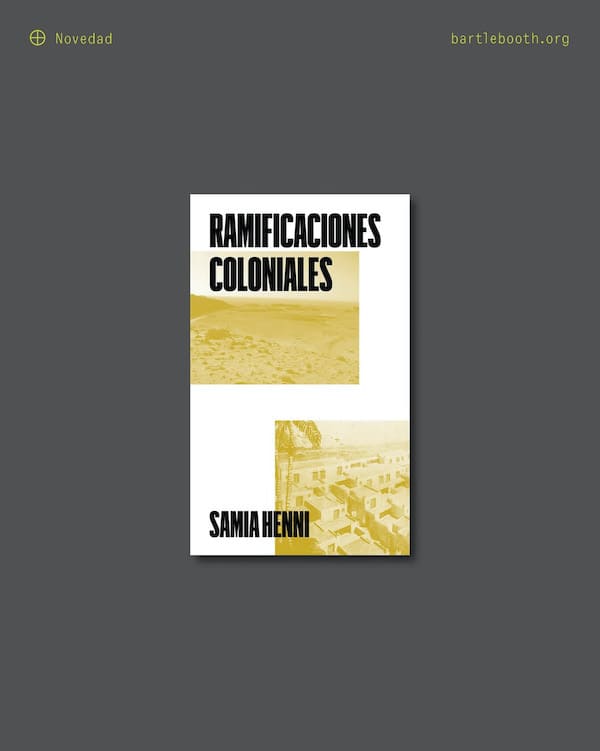
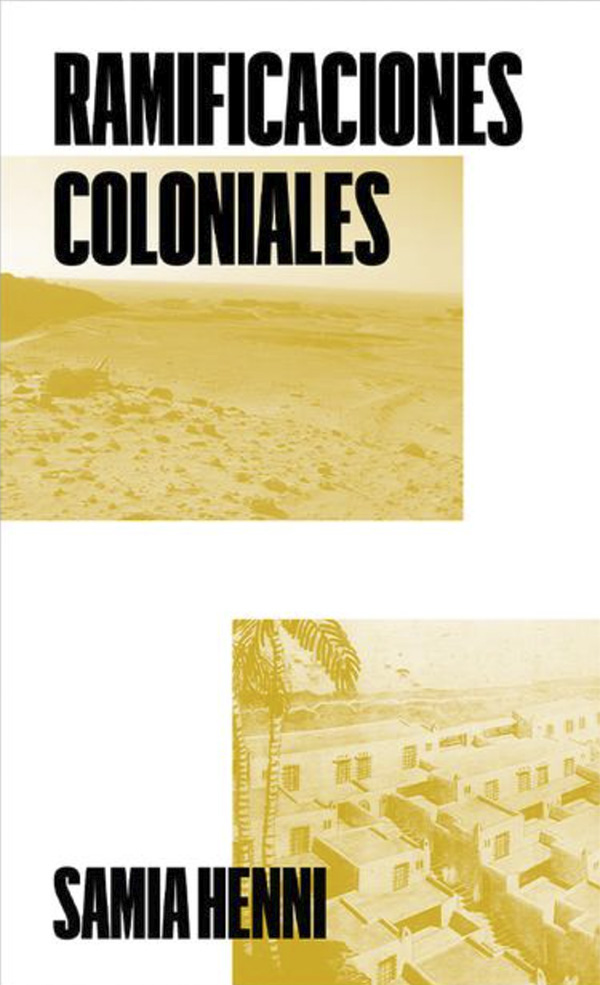
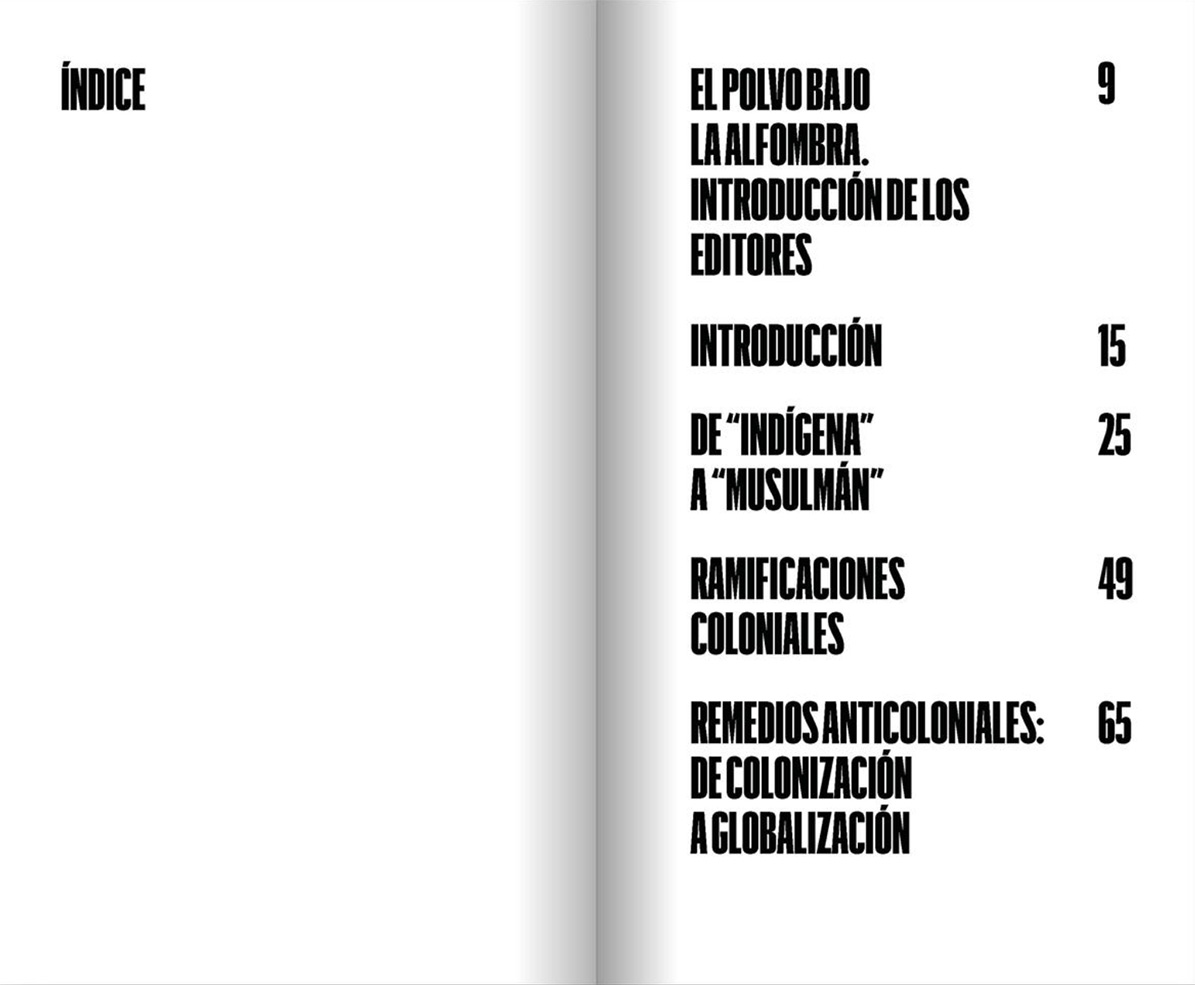
Ramificaciones coloniales

2026

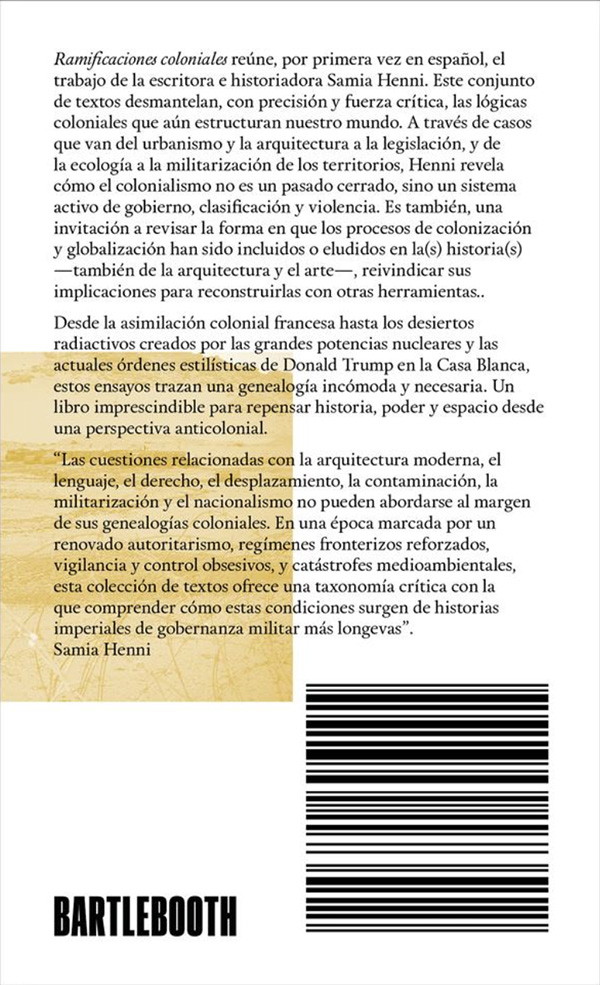
This publication brings together five texts by Samia Henni, translated into Spanish for the first time. Through cases ranging from urban planning and architecture to legislation, and from ecology to the militarisation of territories, Henni reveals how colonialism is not a closed chapter of the past, but an active system of governance, classification and violence.

The book is also an invitation to reconsider the ways in which the processes of colonisation and globalisation have been included in—or omitted from—histories, including those of architecture and art, and to acknowledge their implications so that these histories may be reconstructed using different tools.

From French colonial assimilation to the radioactive deserts created by the major nuclear powers and Donald Trump’s current stylistic directives for the White House, these essays trace an uncomfortable yet necessary genealogy.

Lugo / A Coruña: Bartlebooth, 2026
108 pages
ISBN 979-13-991735-1-2
Text in Spanish
By Samia Henni
Spanish translation by Antonio Giráldez López
Editorial design and layout by Antonio Giráldez López and Pablo Ibáñez Ferrera
Revision by Pablo Ibáñez Ferrera
Copyediting by Diego Galar Irurre

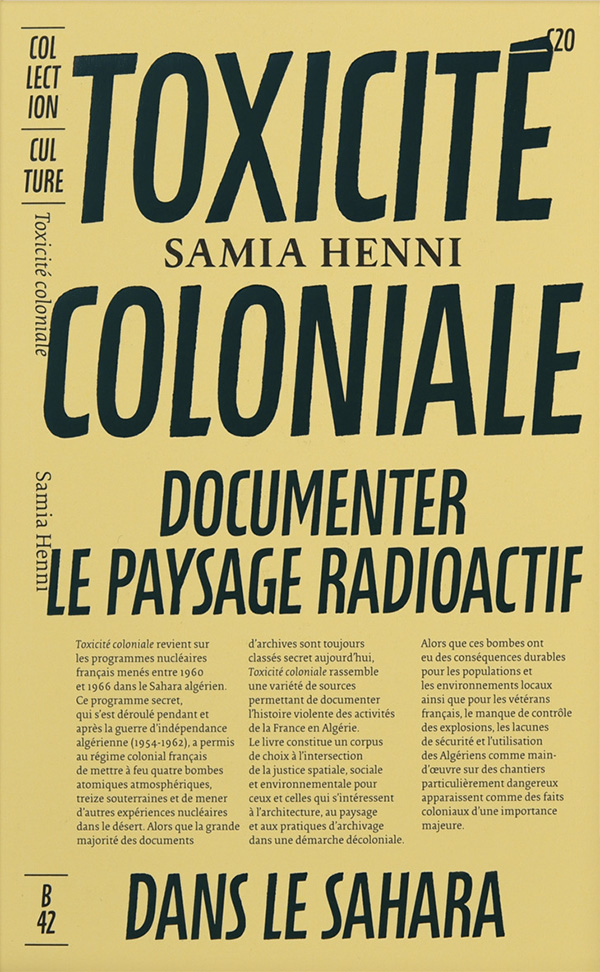
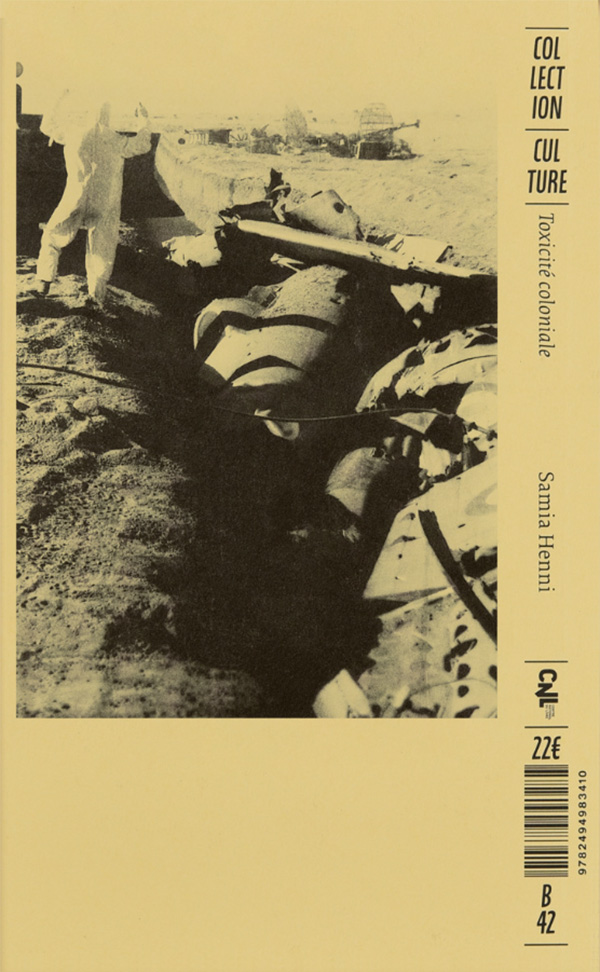
Toxicité coloniale : Documenter le paysage radioactif dans le Sahara

2026

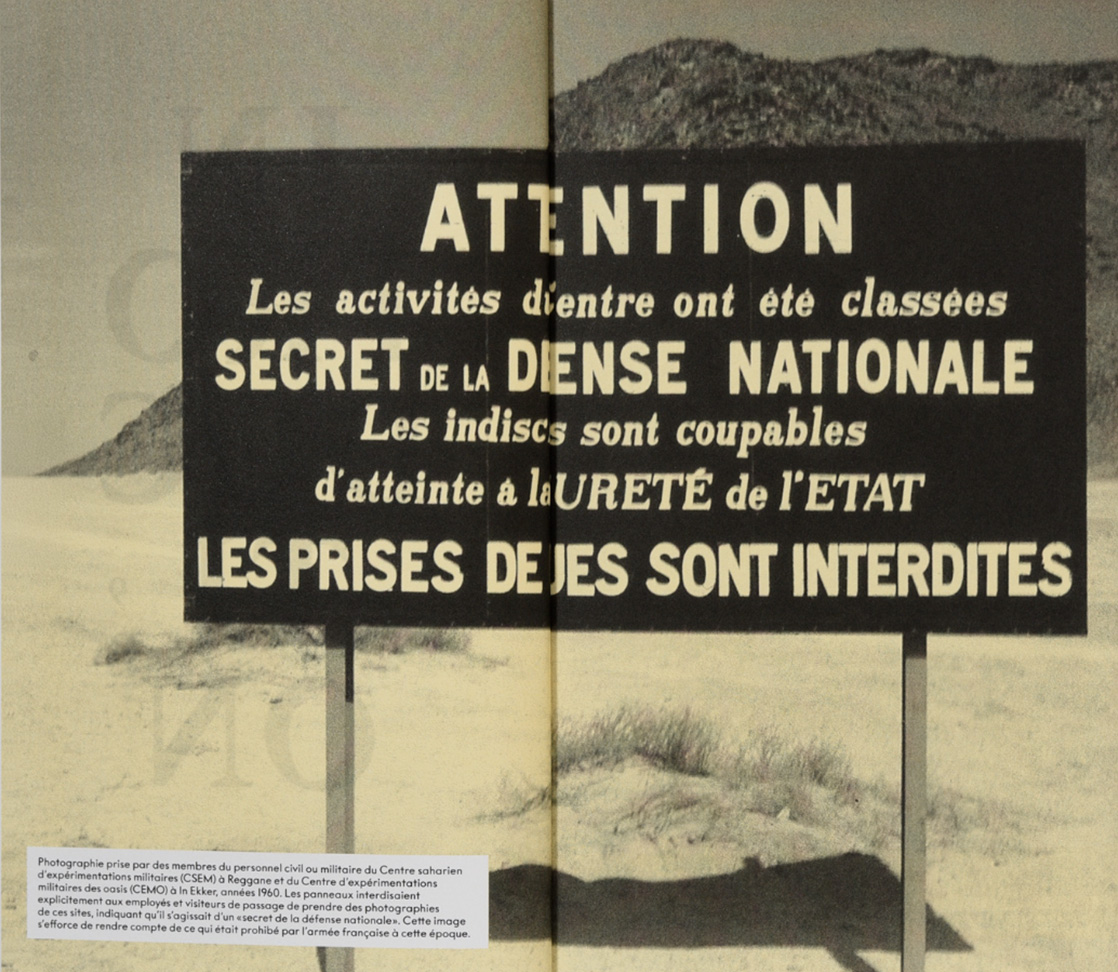
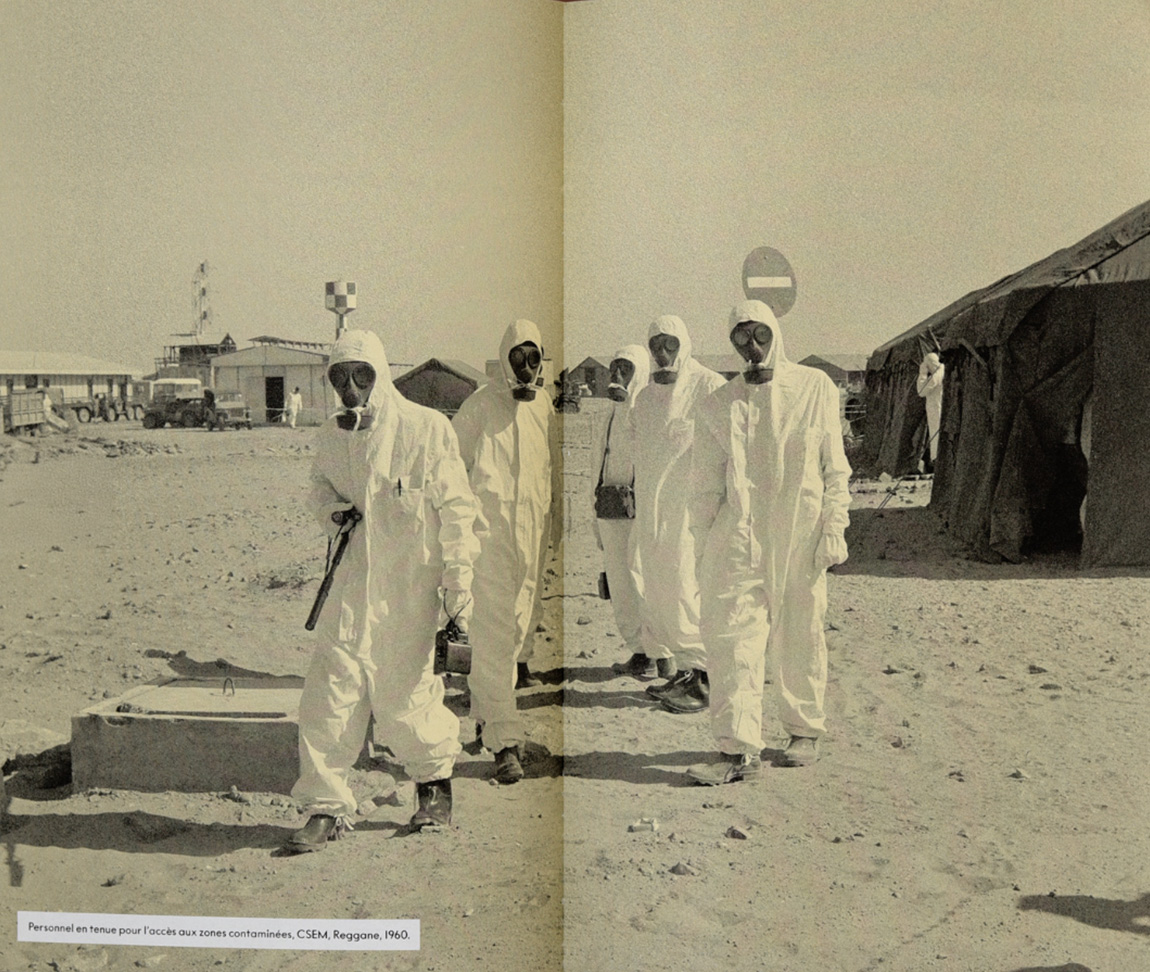
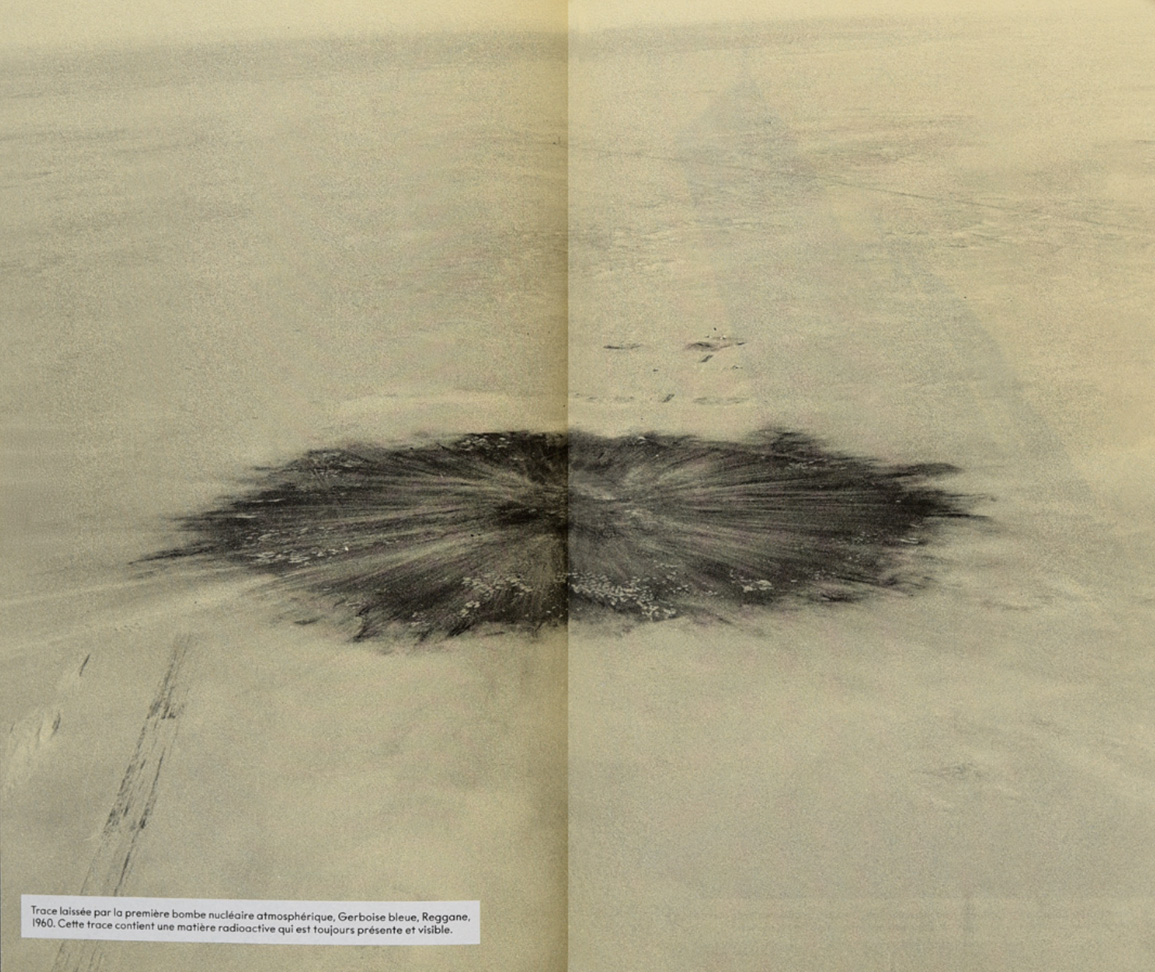
Between 1960 and 1966, the French colonial regime detonated four atmospheric atomic bombs, thirteen underground nuclear bombs and conducted other nuclear experiments in the Algerian Sahara, whose natural resources were being extracted in the process. This secret nuclear weapons programme, whose archives are still classified, occurred during and after the Algerian Revolution, or the Algerian War of Independence (1954–62).

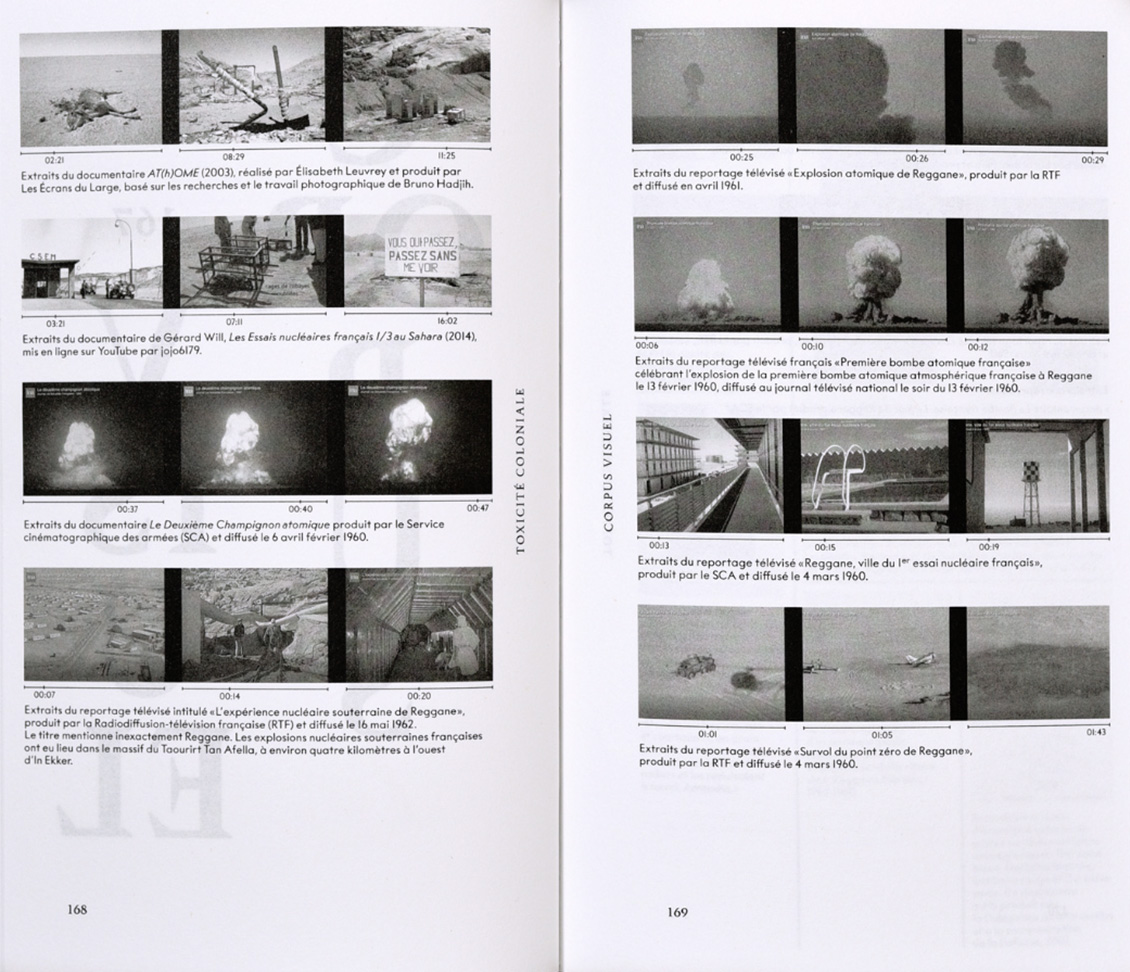
This publication brings together nearly six hundred pages of materials documenting this violent history of France’s nuclear bomb programme in the Algerian desert. Meticulously culled together by the architectural historian from across available, offered, contraband, and leaked sources, the book is a rich repository for all those concerned with histories of nuclear weapons and engaged at the intersections of spatial, social and environmental justice, as well as anticolonial archival practices.

Paris: Éditions B42, 2026
13.8 × 22 cm
184 pages
ISBN 978-2-494983-41-0
Text in French
By Samia Henni
Translated from English by Marc Saint-Upéry
Graphic design by deValence
Published with the support of the Centre national du livre, ETH Zurich, and McGill University

Colonial Toxicity: Rehearsing French Radioactive Architecture and Landscape in the Sahara

2024

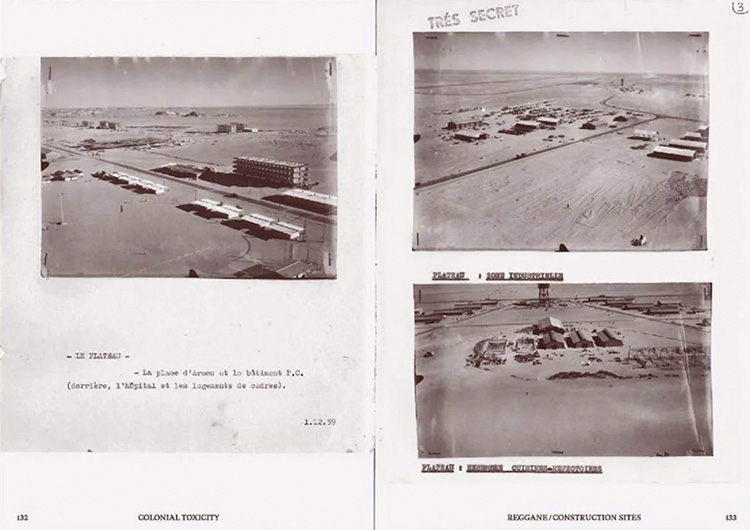
Between 1960 and 1966, the French colonial regime detonated four atmospheric atomic bombs, thirteen underground nuclear bombs and conducted other nuclear experiments in the Algerian Sahara, whose natural resources were being extracted in the process. This secret nuclear weapons programme, whose archives are still classified, occurred during and after the Algerian Revolution, or the Algerian War of Independence (1954–62).

This publication brings together nearly six hundred pages of materials documenting this violent history of France’s nuclear bomb programme in the Algerian desert. Meticulously culled together by the architectural historian from across available, offered, contraband, and leaked sources, the book is a rich repository for all those concerned with histories of nuclear weapons and engaged at the intersections of spatial, social and environmental justice, as well as anticolonial archival practices.

Amsterdam / Zurich: If I Can’t Dance, Framer Framed, and edition fink, 2024
17 × 24 cm, softcover
592 pages, colour illustrations
ISBN 978-94-92139-24-5 (first printing, 2024)
ISBN 978-90-834543-2-0 (second printing, 2025)
Text in English
By Samia Henni
Graphic design by François Girard-Meunier
Managing editor: Megan Hoetger
Contributing editor: Georg Rutishauser
Copy editor: Janine Armin
Printed and bound by Wilco B.V., Amersfoort
Awarded The Best Dutch Book Designs 2024 and The Most Beautiful Swiss Books 2025

Architecture de la contre-révolution: L’armée française dans le nord de l’Algérie
2019

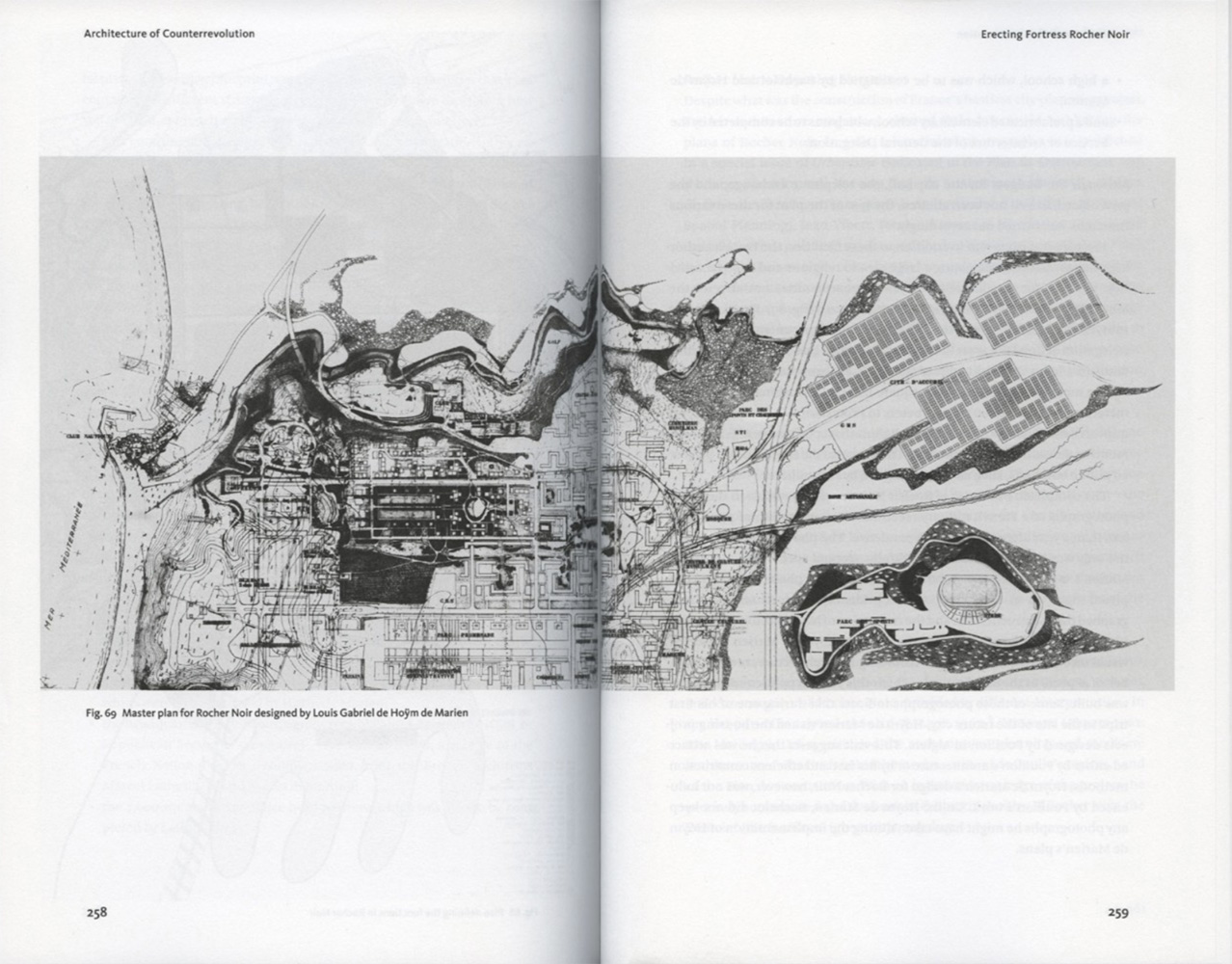
The book examines the intersection of French colonial policies and military counterinsurgency operations in architecture in Algeria during the Algerian Revolution (1954–1962). During this bloody and protracted armed conflict, the French civil and military authorities profoundly reorganized Algeria’s vast urban and rural territory, drastically transformed its built environments, rapidly implanted new infrastructure, and strategically built new settlements in order to keep Algeria under French rule.

The colonial regime had designed and completed not only tactical destructions, but also new constructions in order to allow for the strict control of the Algerian population and the protection of the European communities of Algeria.

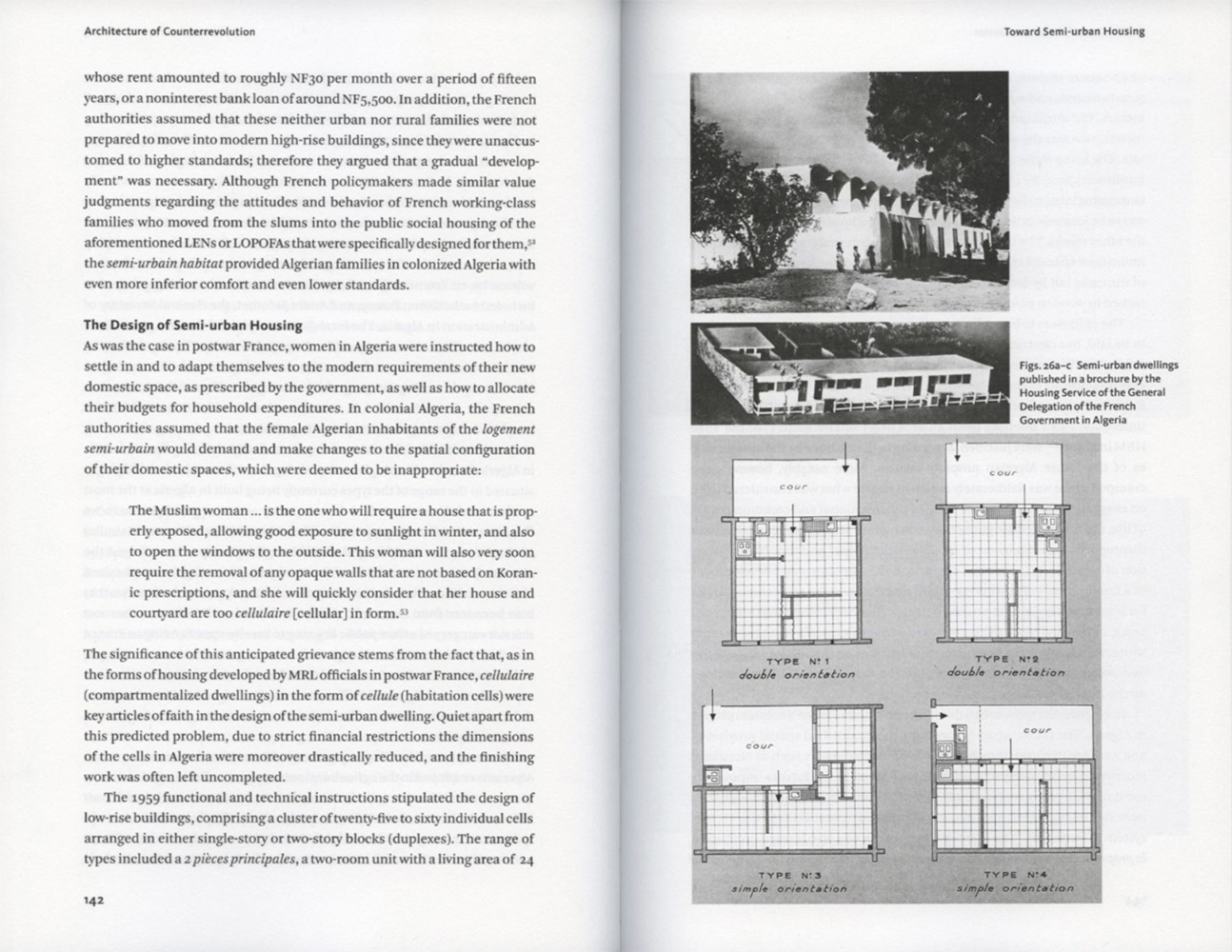
This study focuses on three interrelated spatial counterrevolutionary measures: the massive forced resettlement of Algerian farmers; the mass-housing programs designed for the Algerian population as part of General Charles de Gaulle’s Plan de Constantine; and the fortified administrative new town planned for the protection of the French authorities during the last months of the Algerian Revolution. The aim is to depict the modus operandi of these settlements, their roots, developments, scopes, actors, protocols, impacts, and design mechanisms.

Paris: Éditions B42, 2019
15.6 × 23.5 cm
352 pages, 73 illustrations
ISBN 978-2-490077-20-5
Text in French
By Samia Henni
Translated from English by Marc Saint-Upéry
Graphic design by deValence
Published with the support of Cornell University and the Île-de-France Region

Architecture of Counterrevolution: The French Army in Northern Algeria

2017

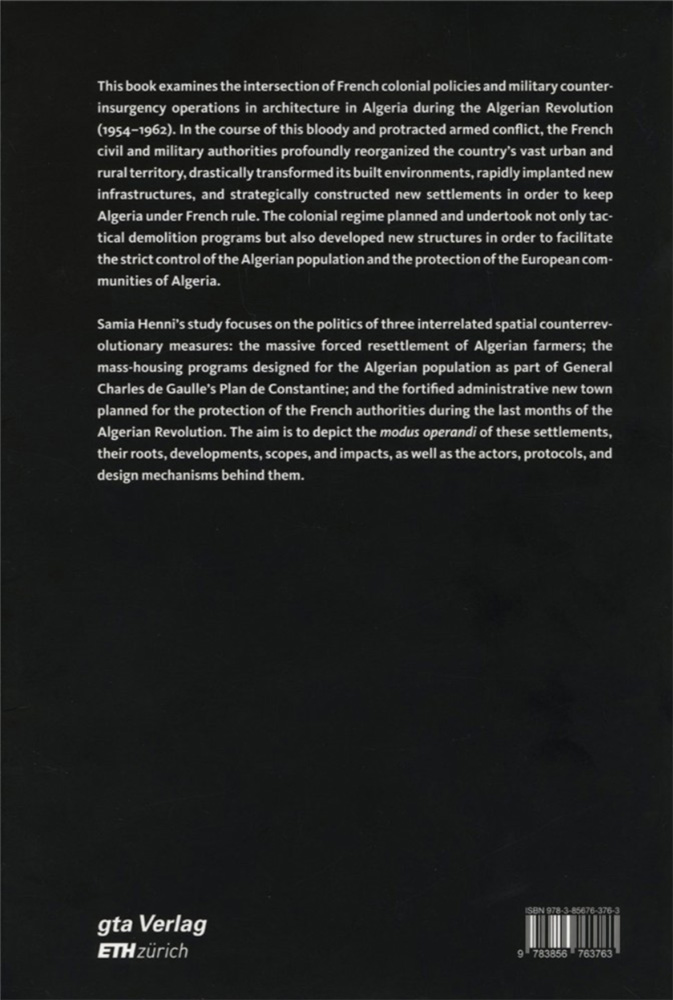
The book examines the intersection of French colonial policies and military counterinsurgency operations in architecture in Algeria during the Algerian Revolution (1954–1962). During this bloody and protracted armed conflict, the French civil and military authorities profoundly reorganized Algeria’s vast urban and rural territory, drastically transformed its built environments, rapidly implanted new infrastructure, and strategically built new settlements in order to keep Algeria under French rule.

The colonial regime had designed and completed not only tactical destructions, but also new constructions in order to allow for the strict control of the Algerian population and the protection of the European communities of Algeria.

This study focuses on three interrelated spatial counterrevolutionary measures: the massive forced resettlement of Algerian farmers; the mass-housing programs designed for the Algerian population as part of General Charles de Gaulle’s Plan de Constantine; and the fortified administrative new town planned for the protection of the French authorities during the last months of the Algerian Revolution. The aim is to depict the modus operandi of these settlements, their roots, developments, scopes, actors, protocols, impacts, and design mechanisms.

Zurich: gta Verlag, 2017
16.5 × 24.5 cm, softcover
336 pages, 73 black-and-white illustrations
ISBN 978-3-85676-376-3
Text in English
By Samia Henni

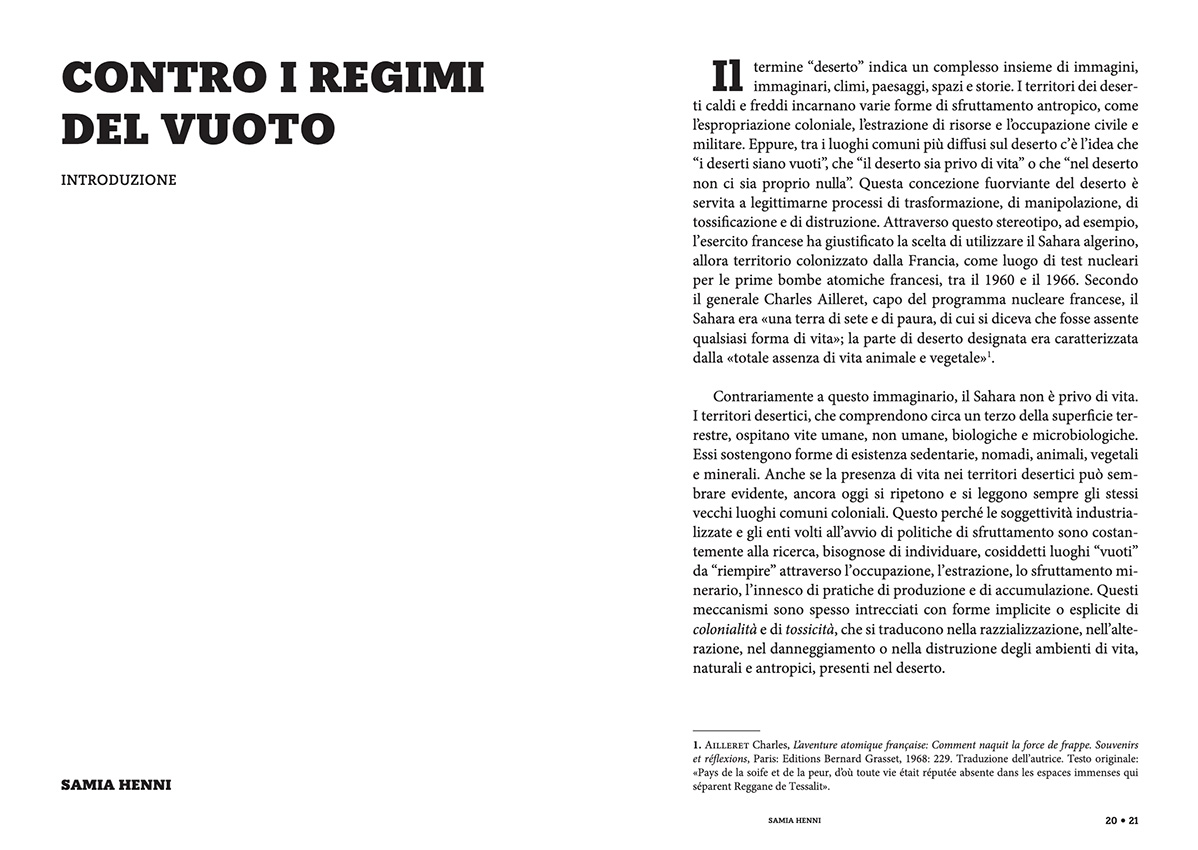
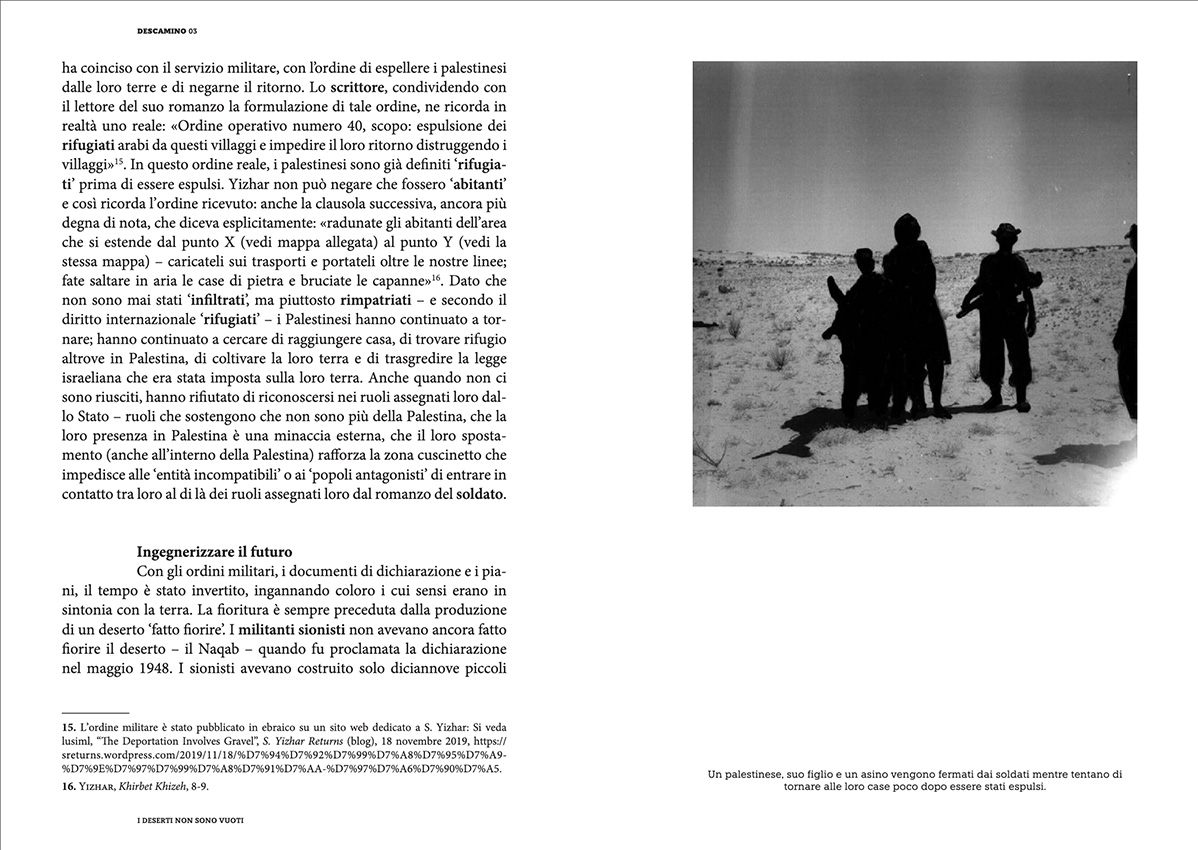
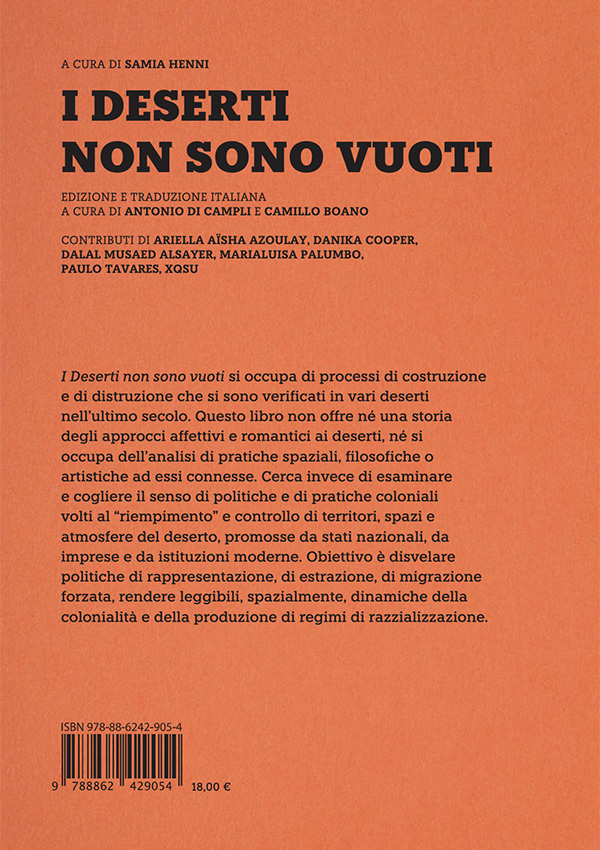
I deserti non sono vuoti

2024

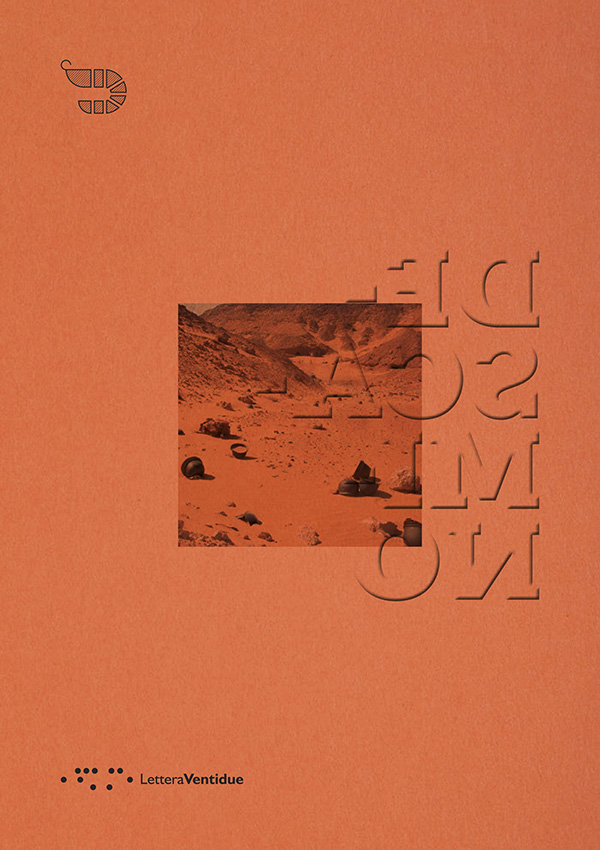
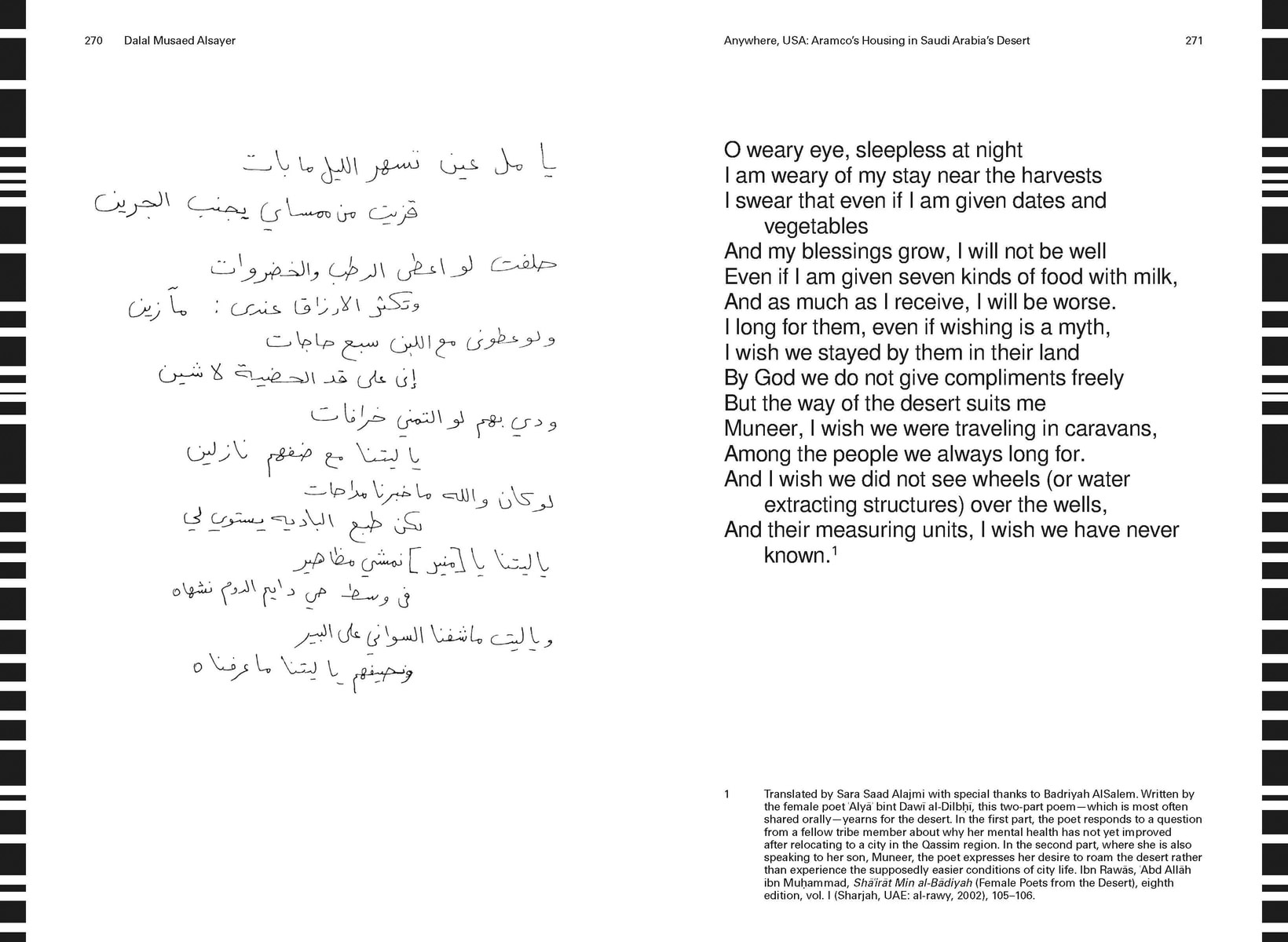
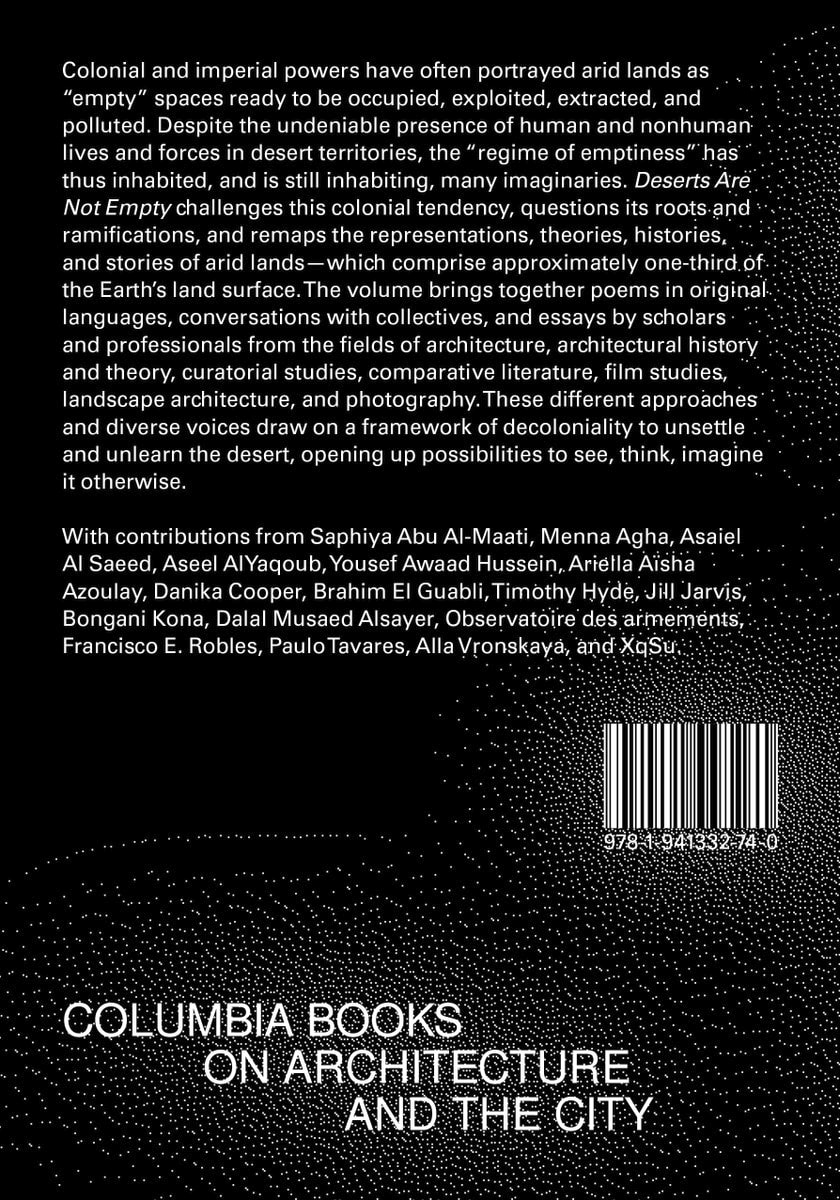
Colonial and imperial powers have often portrayed arid lands as “empty” spaces ready to be occupied, exploited, extracted, and polluted. Despite the undeniable presence of human and nonhuman lives and forces in desert territories, the “regime of emptiness” has inhabited, and is still inhabiting, many imaginaries.

Deserts Are Not Empty challenges this colonial tendency, questions its roots and ramifications, and remaps the representations, theories, histories, and stories of arid lands—which comprise approximately one-third of the Earth’s land surface.

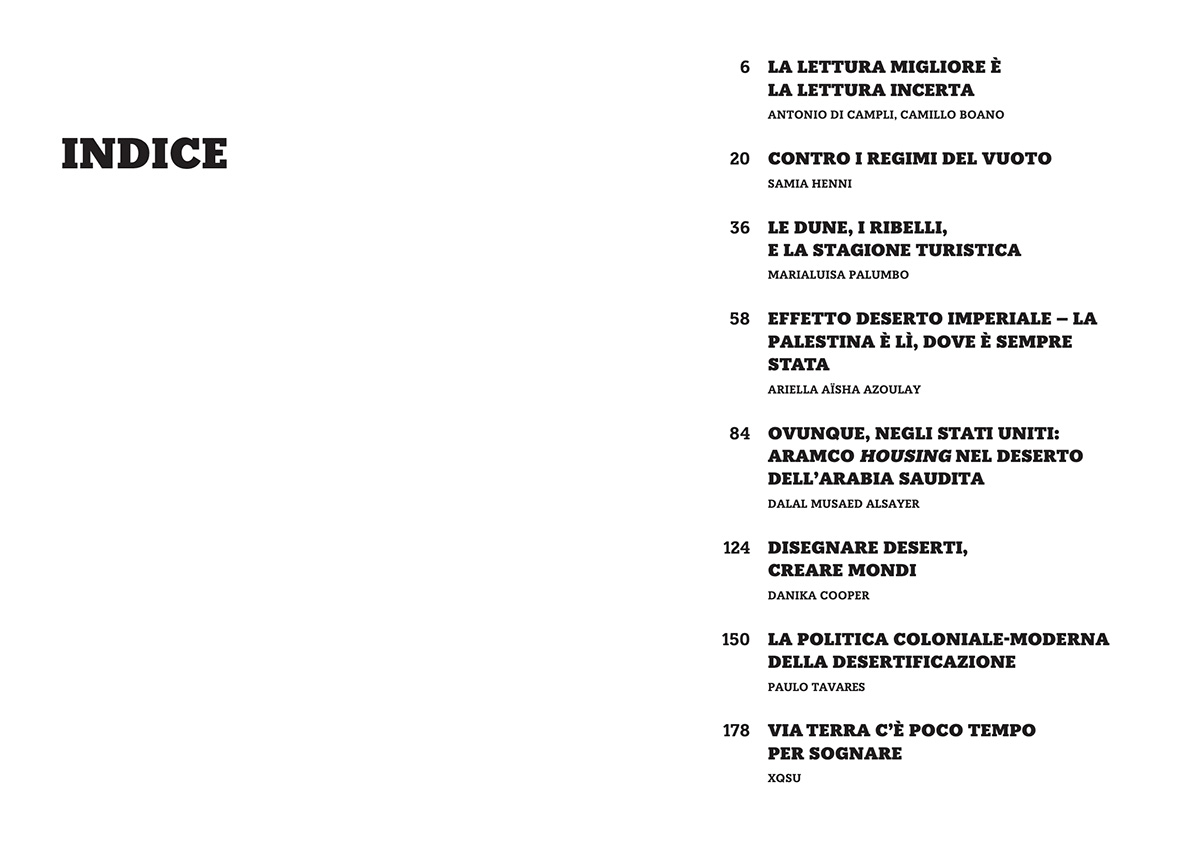
The volume brings together poems in original languages, conversations with collectives, and essays by scholars and professionals from the fields of architecture, architectural history and theory, curatorial studies, comparative literature, film studies, landscape architecture, and photography. These different approaches and diverse voices draw on a framework of decoloniality to unsettle and unlearn the desert, opening up possibilities to see, think, imagine it otherwise.

Siracusa: LetteraVentidue, 2024
207 pages
ISBN 978-88-6242-905-4
Text in Italian
Descamino series, no. 3
Edited by Samia Henni
Italian edition translated and edited by Antonio Di Campli and Camillo Boano
With contributions by Ariella Aïsha Azoulay, Danika Cooper, Dalal Musaed Alsayer, MariaLuisa Palumbo, Paulo Tavares, and XqSu

Deserts Are Not Empty

2022

Colonial and imperial powers have often portrayed arid lands as “empty” spaces ready to be occupied, exploited, extracted, and polluted. Despite the undeniable presence of human and nonhuman lives and forces in desert territories, the “regime of emptiness” has inhabited, and is still inhabiting, many imaginaries.

Deserts Are Not Empty challenges this colonial tendency, questions its roots and ramifications, and remaps the representations, theories, histories, and stories of arid lands—which comprise approximately one-third of the Earth’s land surface.

The volume brings together poems in original languages, conversations with collectives, and essays by scholars and professionals from the fields of architecture, architectural history and theory, curatorial studies, comparative literature, film studies, landscape architecture, and photography. These different approaches and diverse voices draw on a framework of decoloniality to unsettle and unlearn the desert, opening up possibilities to see, think, imagine it otherwise.

New York: Columbia Books on Architecture and the City, 2022
Paperback
384 pages
ISBN 978-1-941332-74-0
Text in English
Distributed by Columbia University Press
Edited by Samia Henni
Graphic design by Laura Coombs
With contributions by Saphiya Abu Al-Maati, Menna Agha, Asaiel Al Saeed, Aseel AlYaqoub, Yousef Awaad Hussein, Ariella Aïsha Azoulay, Danika Cooper, Brahim El Guabli, Timothy Hyde, Jill Jarvis, Bongani Kona, Dalal Musaed Alsayer, Observatoire des armements, Francisco E. Robles, Paulo Tavares, Alla Vronskaya, and XqSu

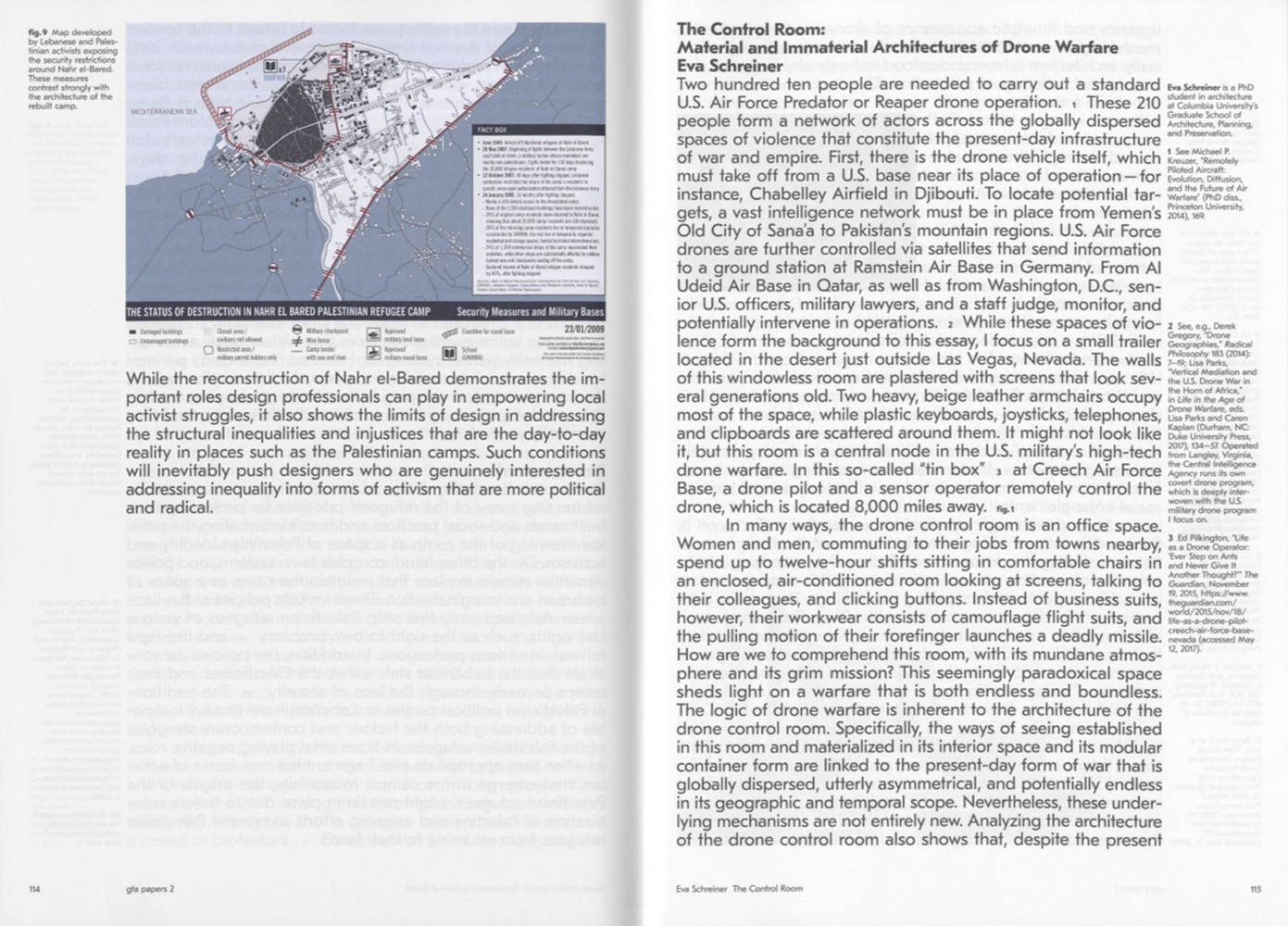
War Zones

2019

After the Second World War and the onset of the Cold War, warfare took different forms, and war zones became gradually blurred and often undeclared. People, landscapes, and built environments came to be subjugated to the strains and constraints of these forms of war, serving both civil and military purposes of armed conflicts. The contributions to War Zones investigate some of these implicit or explicit conditions, legacies, and impacts.

From colonial or total war, asymmetric war or counterinsurgency, to barricaded or besieged cities, refugee camps or borderlines, to nuclear bunkers or “war ghosts,” to the state of emergency and drone warfare, these texts disclose the spatial aspects, statuses, and formation processes of past and current war zones.

Zurich: gta Verlag, 2019
21 × 29.7 cm, softcover
134 pages, 89 illustrations
ISBN 978-3-85676-390-9
Text in English
gta papers 2
Edited by Samia Henni
With contributions by Nora Akawi, Silvia Berger Ziauddin, Jean-Louis Cohen, Léopold Lambert, Asja Mandić, Stanislaus von Moos, Arsalan Rafique, Ayesha Sarfraz, Eva Schreiner, Felicity D. Scott, Ismae’l Sheikh Hassan, Alfredo Thiermann, and Daniel Weiss

Collective books featuring writing by Samia Henni

2022
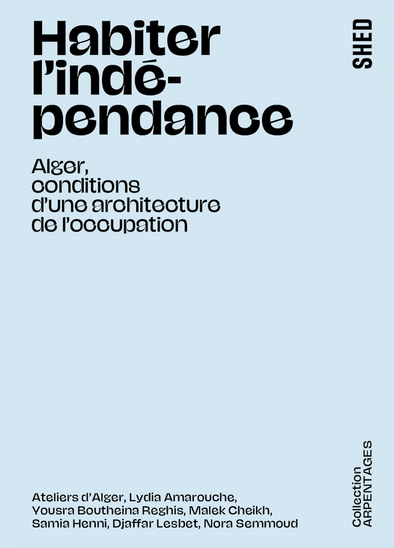
Habiter l’indépendance : Alger, conditions d’une architecture de l’occupation
Texts by Ateliers d’Alger, Lydia Amarouche, Yousra Boutheina Reghis, Malek Cheikh, Samia Henni, Djaffar Lesbet and Nora Semmoud.
Marseille: Shed Publishing, 2022
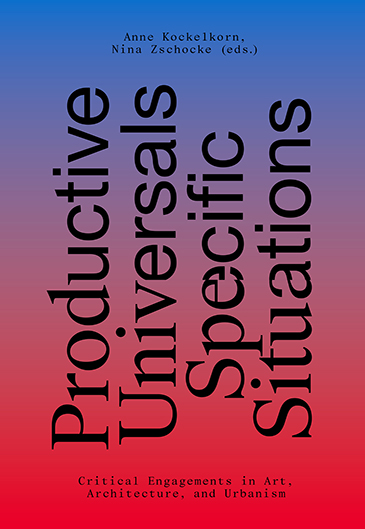
2019
“Female Agency and Psychological Warfare: French Colonial Civil and Military Interventions in Algeria, 1954–1962.”
In Productive Universals–Specific Situations. Clinical Engagements in Art, Architecture, and Urbanism, eds. Anne Kockelkorn and Nina Zschocke.
Berlin: Sternberg Press, 2019
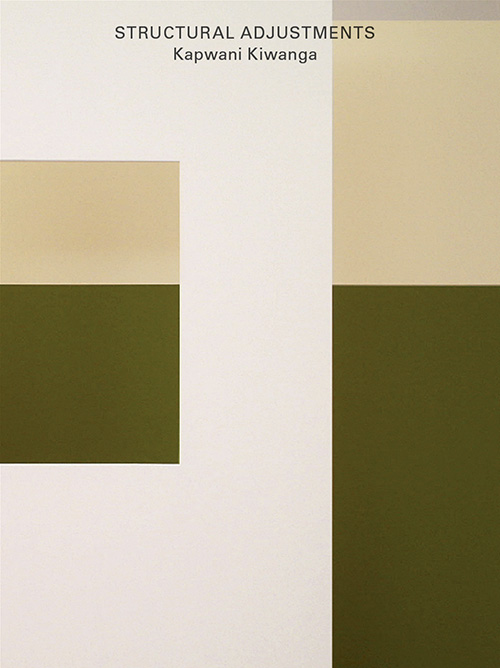
2017
“Reflections on the Authority of Architecture, Or a Brief and Unfinished Cartography of Disciplinary Spaces.”
In Kapwani Kiwanga: Structural Adjustments, eds. Yesomi Umolu and Gaëtane Verna.
Chicago: University of Chicago Press and The Power Plant Contemporary Art Gallery, 2017
Apr 2024
On Frantz Fanon and the Manichean World
Mousse Magazine.
Dec 2022
Jerboasite: Naming French Radioactive Matter in the Sahara
e-flux Architecture: Half-Life, edited by Nick Axel, Nikolaus Hirsch, Himali Singh Soin and Irene Sunwoo.
Nov–Dec 2022
Terra Nucleus: Radiating Desert Lives
The Funambulist: The Desert, no. 44, pp. 60–67.
23 Jun 2022
Nuclear Powers: France’s Atomic Bomb Tests in the Algerian Sahara
The Architectural Review.
Jul–Aug 2022
The Battle for Internationalization and Independence
The Funambulist: Algerian Independence and Global Revolution 1962–2022, no. 42, pp. 48–56.
Oct 2021
Oil, Gas, Dust: From the Sahara to Europe
e-flux Architecture: Coloniality of Infrastructure, edited by Nick Axel, Kenny Cupers and Nikolaus Hirsch.
Spring 2021
Exhibition as a Form of Writing: On “Discreet Violence: Architecture of the French War in Algeria”
Parse: On the Question of Exhibition, issue 13.
2020
Anticolonial Remedies: From Colonization to Globalization
Perspecta 53: Onus, pp. 193–203.
23 Jun 2020
The Coloniality of an Executive Order
Canadian Centre for Architecture.
Jan–Feb 2020
Reading Colonial Landscapes in Algeria and Palestine: A Conversation Between Samia Henni and Mostafa Minawi
The Funambulist: Learning with Palestine, no. 27, pp. 42–49.
2020
Housing Pharmacology
Manifesta 13, Marseille.
2019
Colonial Prescriptions in Paris
Perspecta 52: Ensemble, pp. 245–254.
2019
Boumedienne, Niemeyer: When Militarism Meets Modernism
Preface to Jason Oddy, Oscar Niemeyer in Algeria. Columbia Books on Architecture and the City.
31 Oct 2018
Colonial Ramifications
e-flux Architecture: History/Theory, gta Institute, ETH Zurich.
2018
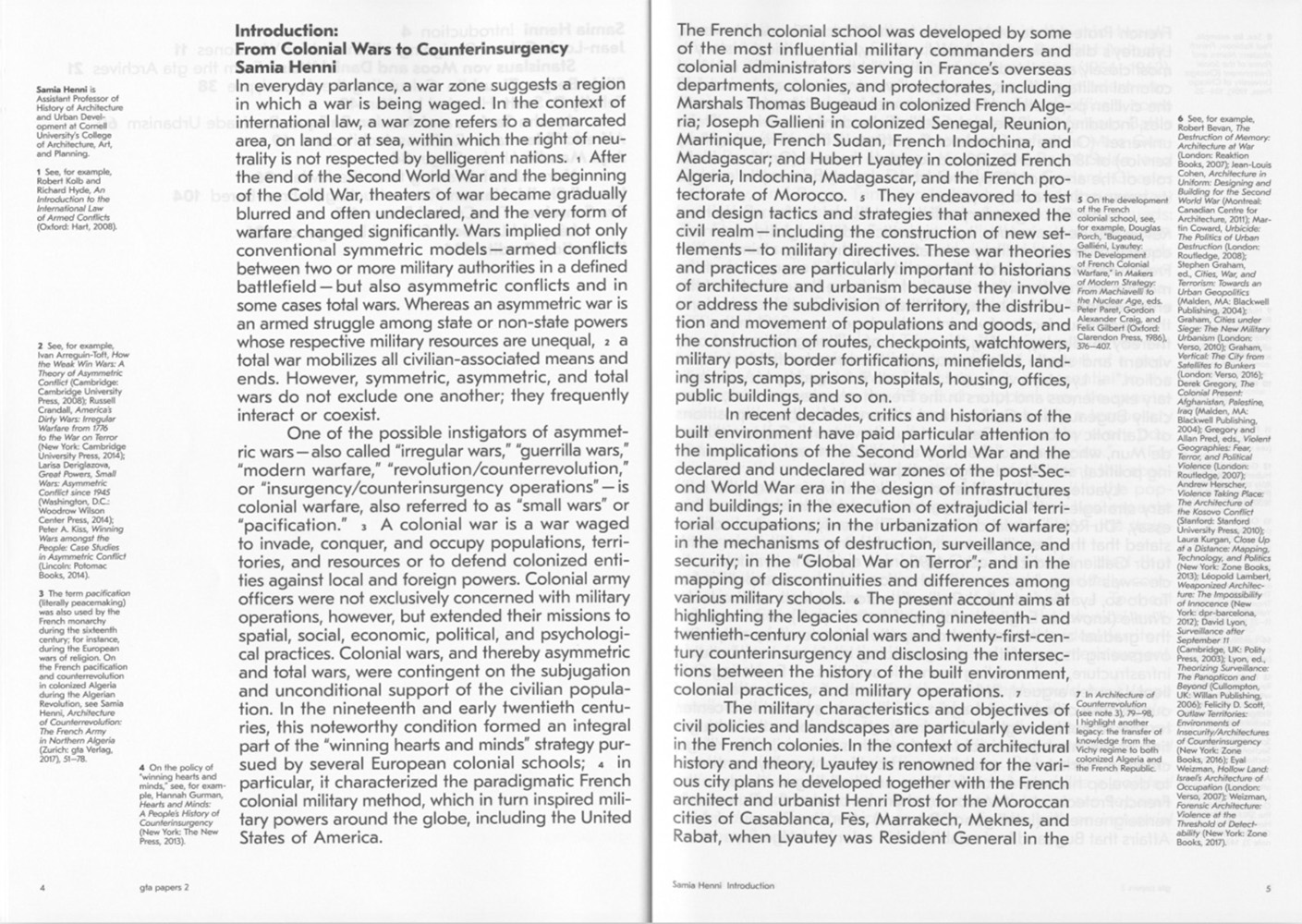
Introduction: From Colonial Wars to Counterinsurgency
In gta papers 2: War Zones, edited by Samia Henni. gta Verlag.
Feb 2018
Norms and Forms of Dispossession: The Politics of Naming
Pidgin 23, Princeton University School of Architecture Journal, pp. 16–29.
Nov–Dec 2017
Toxic Imprints of Bleu, Blanc, Rouge: France’s Nuclear Bombs in the Algerian Sahara
The Funambulist: Toxic Atmospheres, no. 14, pp. 28–33.
Spring 2017
Black Color and “Negro Village”: Why Skin Color Still Matters in Architecture
Trans Magazin: Farbe (Color), no. 30, pp. 158–161.
2017
What the Hell do They Mean When They Say “Independence”?
Written and read for Barby Asante; broadcast at the Diaspora Pavilion, 57th Venice Biennale.
1 Dec 2017
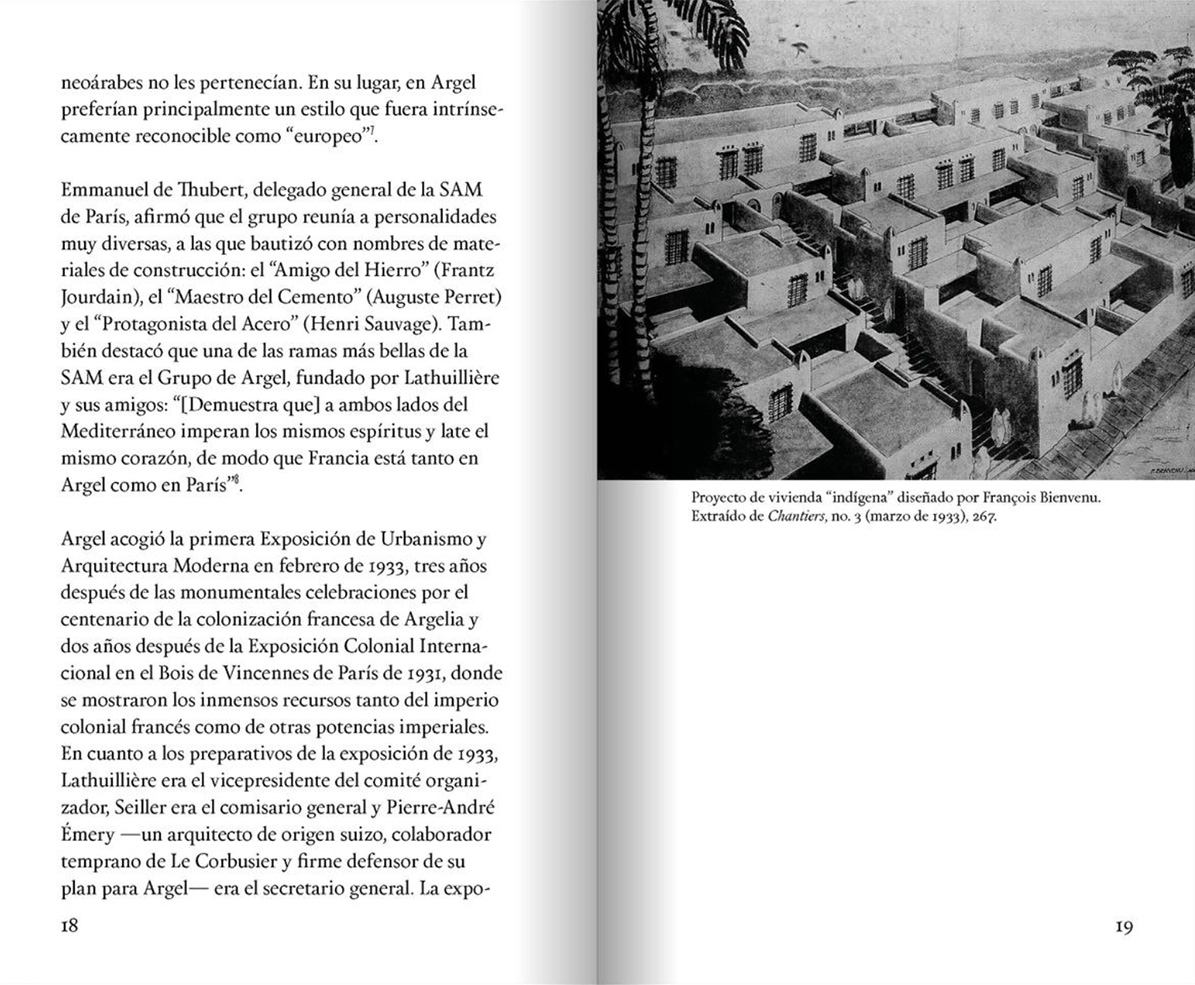
From “Indigenous” to “Muslim”: On the French Colonial Assimilationist Doctrine
Positions, e-flux Architecture.
Autumn 2016
On the Spaces of Guerre Moderne: The French Army in Northern Algeria (1954–1962)
Footprint: Spaces of Conflict, no. 19, pp. 37–57.

EXHIBITING

2025–

Psychocolonial Spaces — Act 1

Ar/Ge Kunst
Bolzano / Bozen, Italy
24 May–2 August 2025

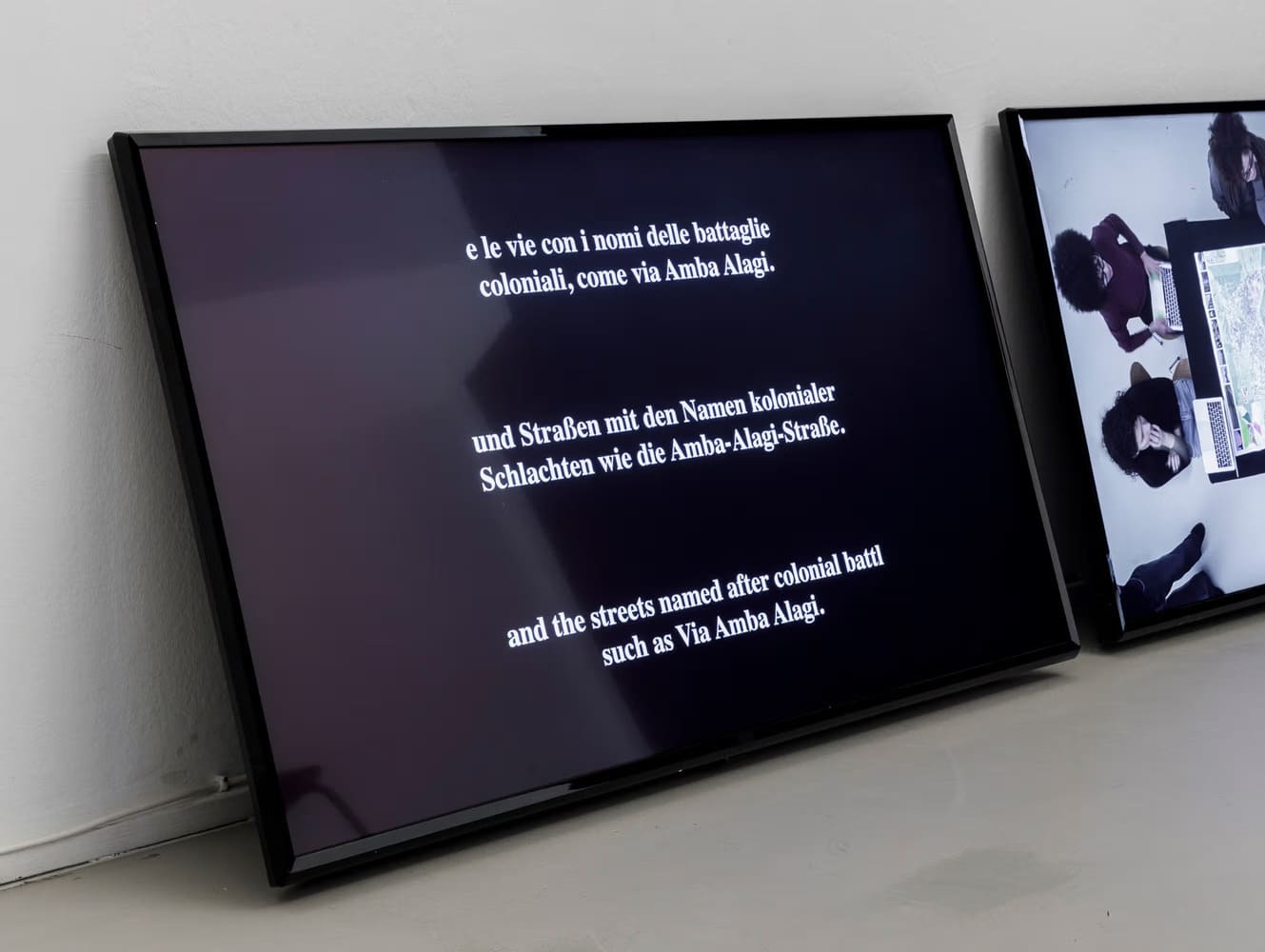
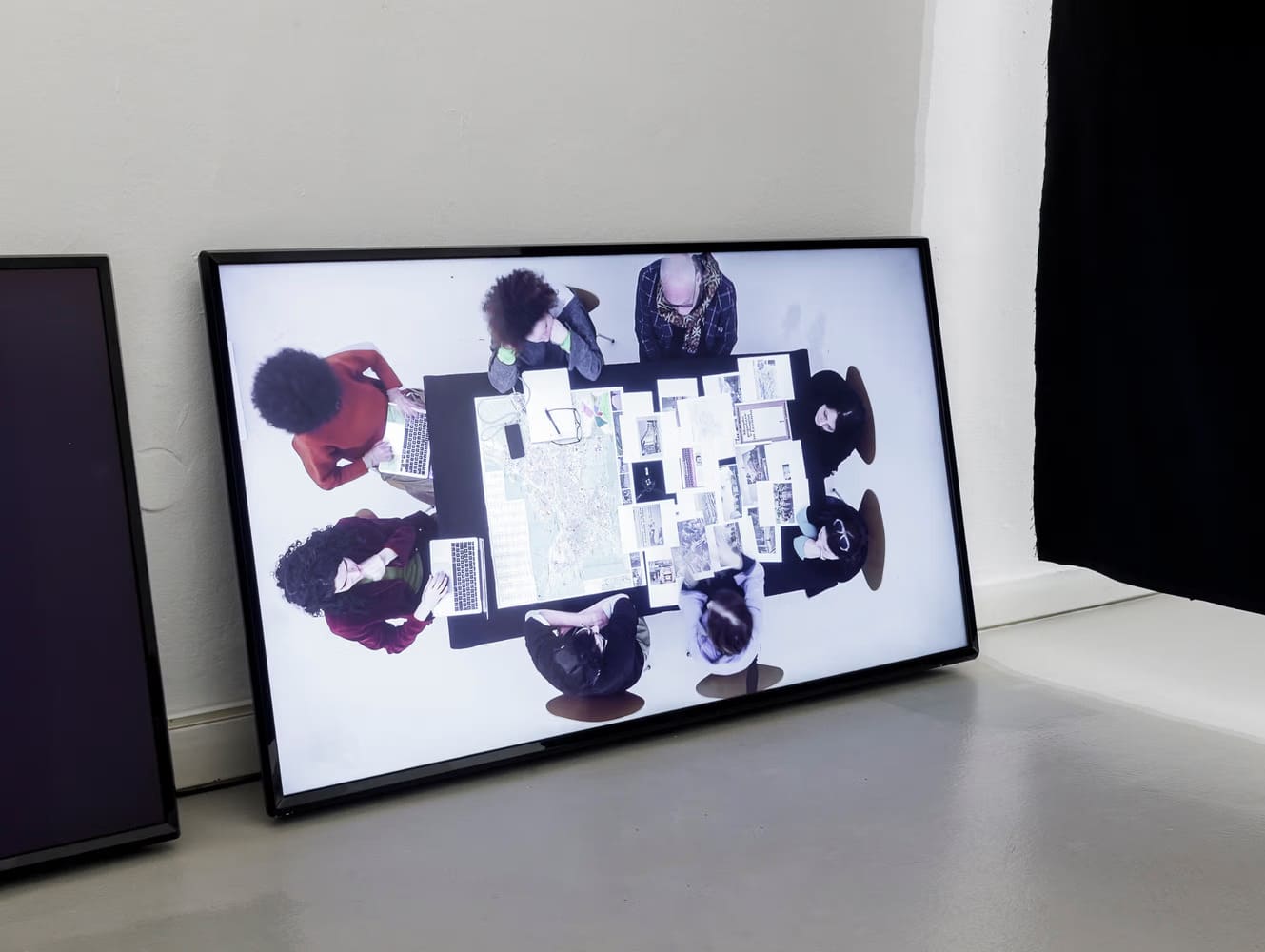
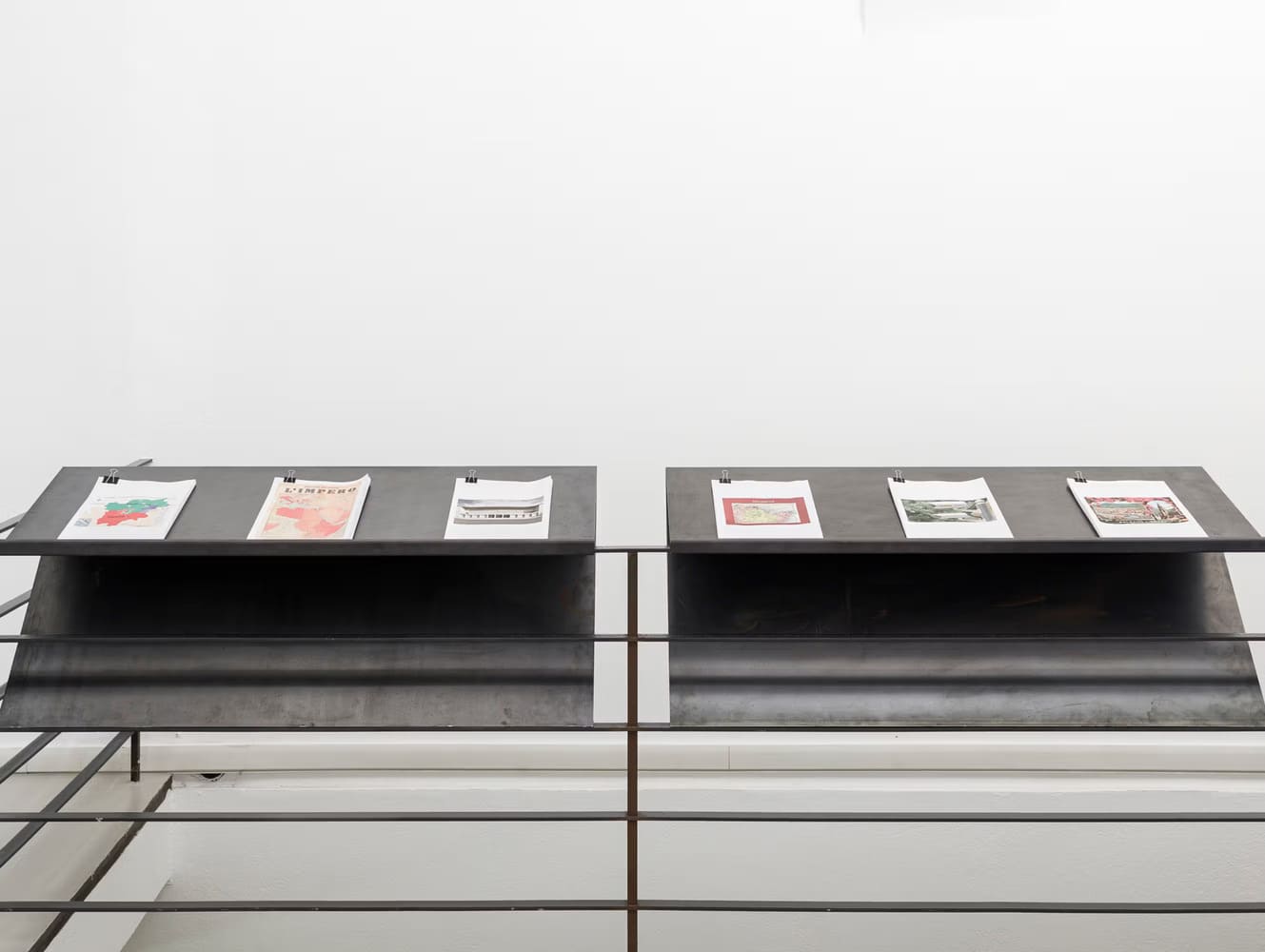
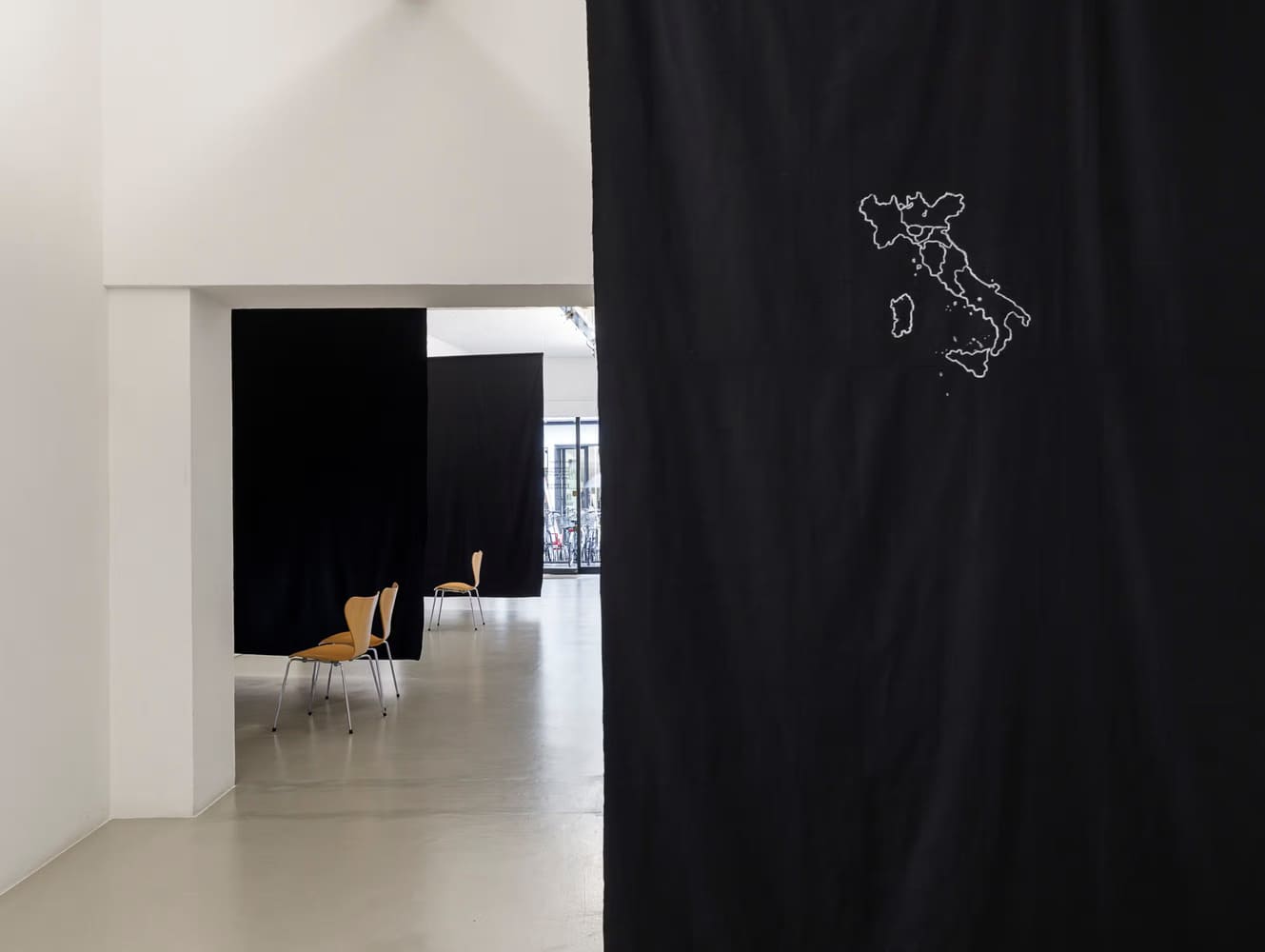
Psychocolonial Spaces - Act 1 is a project conceived and implemented by Samia Henni, and commissioned by Ar/Ge Kunst, to be held in Bolzano between 24 May and 2 August 2025. The project investigates the relationships between borders, territories and inhabited spaces, and Frantz Fanon's analysis of the psychology of colonialism.

As argued in Henni's 2024 article, entitled "On Frantz Fanon and the Manichean World" and published in Mousse, the work of the psychiatrist, political philosopher and anti-colonial activist Frantz Omar Fanon (1925-1961) played a key role in treating and theorizing the psychological and psychiatric agony of colonialism. Fanon's theories are relevant to today's colonial world order, especially in relation to the organization of states, property and space, and to the distribution of resources and capital. One of the key points of Fanon's practice was precisely his focus on (de)colonization challenges also from a psychological point of view.

The project for Ar/Ge Kunst, Psychocolonial Spaces, is the first of a series of events that may be activated in various cities and places. Act 1 sets out from the analysis of the invisible and invisibilized spaces of segregation and alienation across the territory of Bolzano and its surroundings: colonial traces, monuments and streets, places that even today have an impact on people's lives. But what comes to mind when we think of "psychocolonial" spaces? How do they affect us and how do we recognize them? How does our body absorb the violence of these spaces and how do our education, origins and attitude change the way we think about these places? What emerges when we deviate from binary systems of thought and organization?

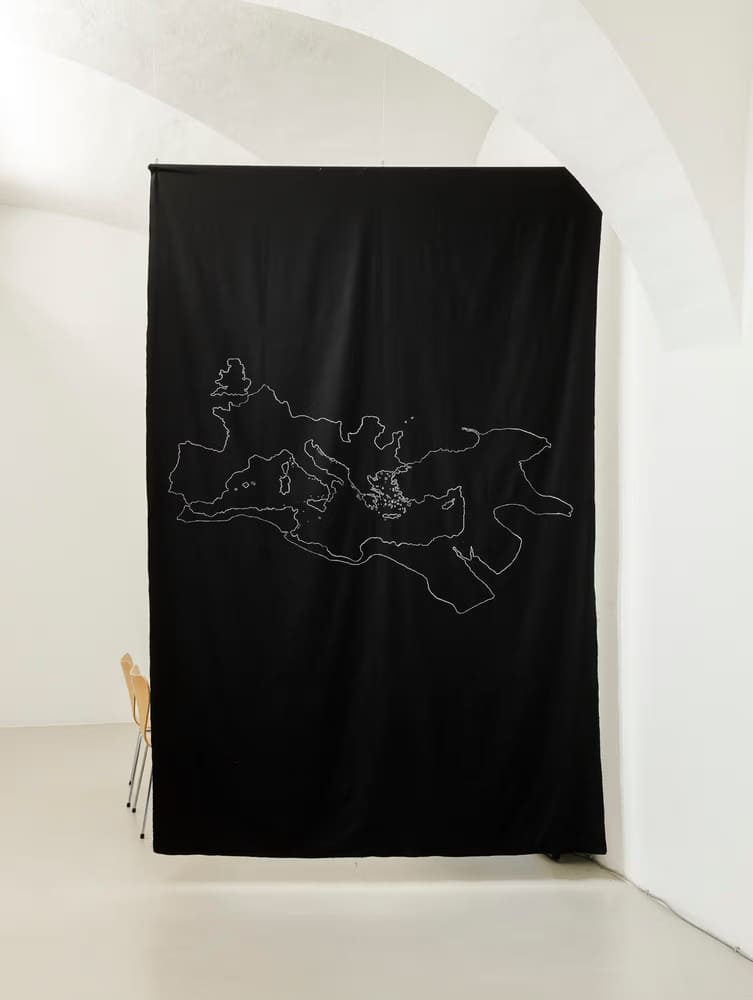
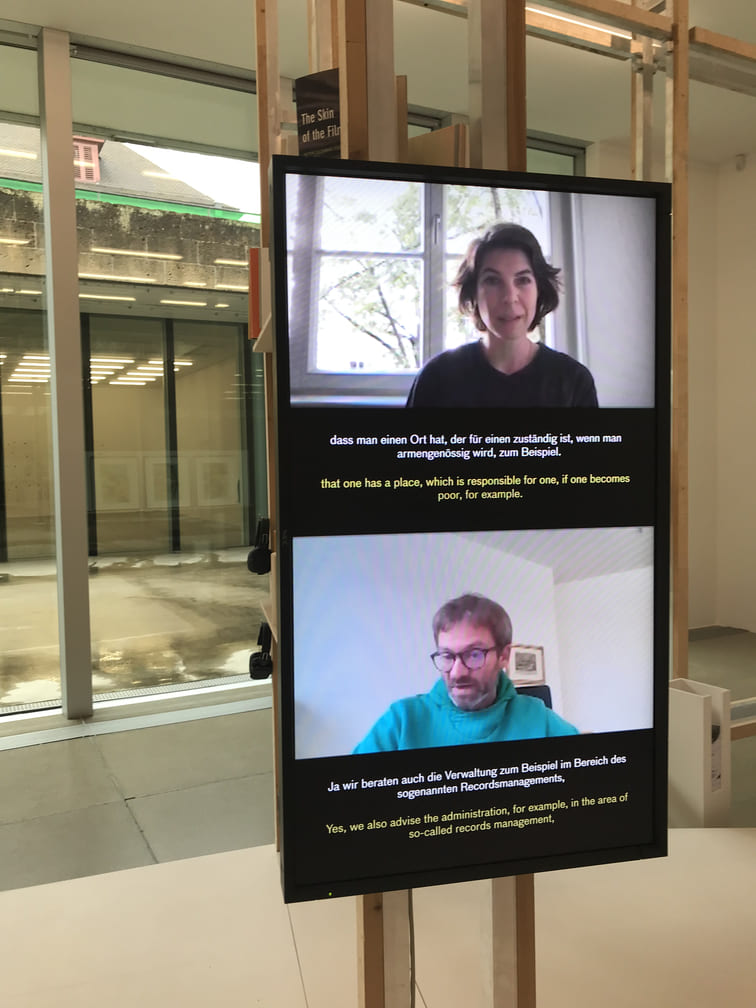
Thinking about psychocolonial spaces can be both a "provocation" and a challenge, because naming them makes us imagine them. Associating the word "colonial" with the word "psycho" triggers a personal and psychological connection, which very often depends on the subjective experience of being in that space. In the preparatory phase of Psychocolonial Spaces: Act 1, students and professionals from the province of Bolzano were invited to reflect on what they perceive to be a "psychocolonial" space today; what are the degrees of oppression or liberation that the body undergoes in space and what are these spaces? These interlocutors contributed to the construction of the final project, which might be defined as filmic. In fact, Samia Henni constructs a film "broken down" into small parts, staging its semantic level in the (dis)assembly, and reassembling everything to form an installation that - through audio, texts, drawings and videos - offers a journey through film direction.

By Samia Henni
Curated by Francesca Verga and Zasha Colah
Commissioned by Ar/Ge Kunst
Supported by Swiss Arts Council Pro Helvetia
Participants: Alessio Giordano, Anastasia Routou, Andrea Di Michele, Angelika Burtscher, Annalisa Conti, Astrid Kofler, Beatrice Harb, Camilla Corti, Carmela Nevano, Claudia Gianella, David Calas, David Hofman, Elisa Piras, Elisabetta Rattalino, Filippo Contatore, Frida Carazzato, Gabriele Di Luca, Hannes Obermair, Hans Knapp, Jasmin Khalifi, Katherina Longariva, Martin Hanni, Martina Drechsel, Marzia Bona, Monika Verdorfer, Raffaele Virgadaula, Renato Sette, Roberto Gigliotti, Valentina Cramerotti, and Verena Perwanger
Many thanks to: Mayyasah Akour, Carmine Auricchio, Ivan Bocchio, Melinda Bieri, Roberto Bors, Carlo Calderan, Elisa Cappellari, Andrea Conca, Fischli Fredi, Angelika Klammer, Waltraud Kofler-Engl, Ermira Kola, David Krawitz, Christa Ladurner, Ivana Milenkovic, Dora Musola, Bright Nnadi, Olsen Niels, Angelina Radakovic, Sylvie Riant, Stefano Riba, Anita Rossi, Pascal Schwaighofer, Luigi Scolari, Daniel Sommer, Ipek Tureli, David Theodore, Paul Videsott, Margot Wittig, and all the participants of the workshops and the making of the show
2023–

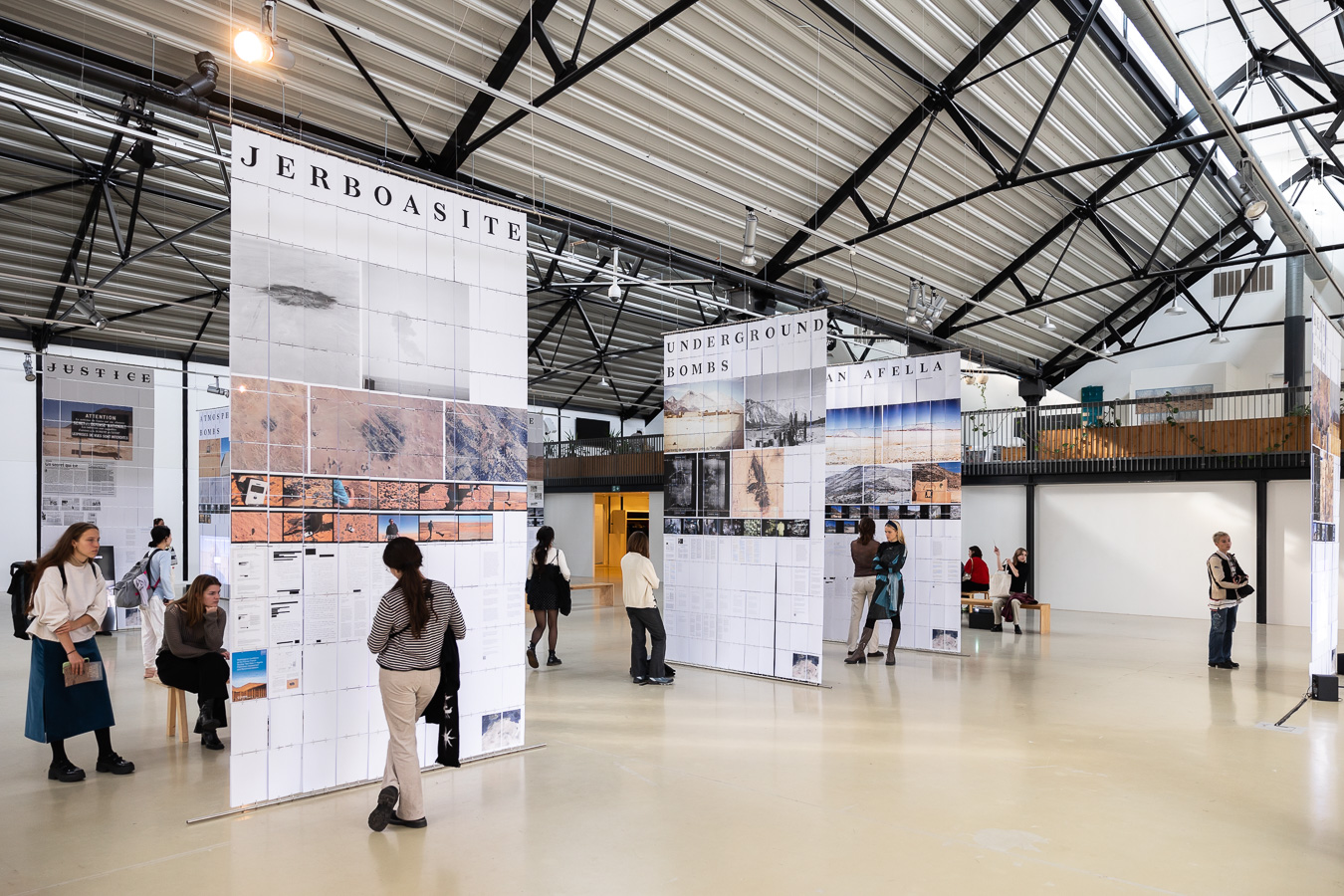
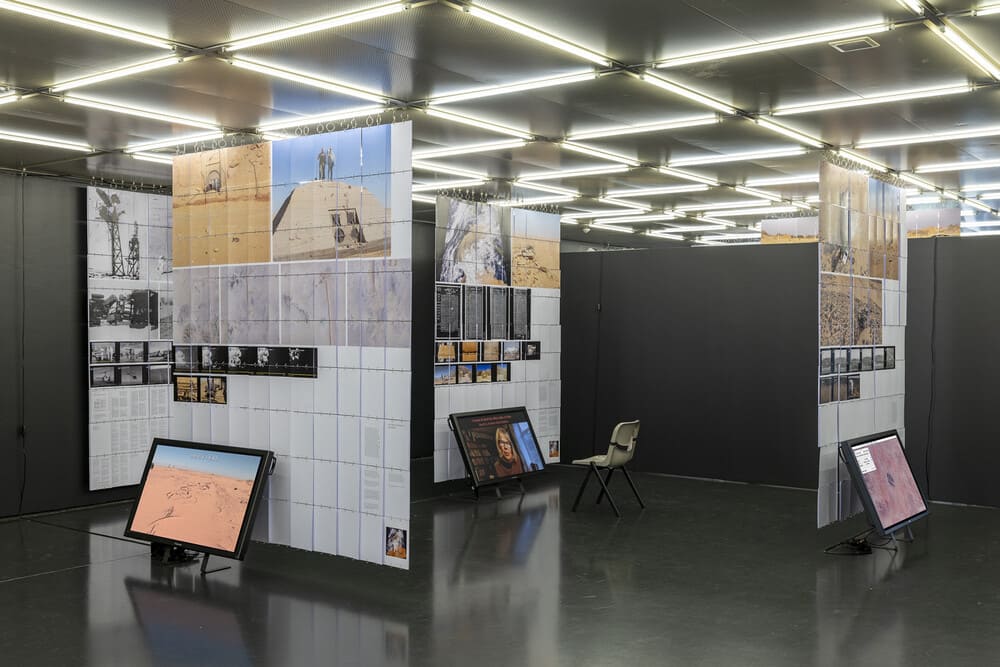
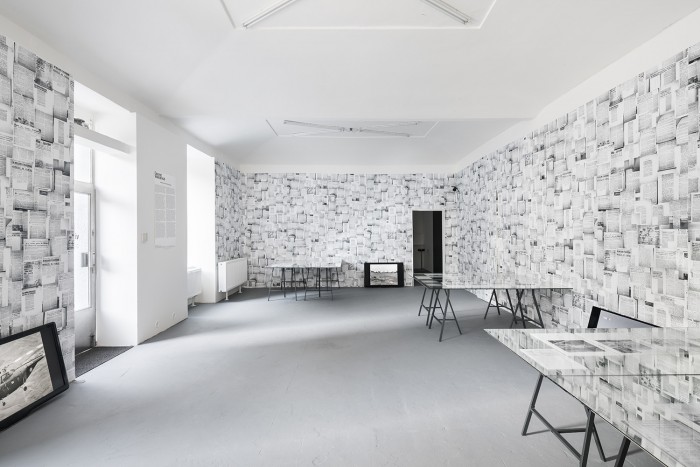
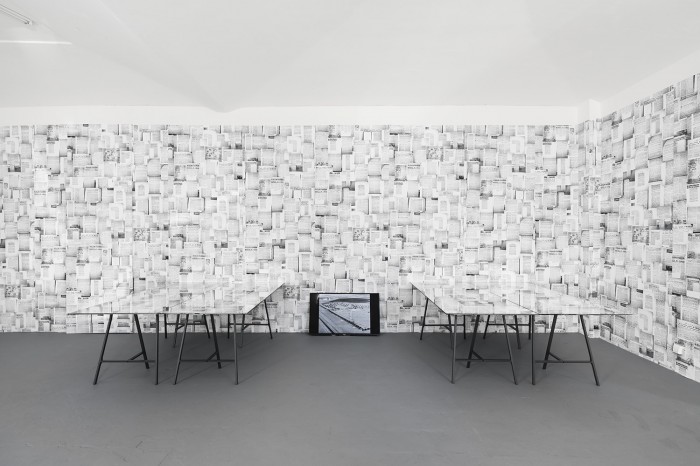
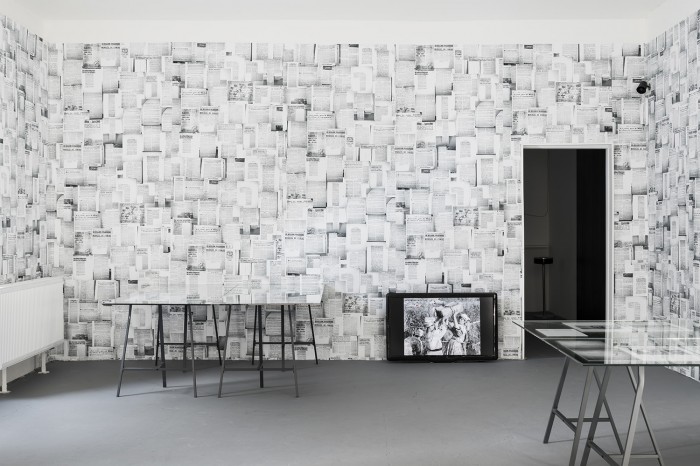
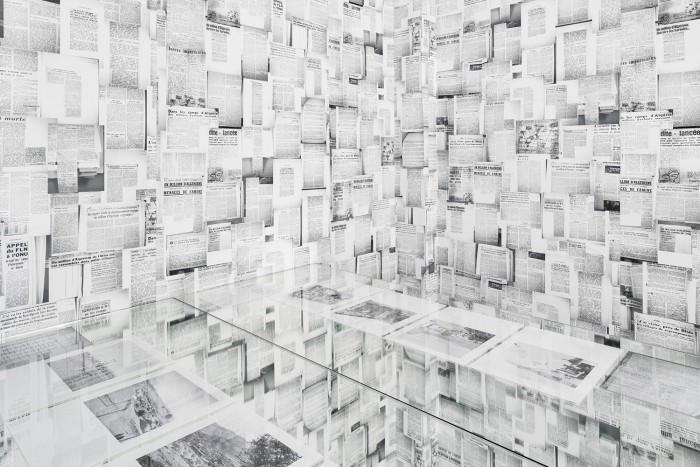
Performing Colonial Toxicity

Travelling exhibition
Amsterdam · Zurich · London · Providence · Paris · Ottawa · Montréal

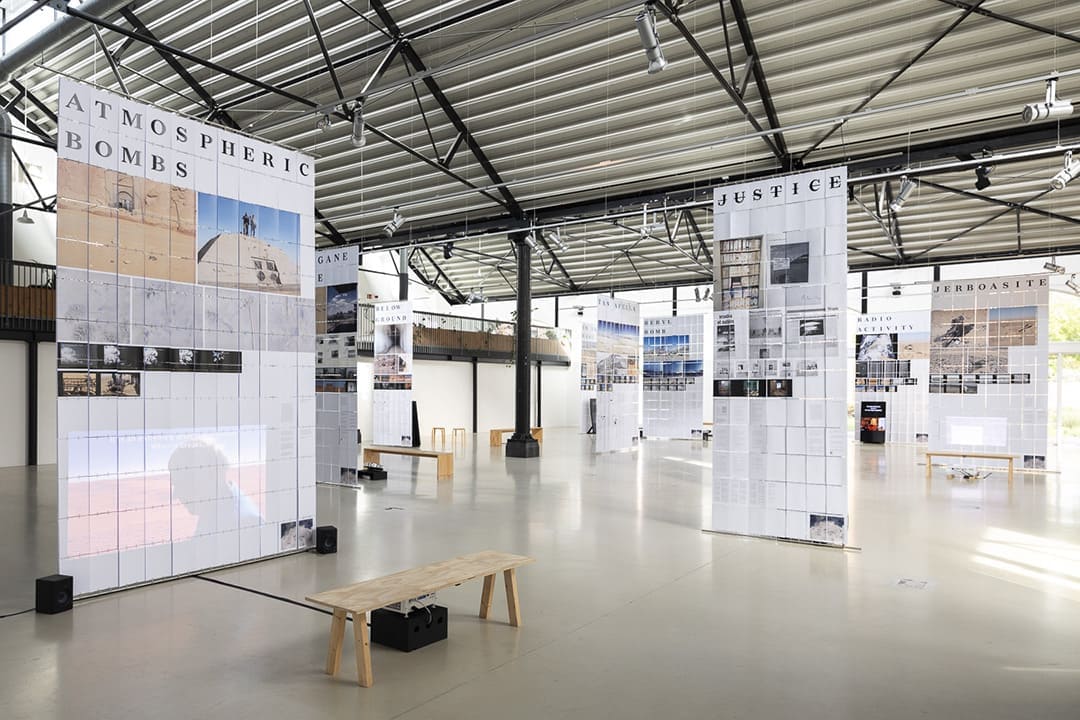
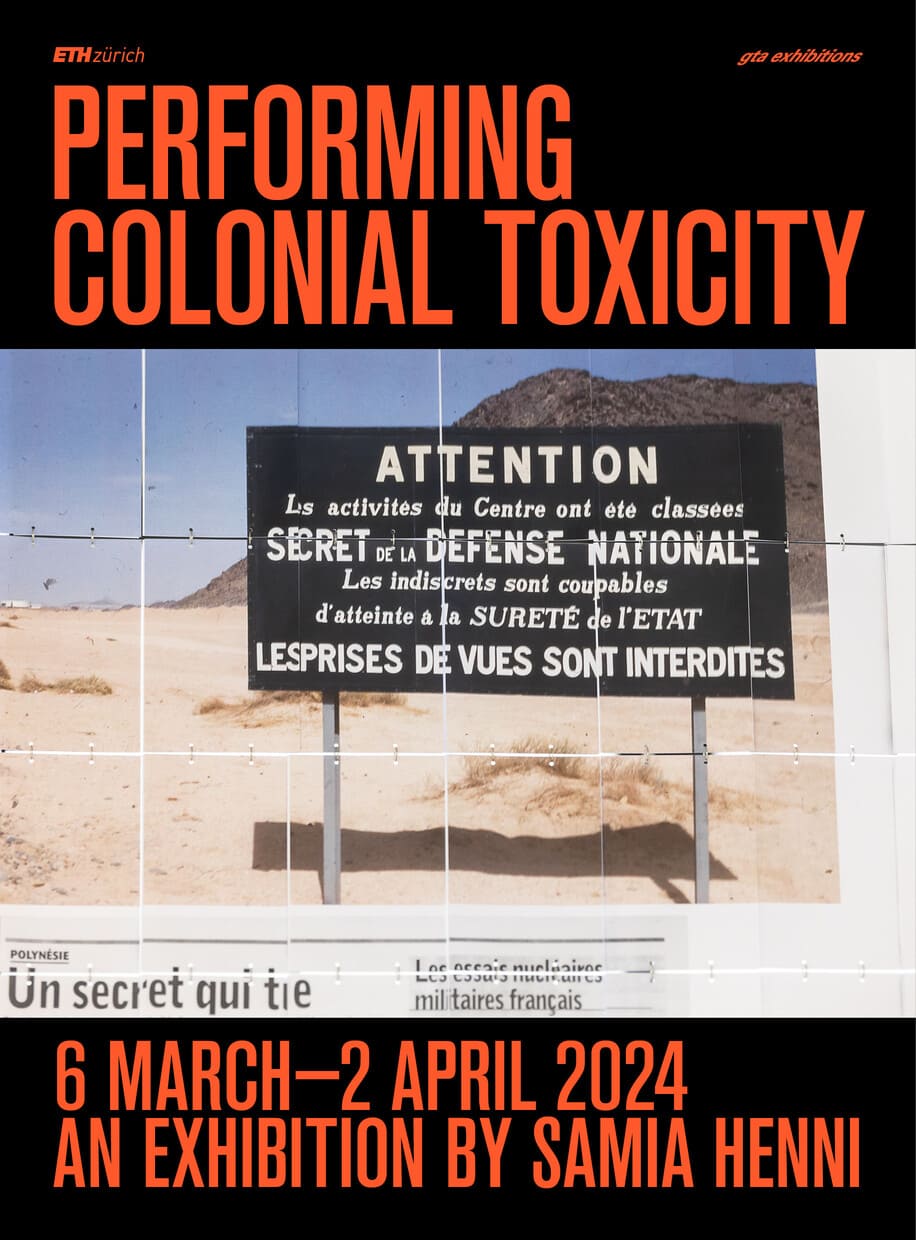
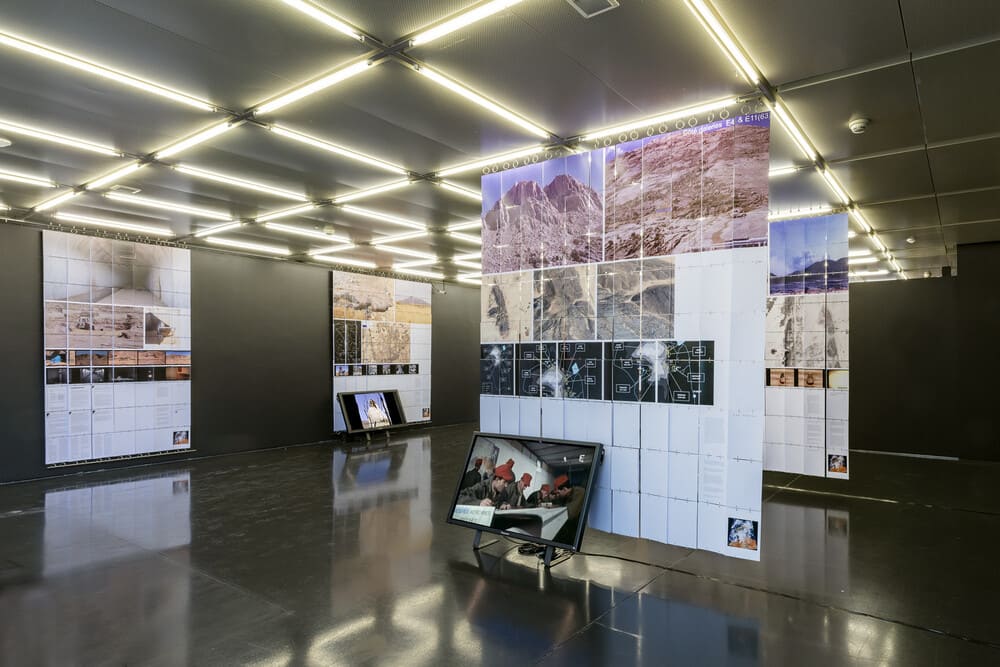
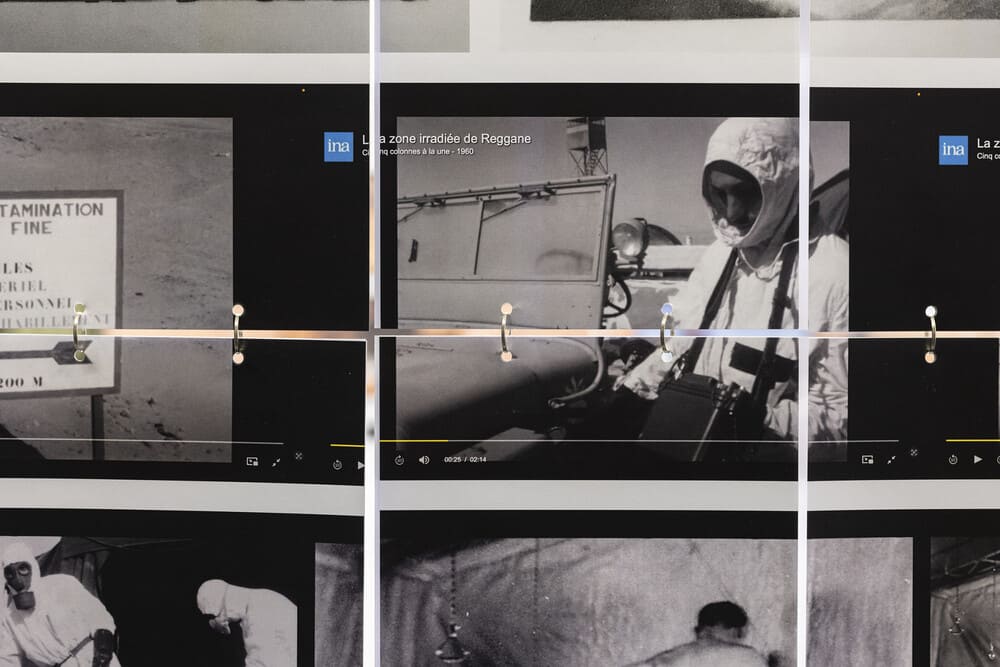
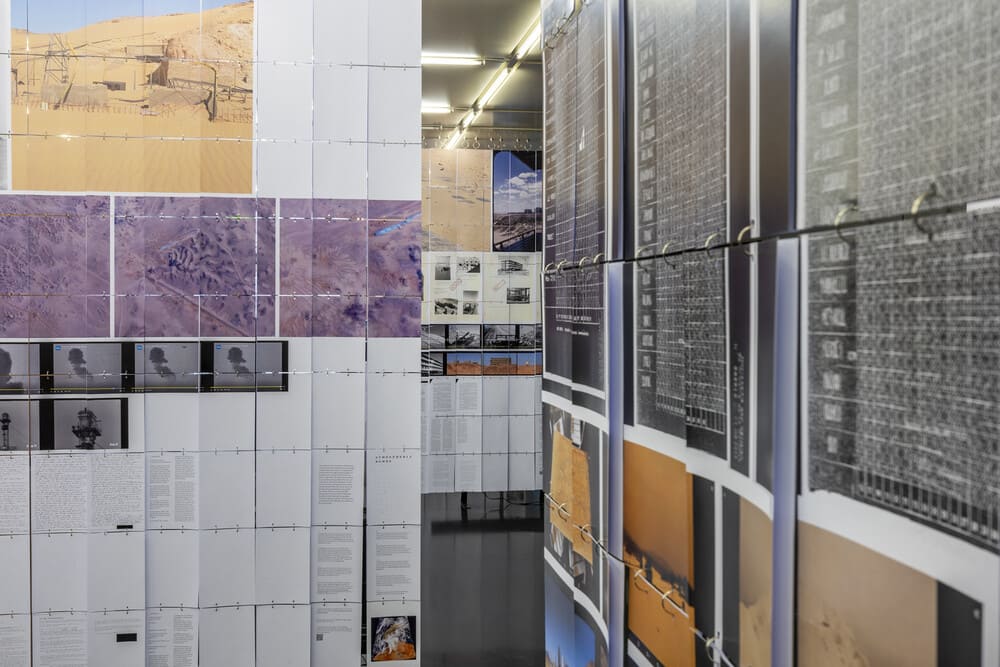
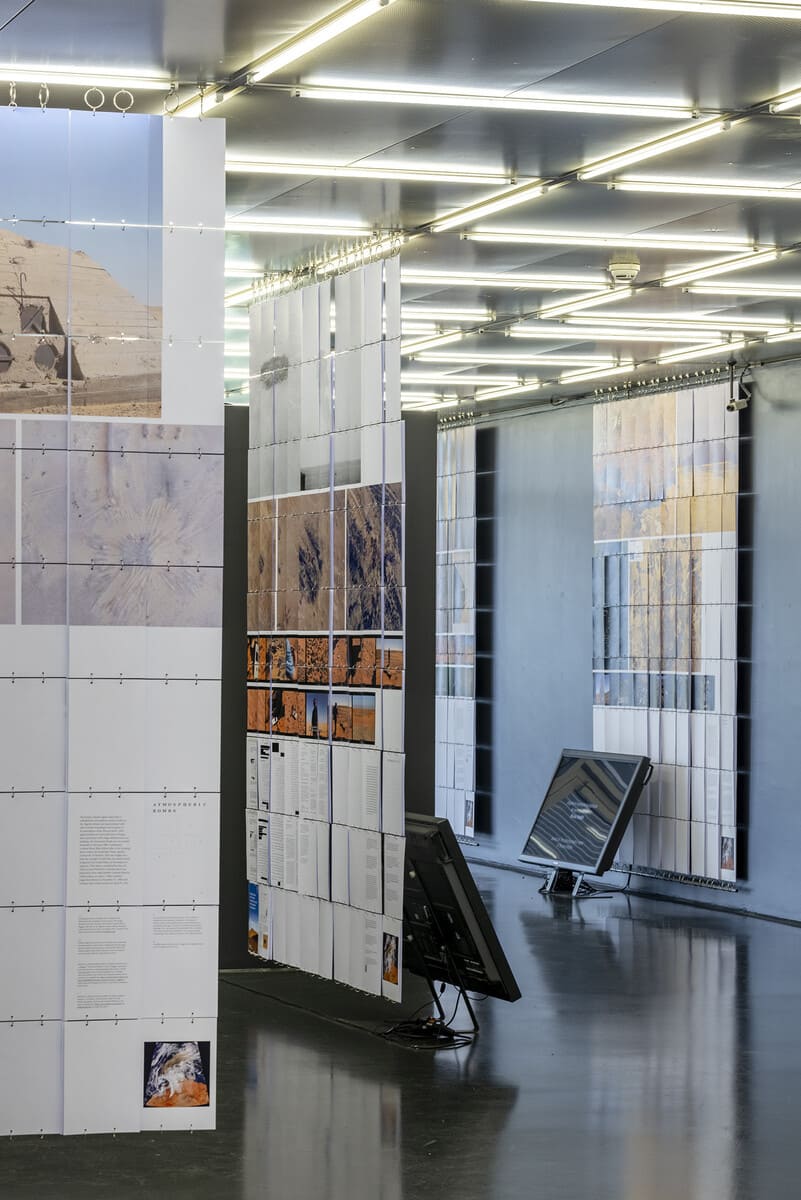
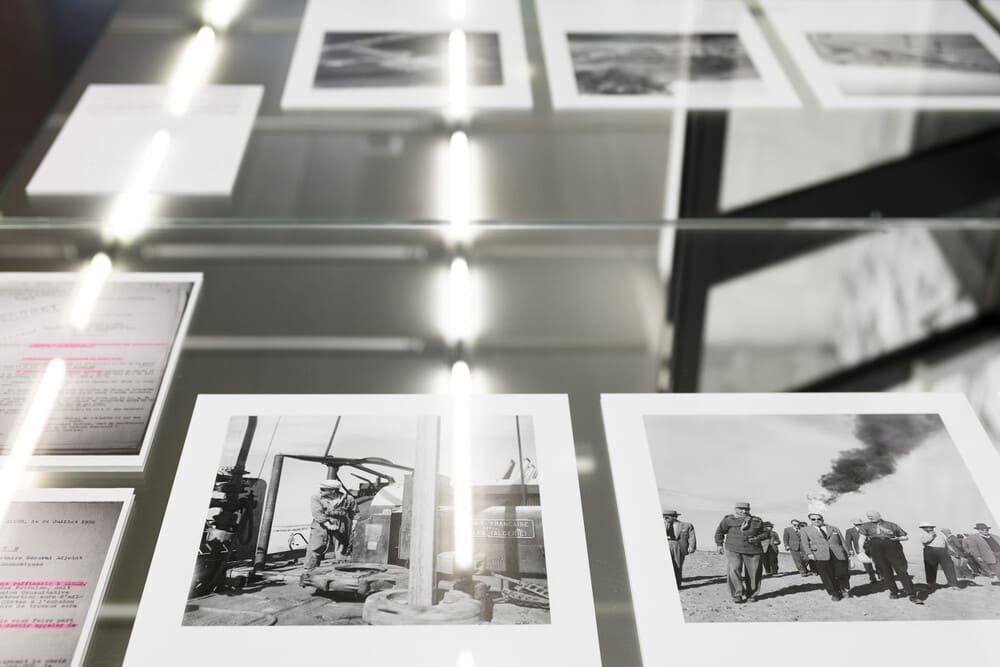
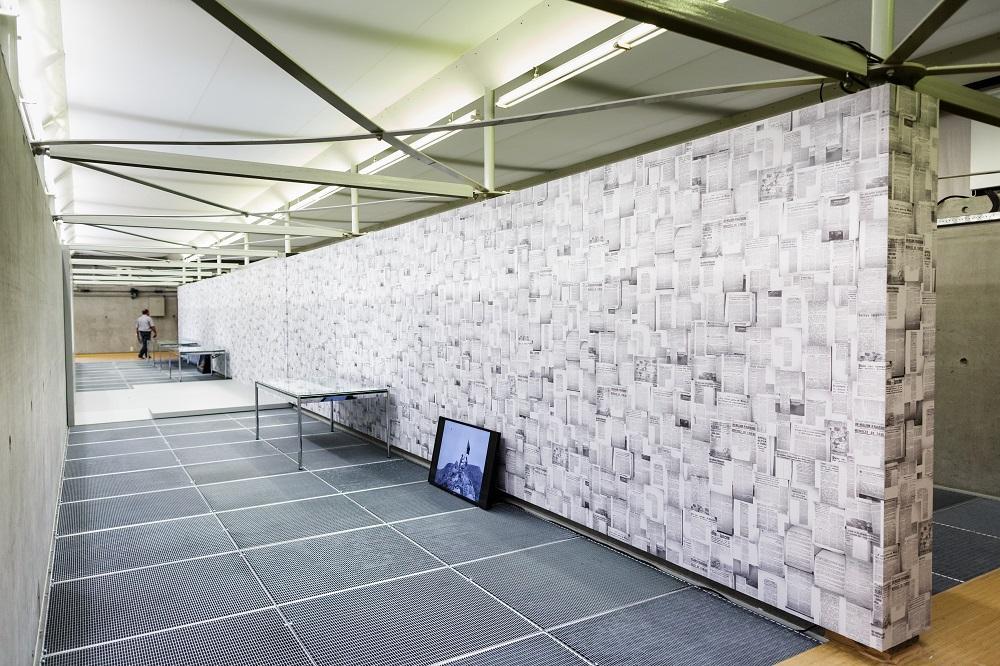
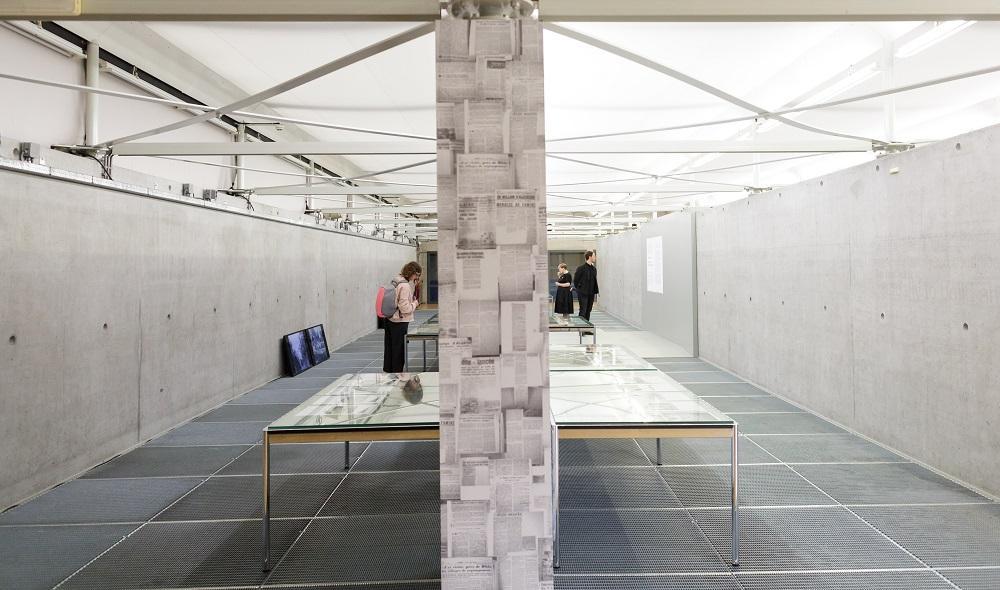
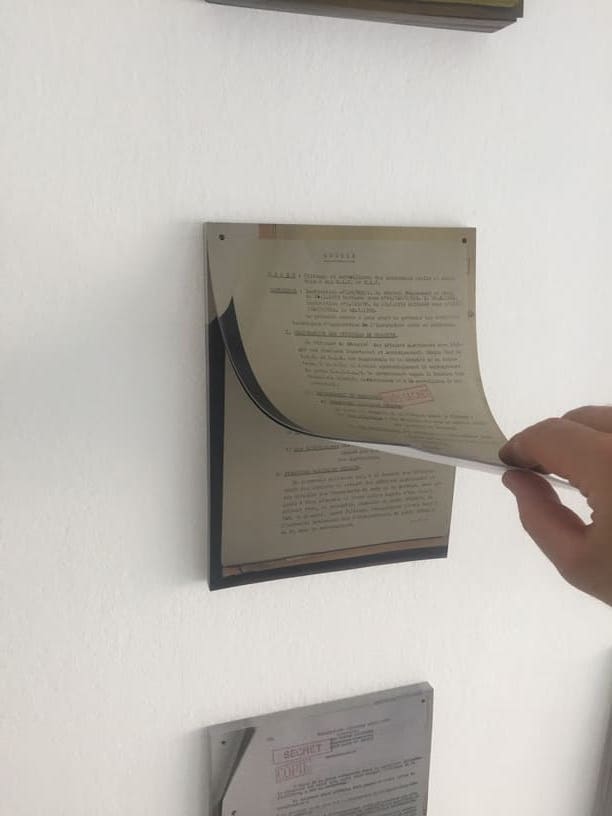
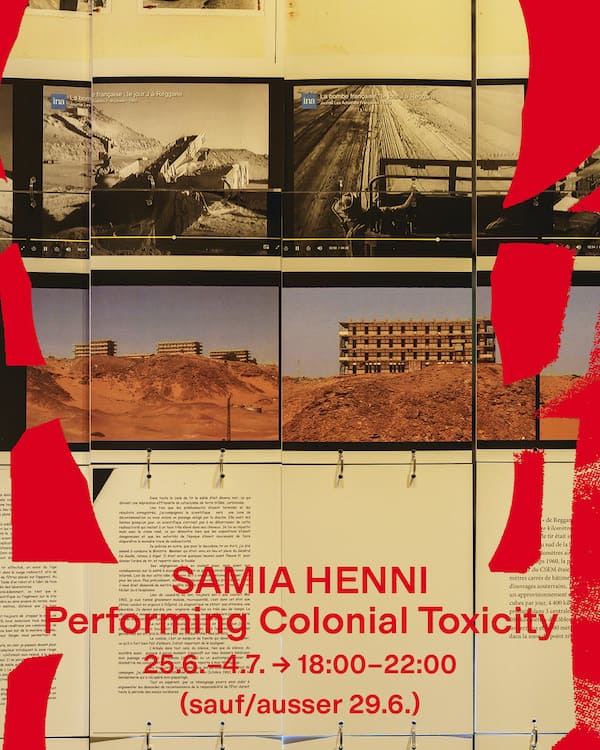
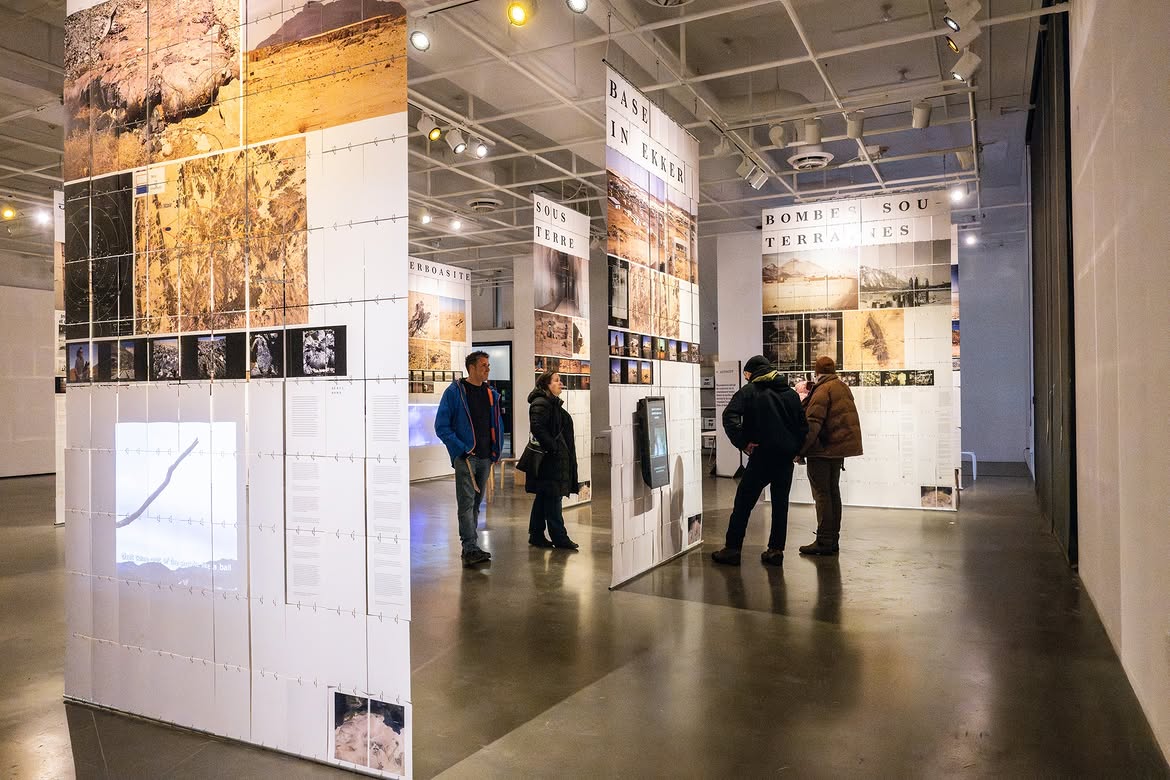
Between 1960 and 1966, the French colonial regime detonated four atmospheric atomic bombs, thirteen underground nuclear bombs and conducted other nuclear experiments in the Algerian Sahara, whose natural resources were being extracted in the process. This secret nuclear weapons programme occurred during and after the Algerian Revolution, or the Algerian War of Independence (1954-62). The resulting toxification of the Sahara spread radioactive fallout across Algeria, North, Central and West Africa, and the Mediterranean (including Southern Europe), causing irreversible and still ongoing contaminations of living bodies, cells and particles, as well as in the natural and built environments. Because the archives of the French nuclear programme remain closed over fifty years later, historical details and continuing impacts remain largely unknown.

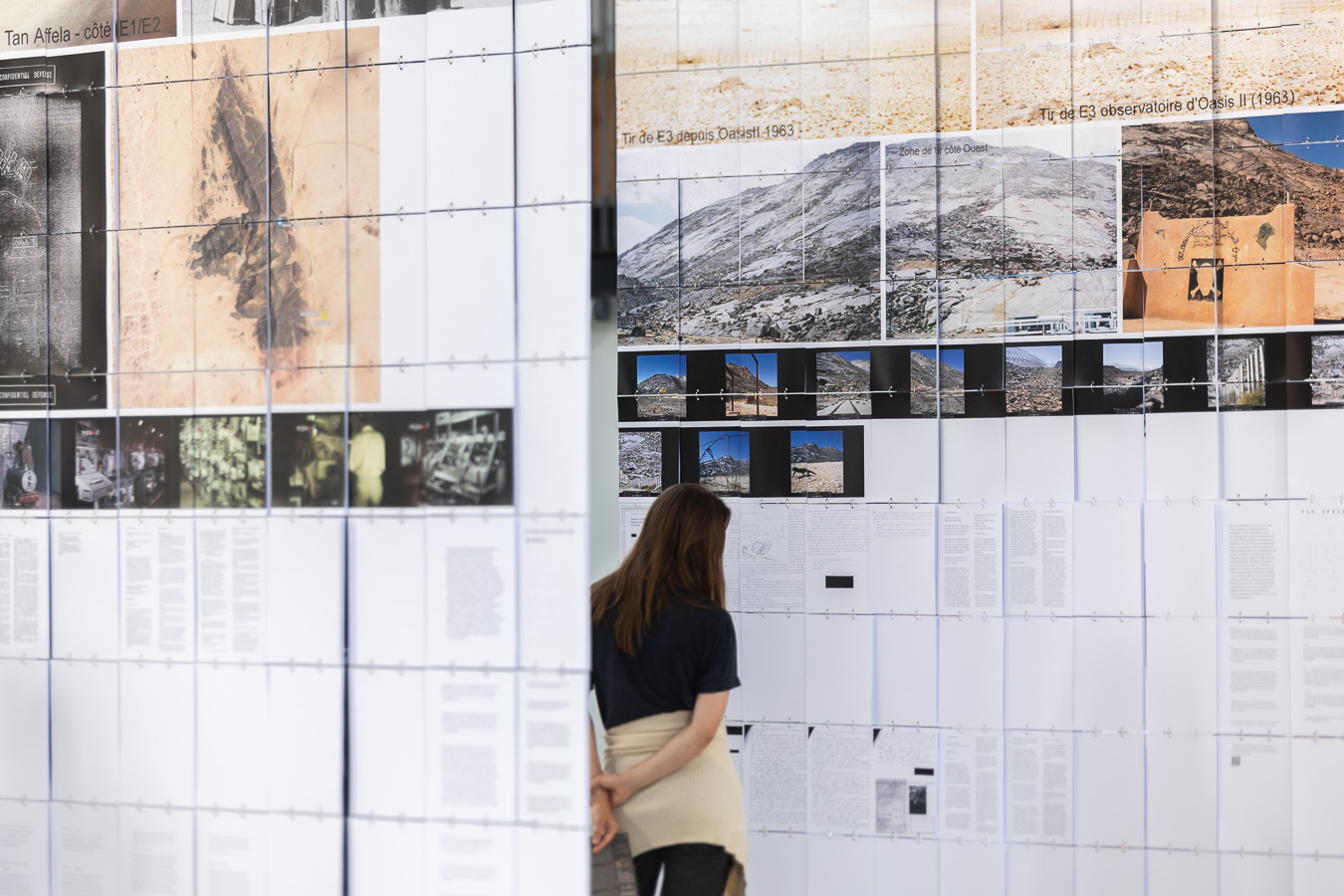
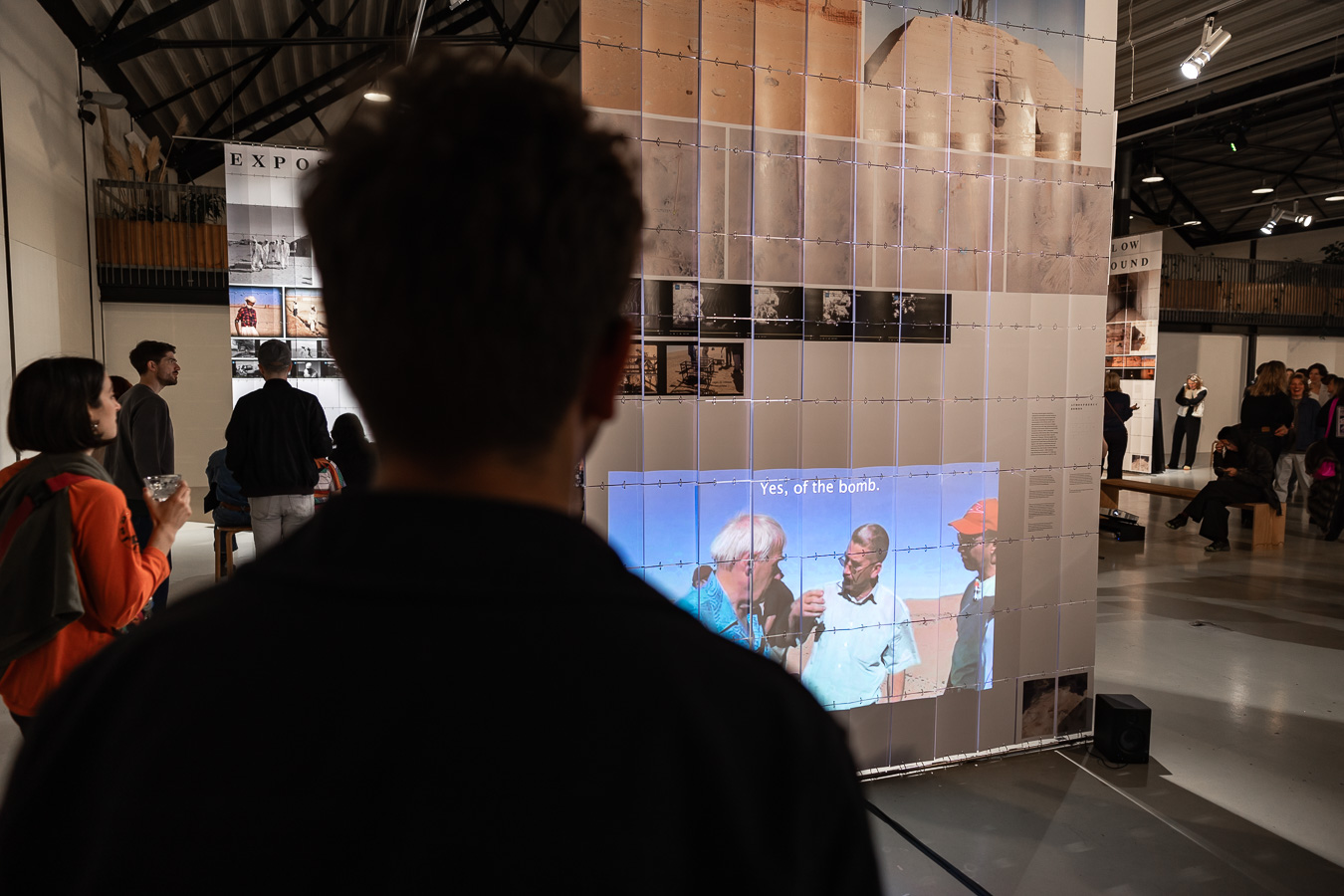
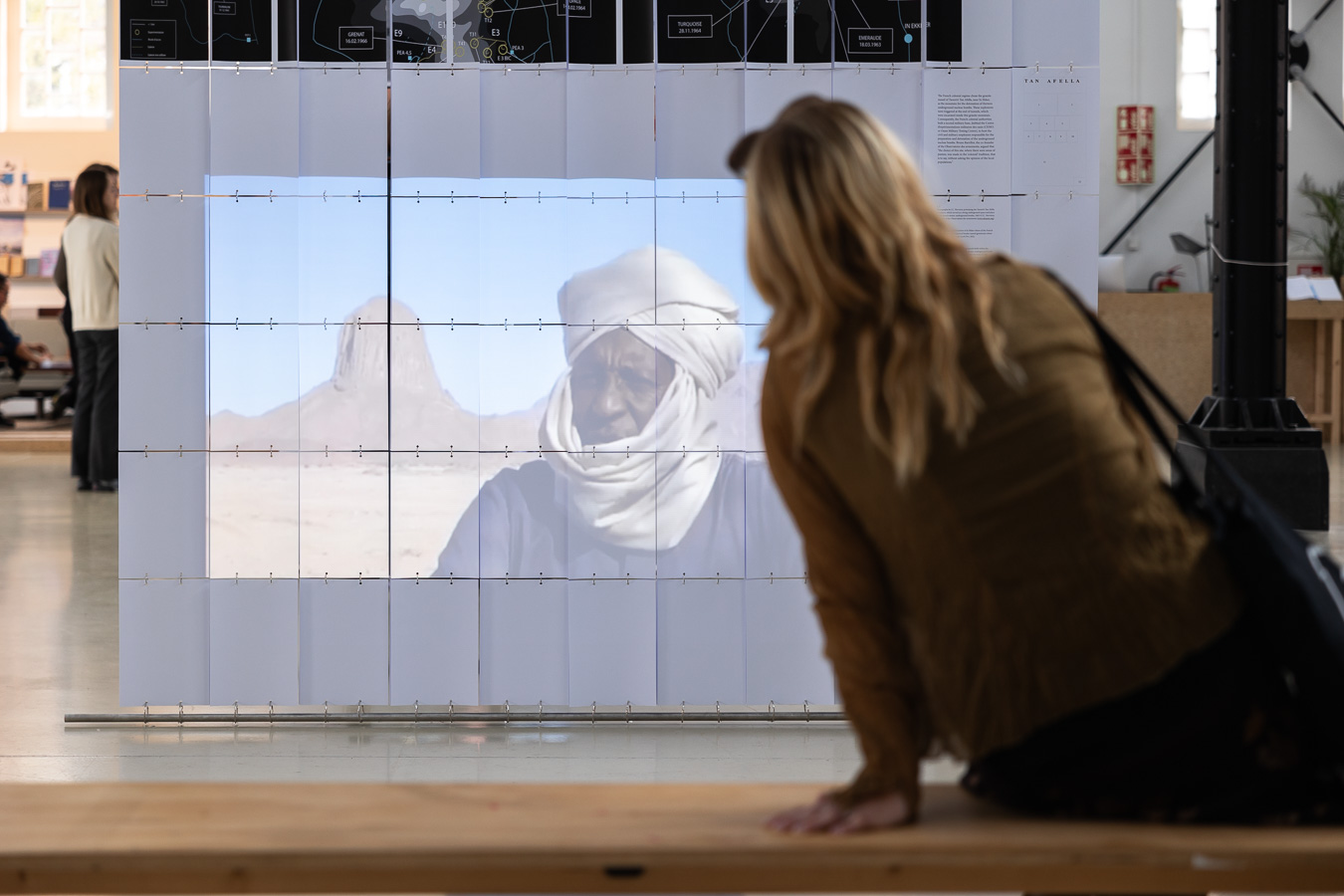
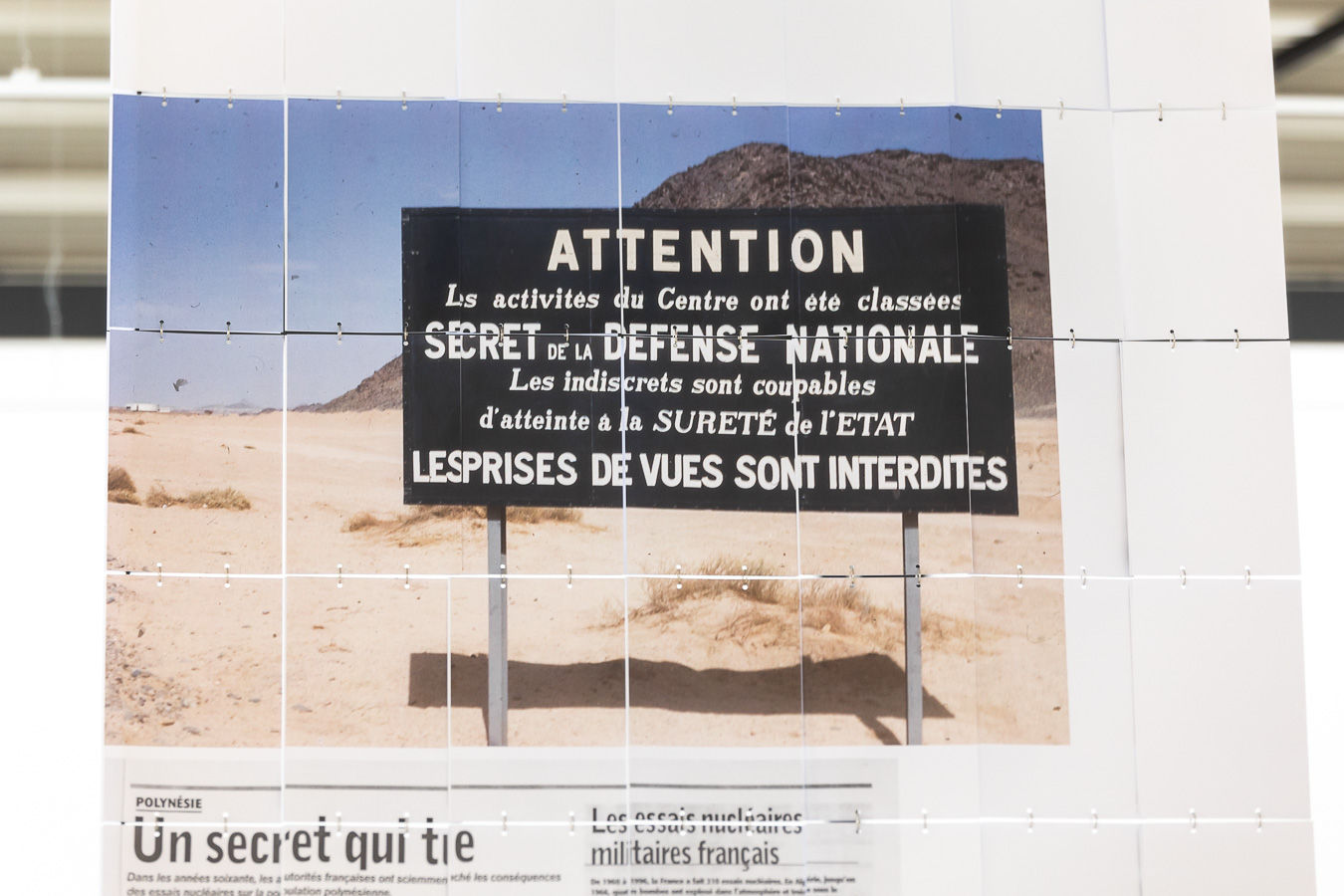
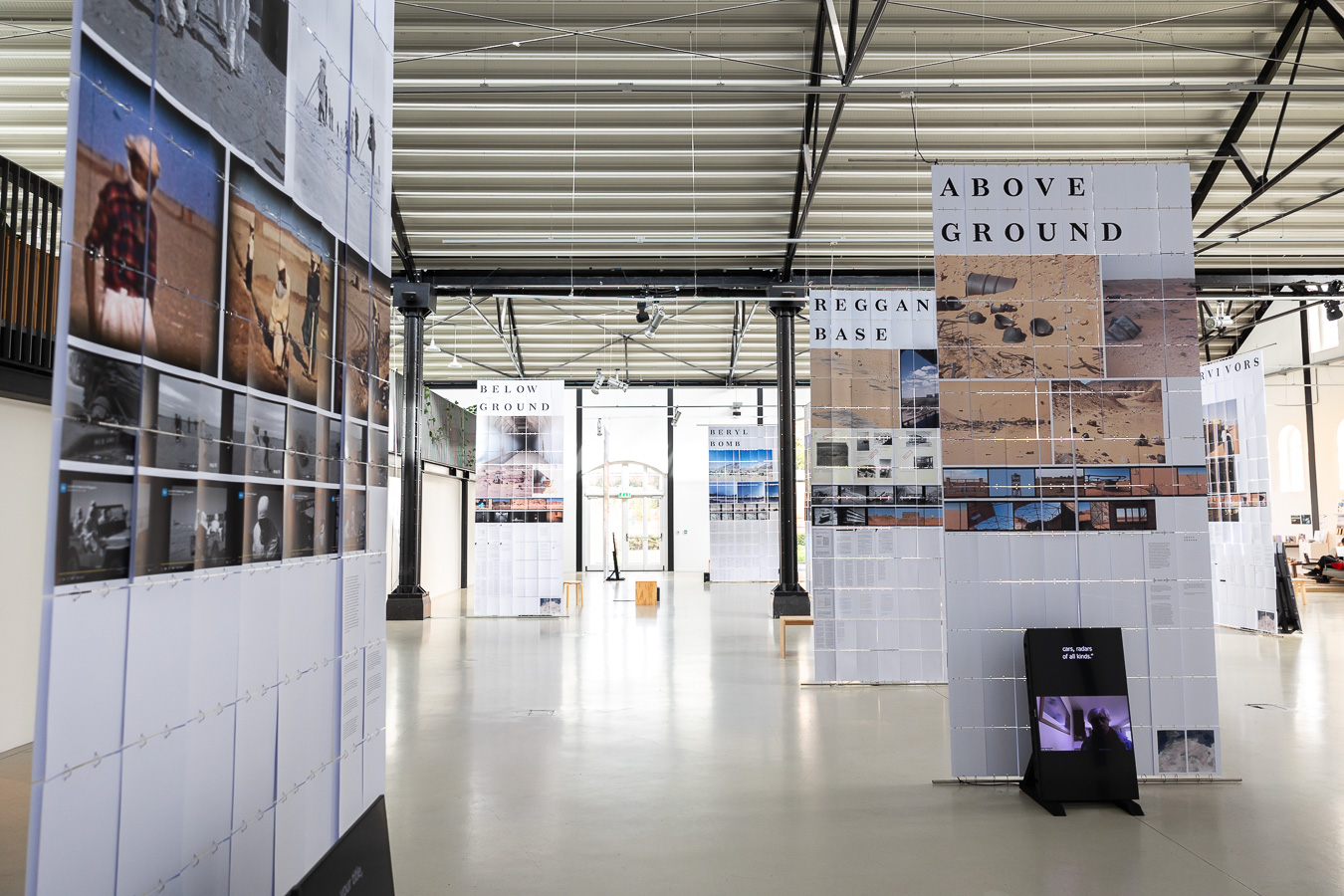
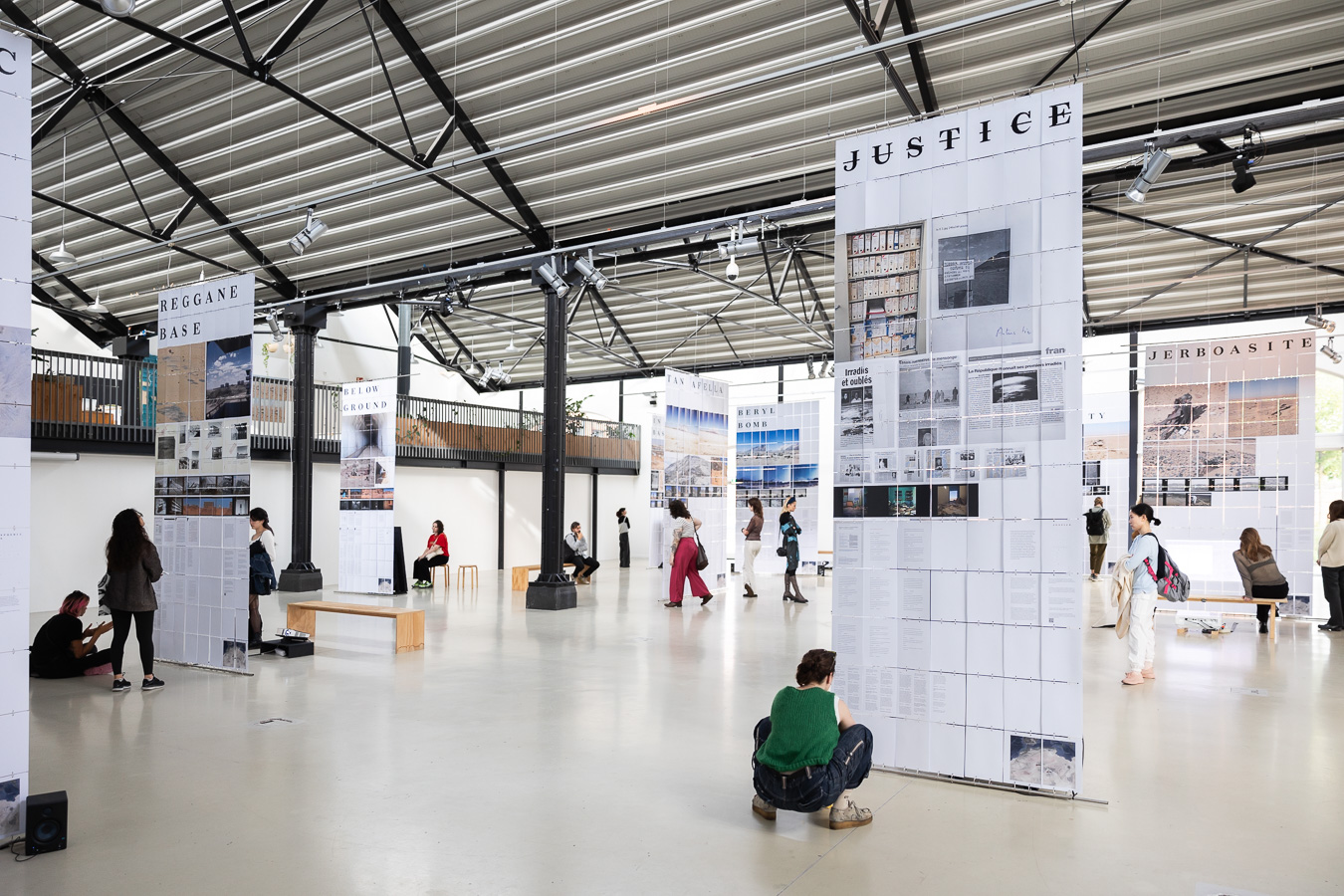
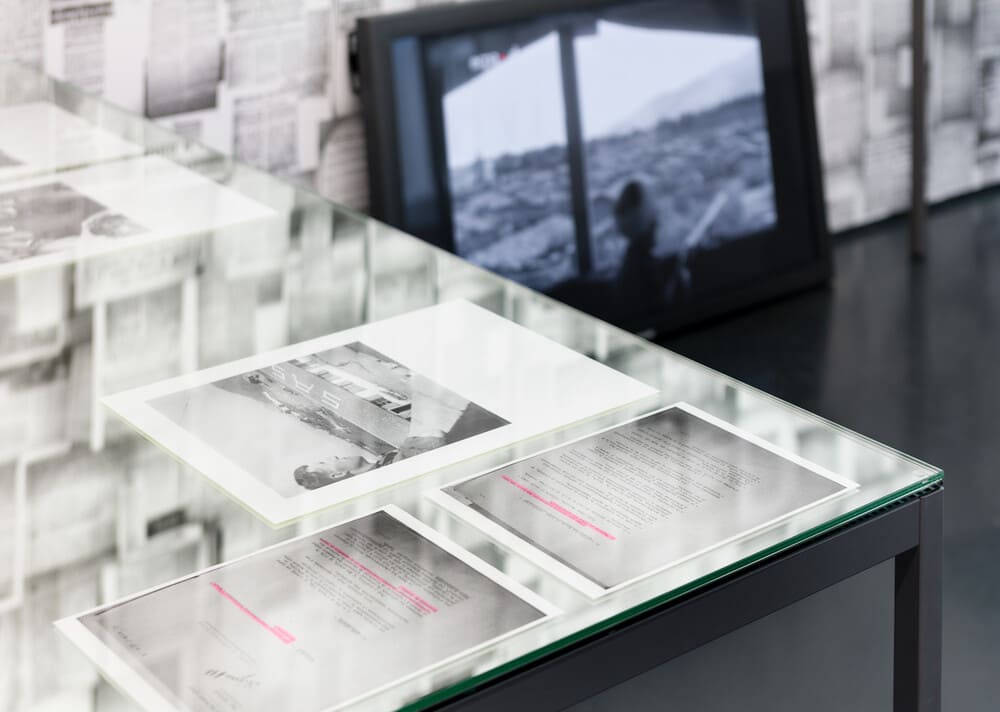
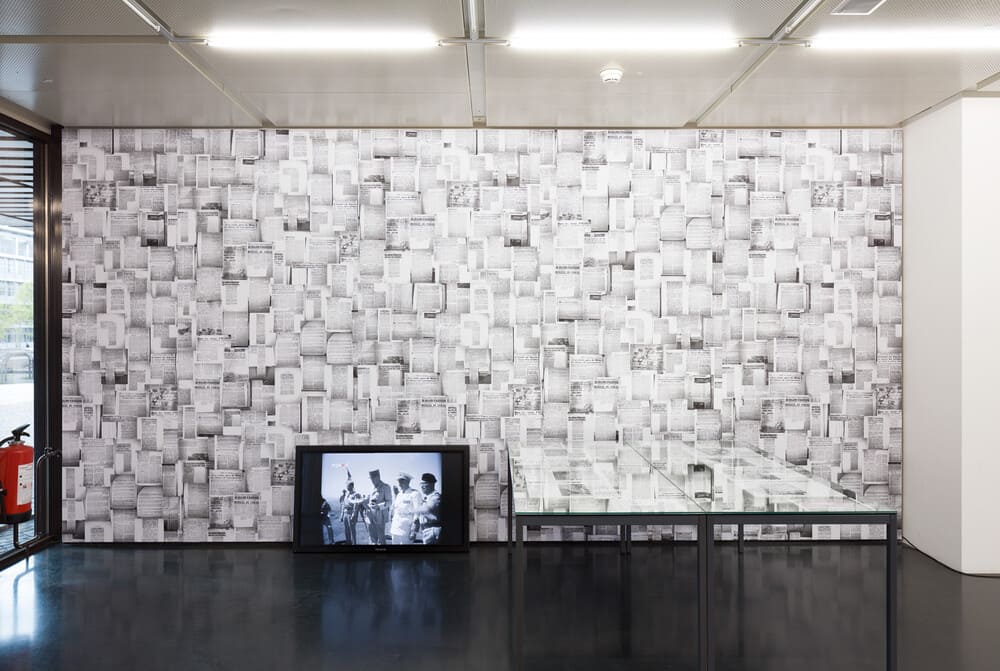
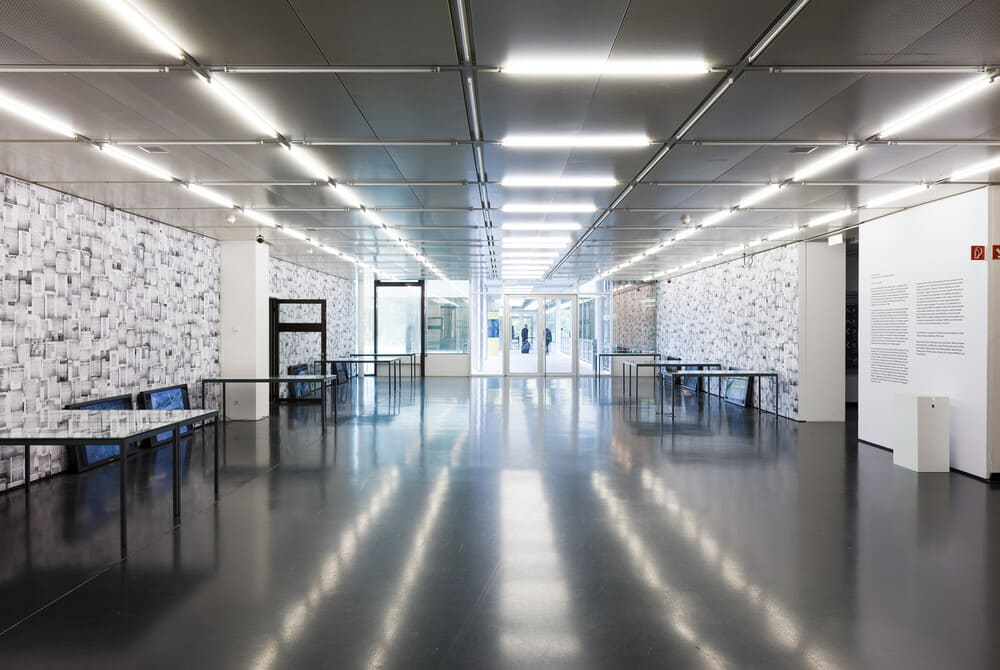
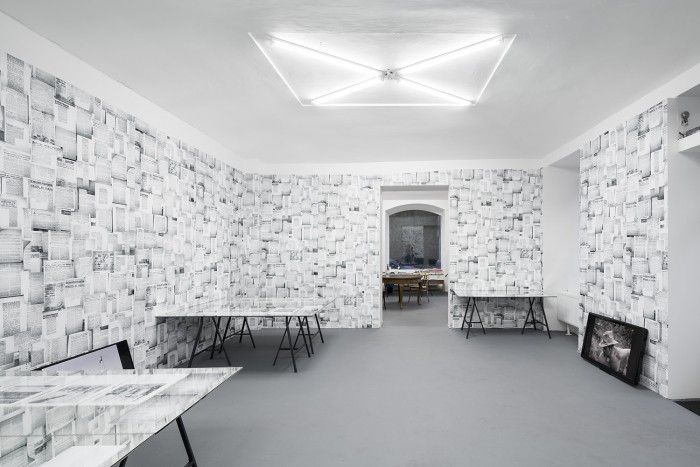
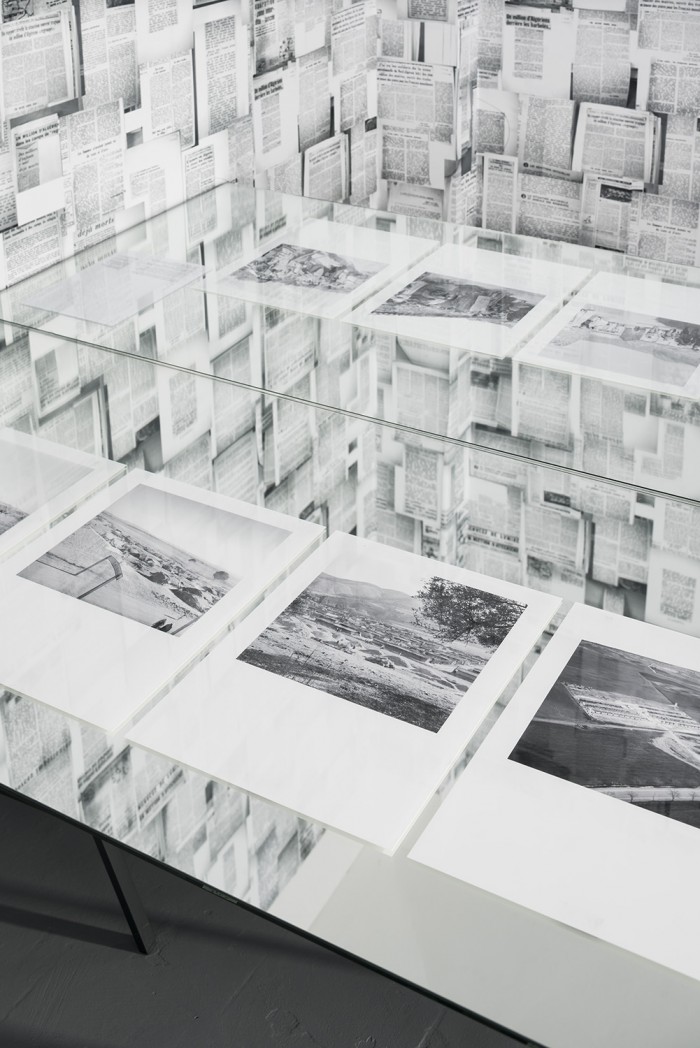
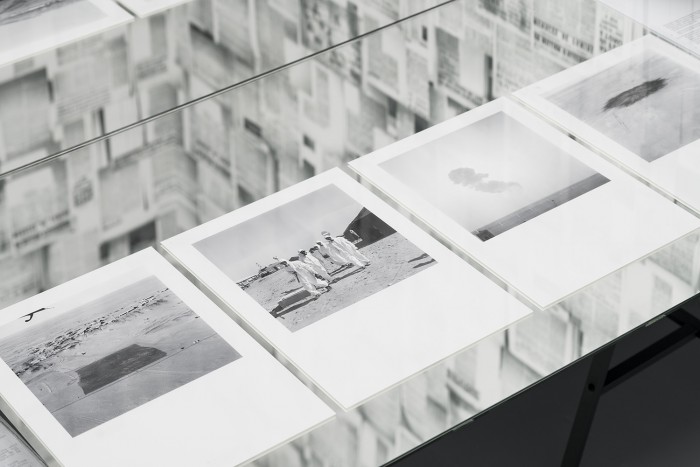
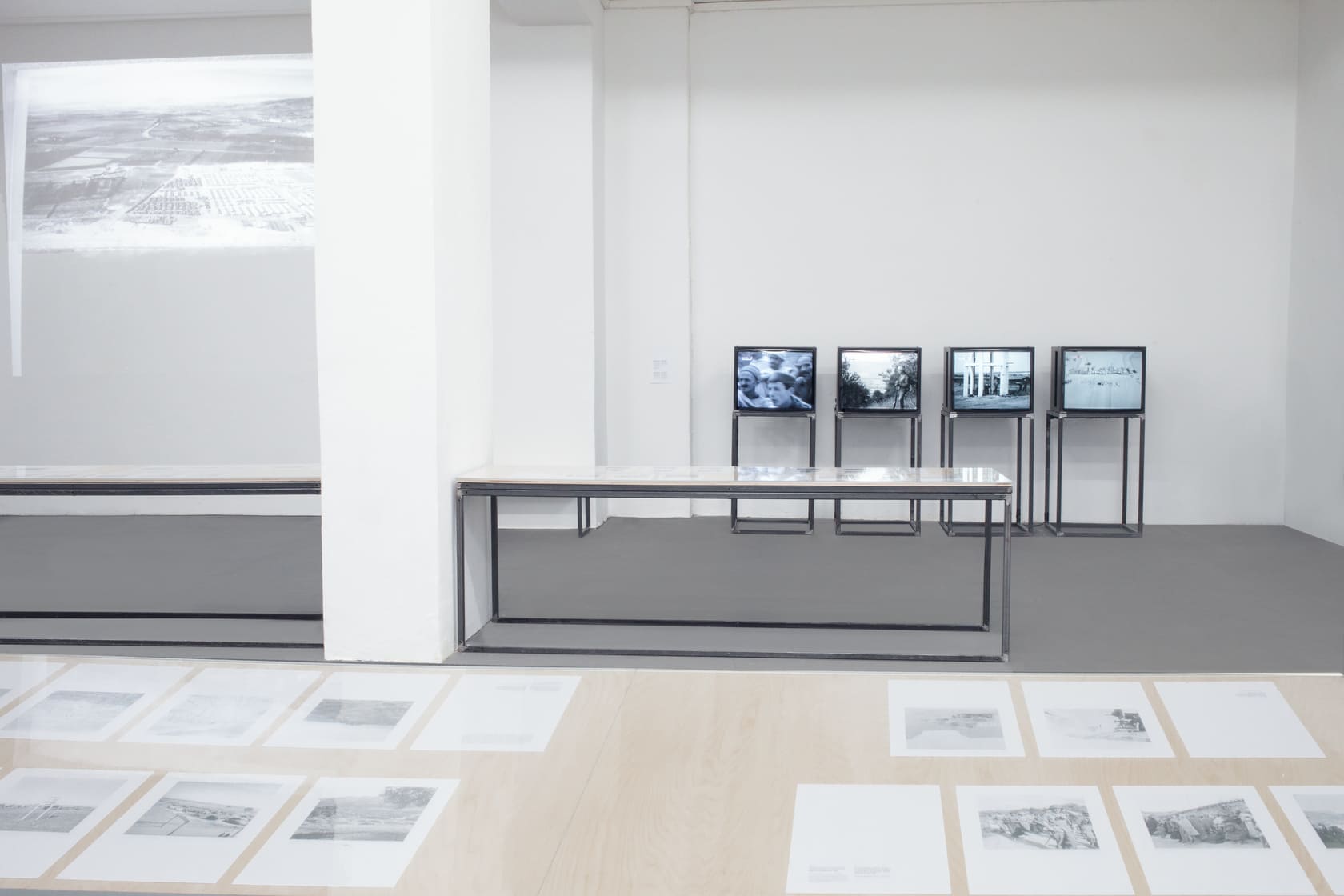
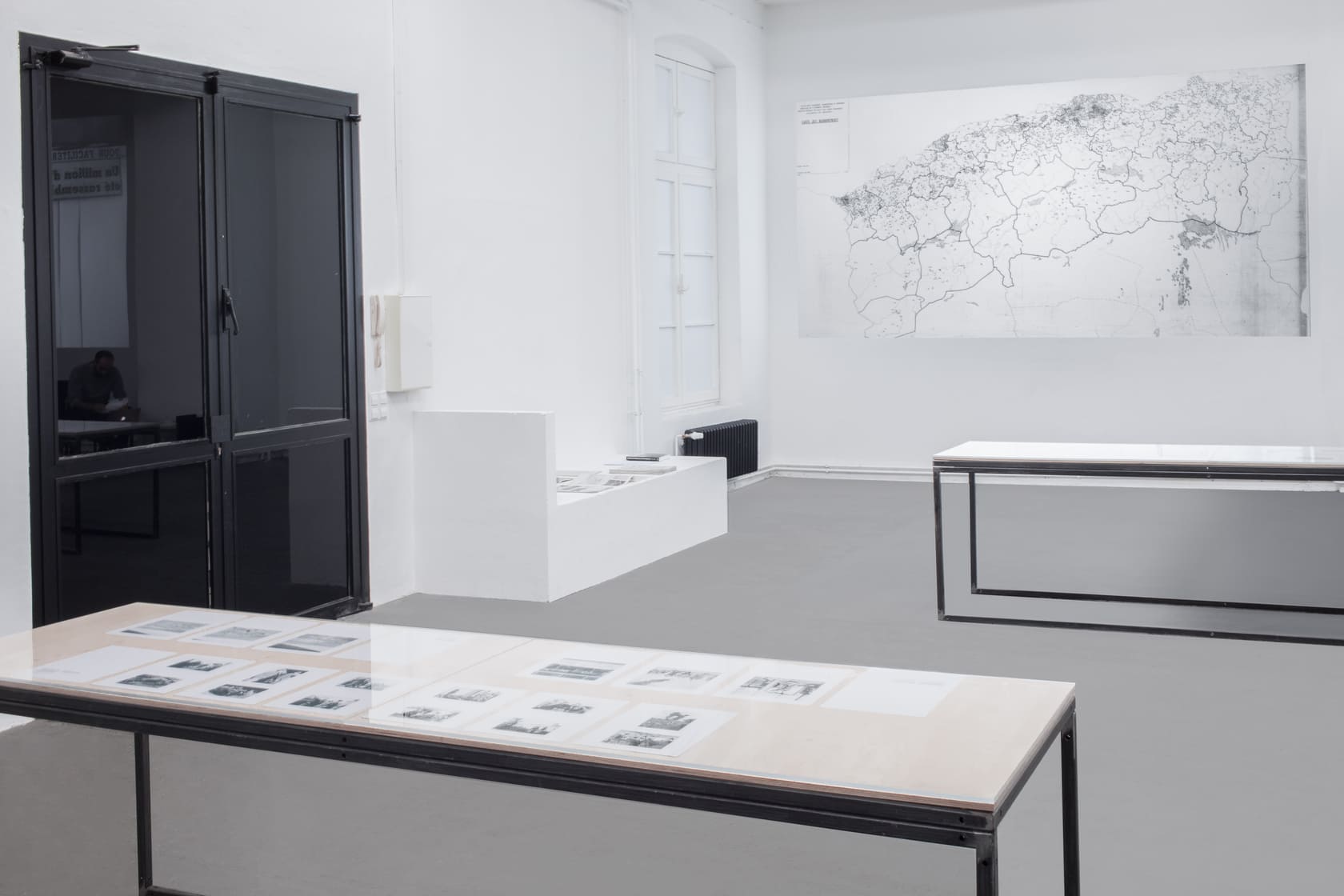
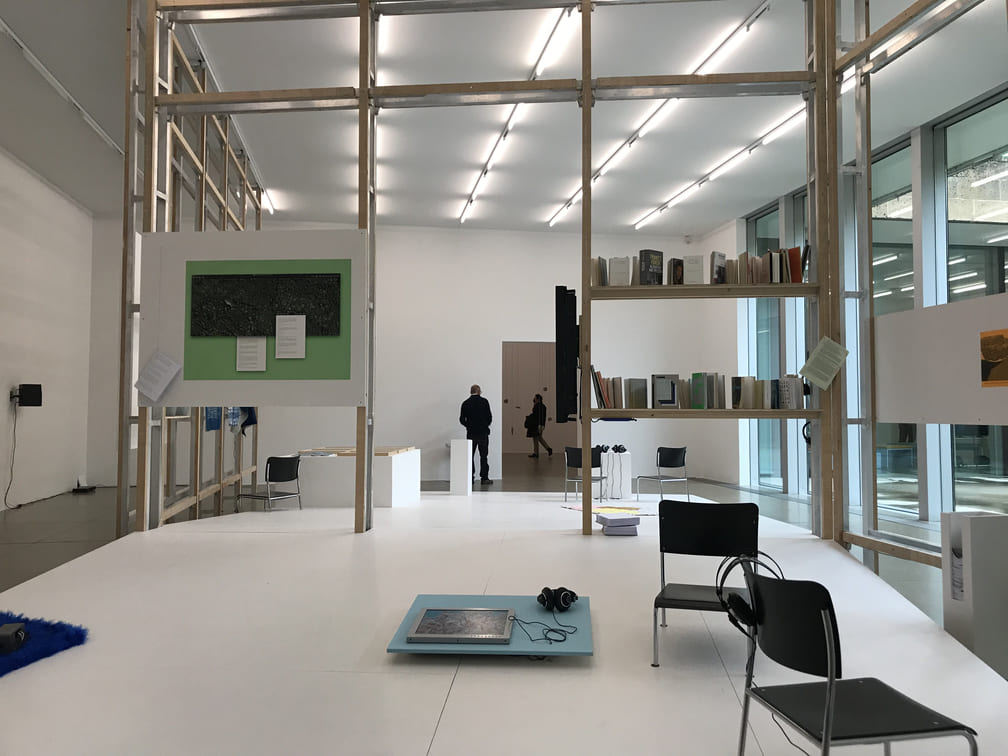
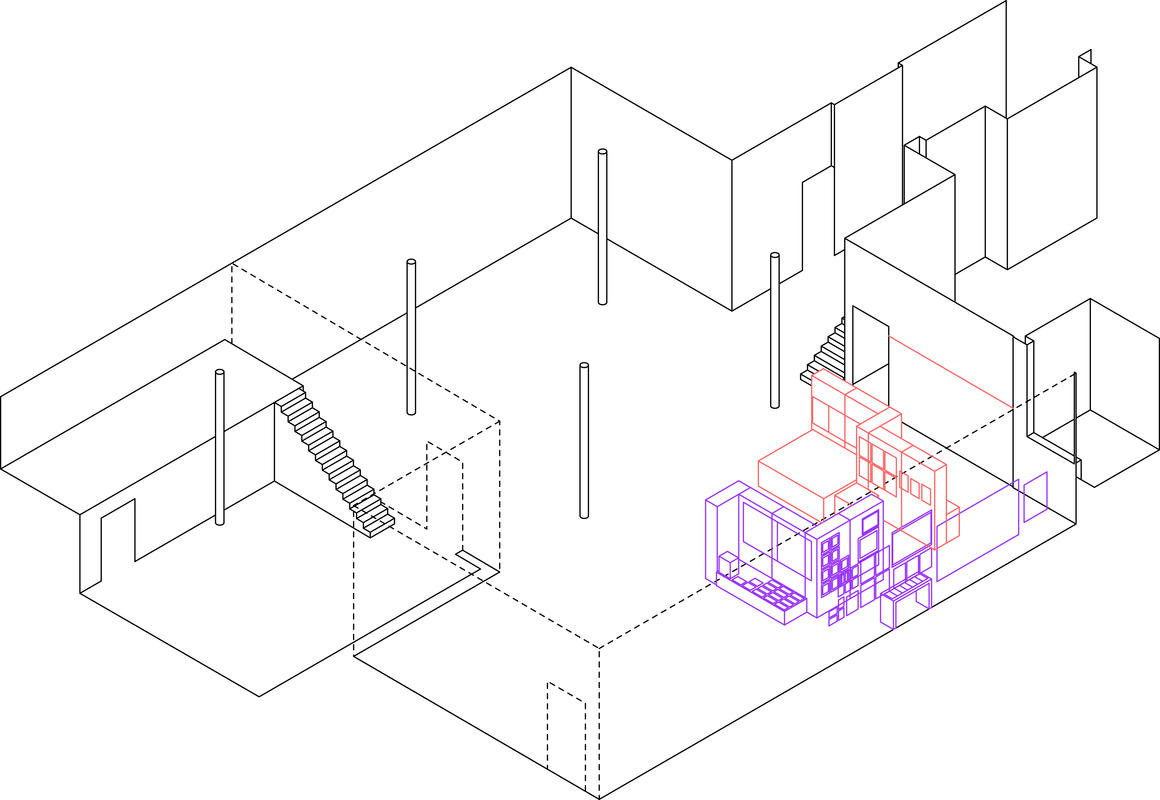
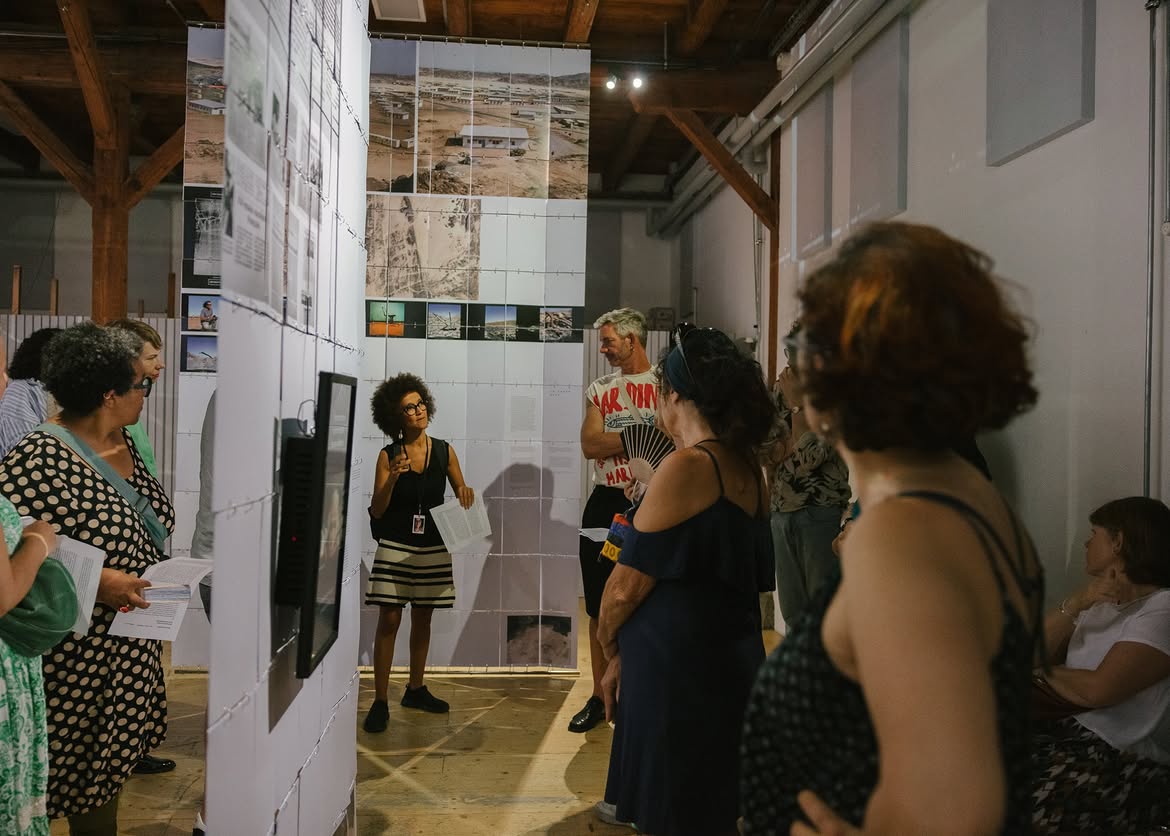
Performing Colonial Toxicity presents available, offered, contraband and leaked materials from these archives in an immersive multimedia installation. It creates with them a series of audio-visual assemblages, which trace the spatial, atmospheric, and geological impacts of France's atomic bombs in the Sahara, as well as its colonial vocabularies, and the (after)lives of its radioactive debris and nuclear waste. Taking on an architectural scale, these 'stations', as Henni refers to them, are meant to be moved through and engaged with. Visitors are invited in to draw their own connections between what is present in the installation, as well as what is absent from it.

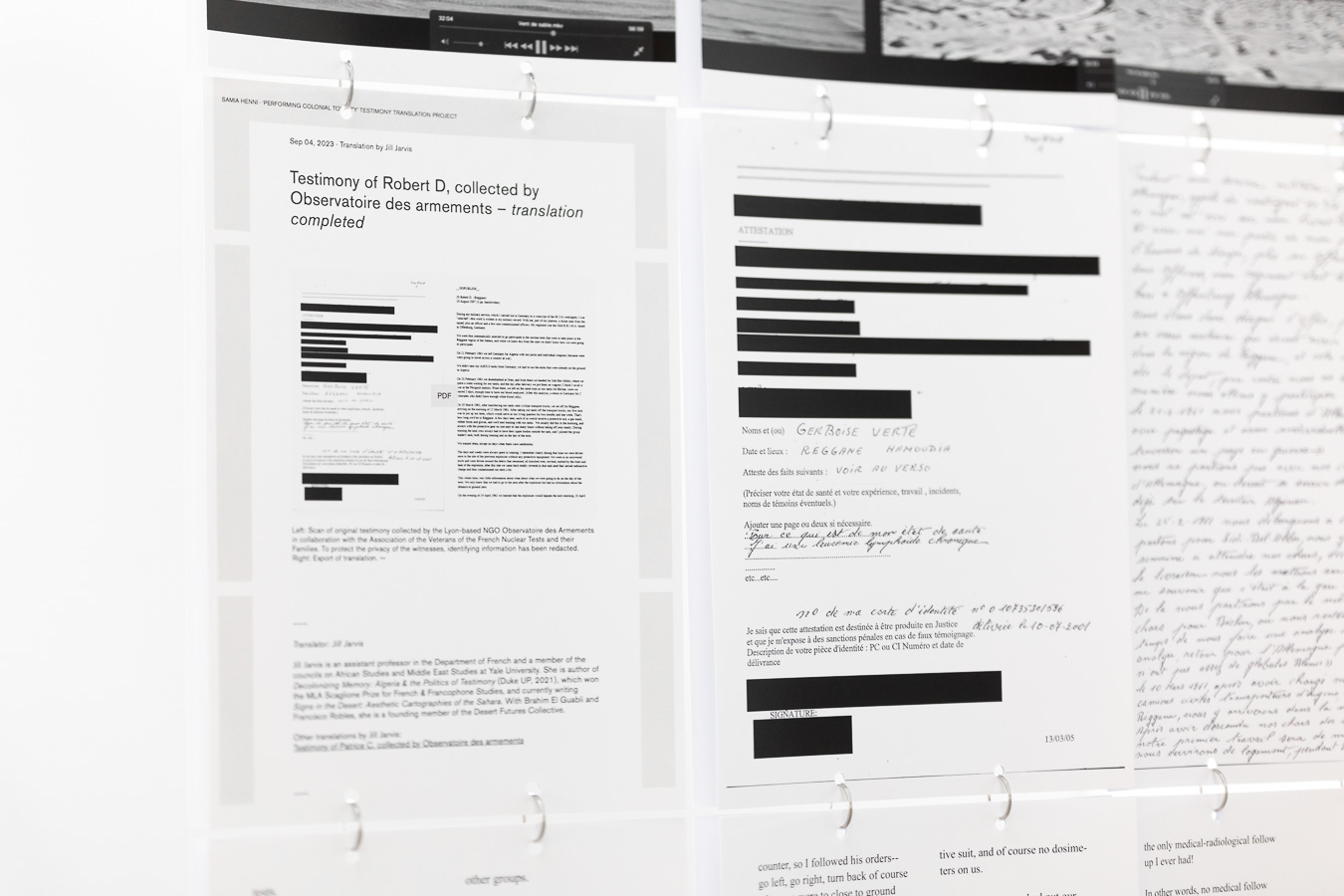
The exhibition emerges from a broader research project, which also includes the publication Colonial Toxicity: Rehearsing French Nuclear Architecture and Landscape in the Sahara and an open access digital database entitled The Testimony Translation Project. Experimenting with different methods of spatialising and circulating suppressed information, the project's three-part structure constitutes a powerful call to action to open the still-classified archives and to clean/decontaminate the sites: both crucial steps for exposing the pasts, presents and futures of colonial toxicity.

Including interviews with Larbi Benchiha, Patrice Bouveret, Roland Desbordes, Bruno Hadjih, Gabrielle Hecht, Penelope Harvey, Jill Jarvis, and Roxanne Panchasi. Many thanks to the translator-participants, including: Raoul Audouin, Adel Ben Bella, Omar Berrada, Megan Brown, Severine Chapelle, Simona Dvorak, Hanieh Fatouree, Alessandro Felicioli, Anik Fournier, Jill Jarvis, Augustin Jomier, Timothy Scott Johnson, Anna Jayne Kimmel, Corentin Lecine, Natasha Llorens, Miriam Matthiesen, Martine Neddam, M'hamed Oualdi, Roxanne Panchasi, and Alice Rougeaux.

In the frame of the research project Performing Colonial Toxicity, investigating the use of the Algerian Sahara as a nuclear firing field by the French state between 1960 and 1966, the architecture-historian has conceived her If I Can't Dance Studio room as a space for the Testimony Translation Project. Here the process begins with digitalising and translating the nearly seven hundred pages of written testimonies from victims of these French nuclear detonation programmes. In the coming four months you can follow the selected documents being activated through a constantly unfolding translation process, engaging participants from around the world.

By Samia Henni
Co-produced by Framer Framed and If I Can’t Dance, I Don’t Want To Be Part Of Your Revolution
Commissioned by Megan Hoetger, If I Can't Dance, I Don't Want to be Part of Your Revolution
2022-23 Biennial, Edition IX: Bodies and Technologies, Amsterdam
Supported by Swiss Arts Council Pro Helvetia
Many thanks to Patrice Bouveret and the collaborators and partners of the Observatoire des armements, Larbi Benchiha, Bruno Hadjih, Elisabeth Leuvrey, Farid Rezkallah, Frederique Bergholtz, Megan Hoetger, the extended If I Can't Dance team, Framer Framed team, and Swiss Art Council's Pro Helvetia Foundation for their support of the project. Deep thanks also go to the interviewees who have generously accepted to share their expertise and experience, including: Larbi Benchiha, Patrice Bouveret, Roland Desbordes, Bruno Hadjih, Gabrielle Hecht, Penelope Harvey, Jill Jarvis, and Roxanne Panchasi, as well as the translator-participants who have committed their time to translating Henni's selection of testimonies, including: Raoul Audouin, Adel Ben Bella, Omar Berrada, Megan Brown, Severine Chapelle, Simona Dvorak, Hanieh Fatouree, Alessandro Felicioli, Anik Fournier, Jill Jarvis, Augustin Jomier, Timothy Scott Johnson, Anna Jayne Kimmel, Corentin Lecine, Natasha Llorens, Miriam Matthiesen, Martine Neddam, M'hamed Oualdi, Roxanne Panchasi, and Alice Rougeaux. And, finally, much appreciation to Marley Jaeda Barnes, Amina Belghiti, Samuel Fuchs, Floriane Germain, Francois Girard-Meunier, Maxime Groslambert, Pamela Hampton Hunsinger, Megan Gail Mueller, Caroline Ann O'Donnell, Roxanne Panchasi, Georg Rutishauser, Sabine Sarwa, Pascal Schwaighofer, Philip Ursprung, Oliver Wyss, Meejin Yoon, and all those who have over the years contributed to the development of this research and who asked to remain anonymous.
2017–22

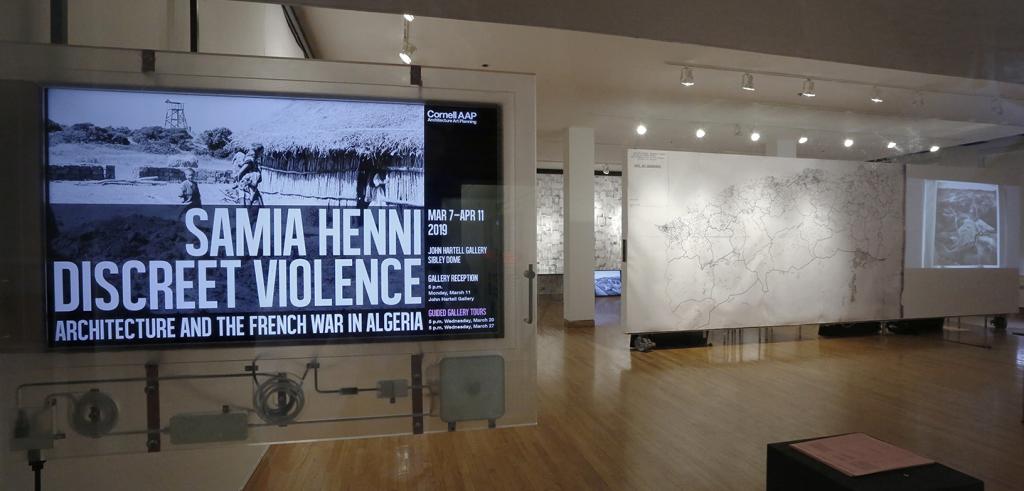
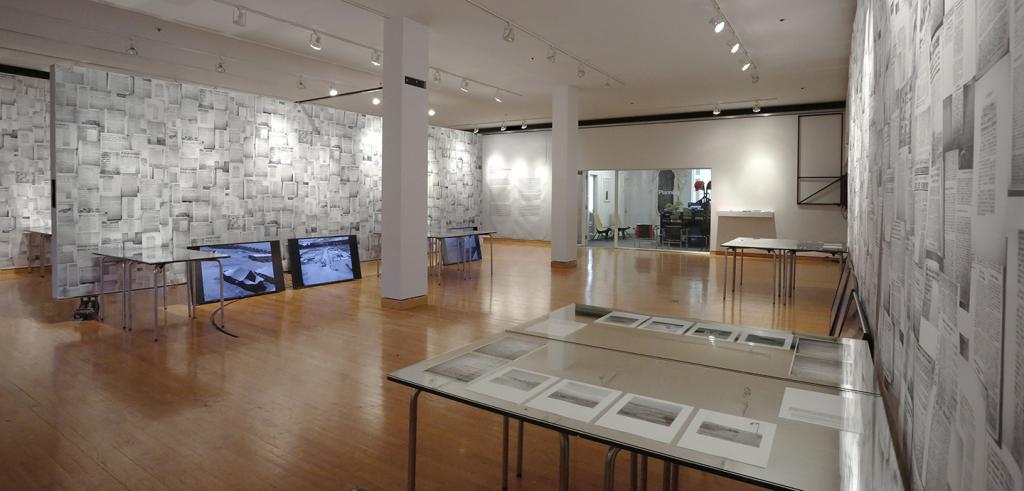
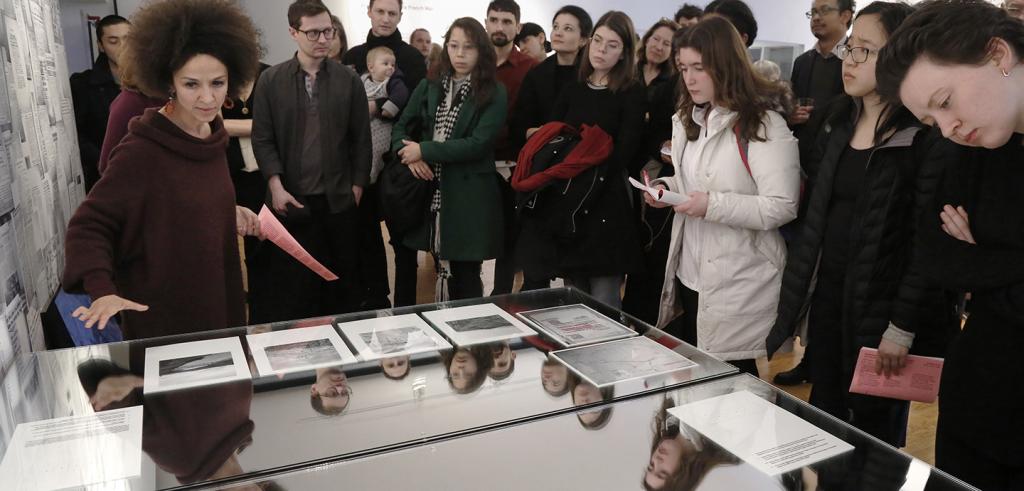
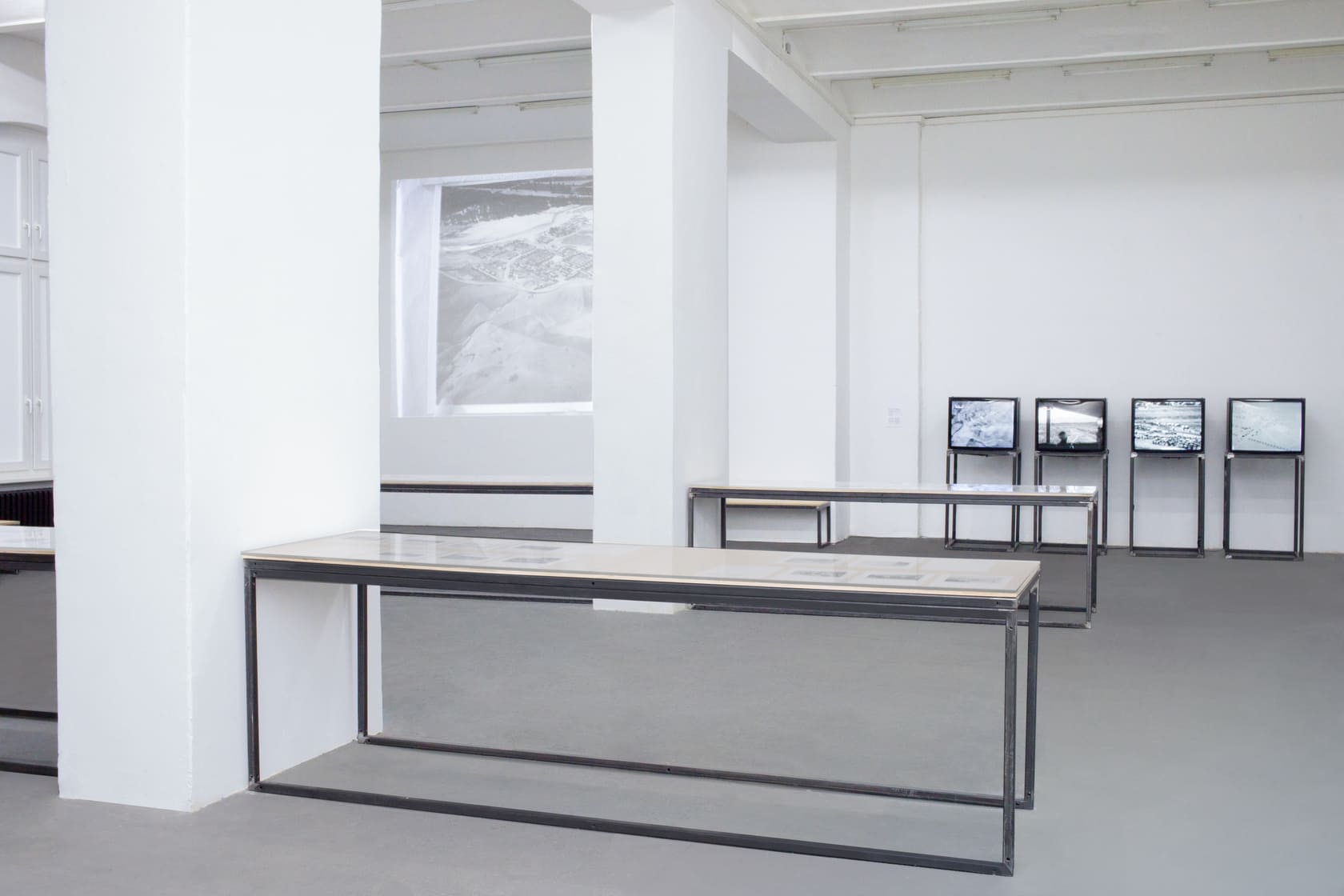
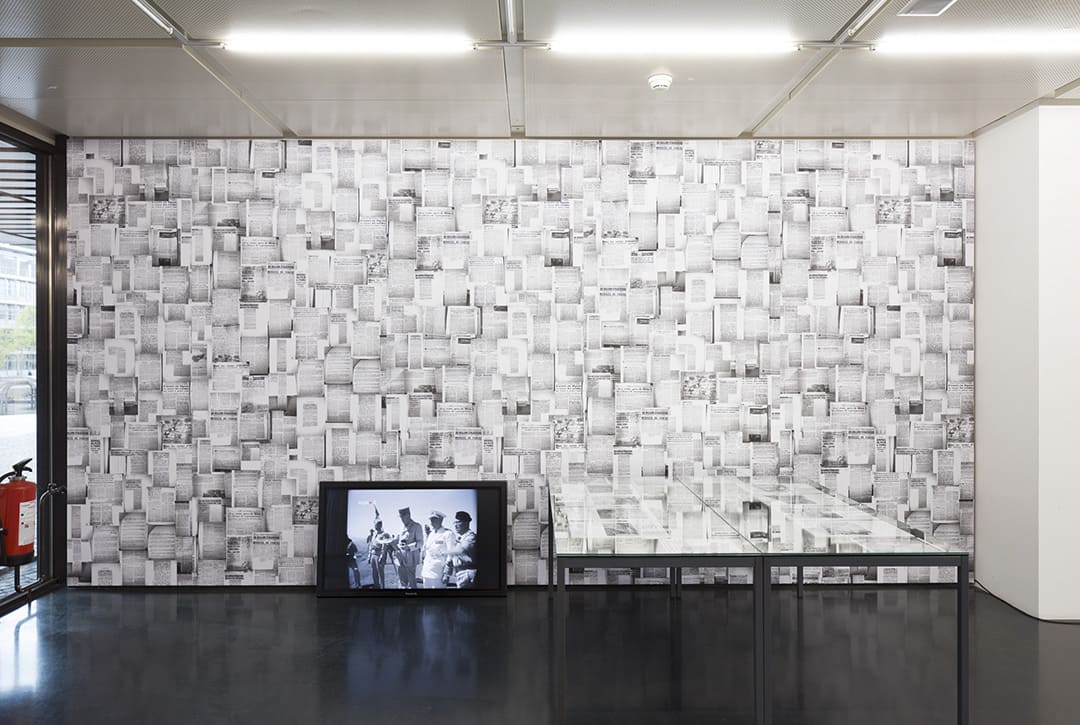
Discreet Violence: Architecture and the French War in Algeria
Travelling exhibition
Zurich · Rotterdam · Berlin · Johannesburg · Paris · Prague · Ithaca · Philadelphia · Charlottesville

During the Algerian Revolution (1954-1962), or the Algerian War of Independence, the French civil and military authorities profoundly reorganized Algeria's urban and rural territory, drastically transformed its built environments, rapidly implanted new infrastructure, and strategically built new settlements in order to keep Algeria under French colonial rule and protect France's interests in Algeria.

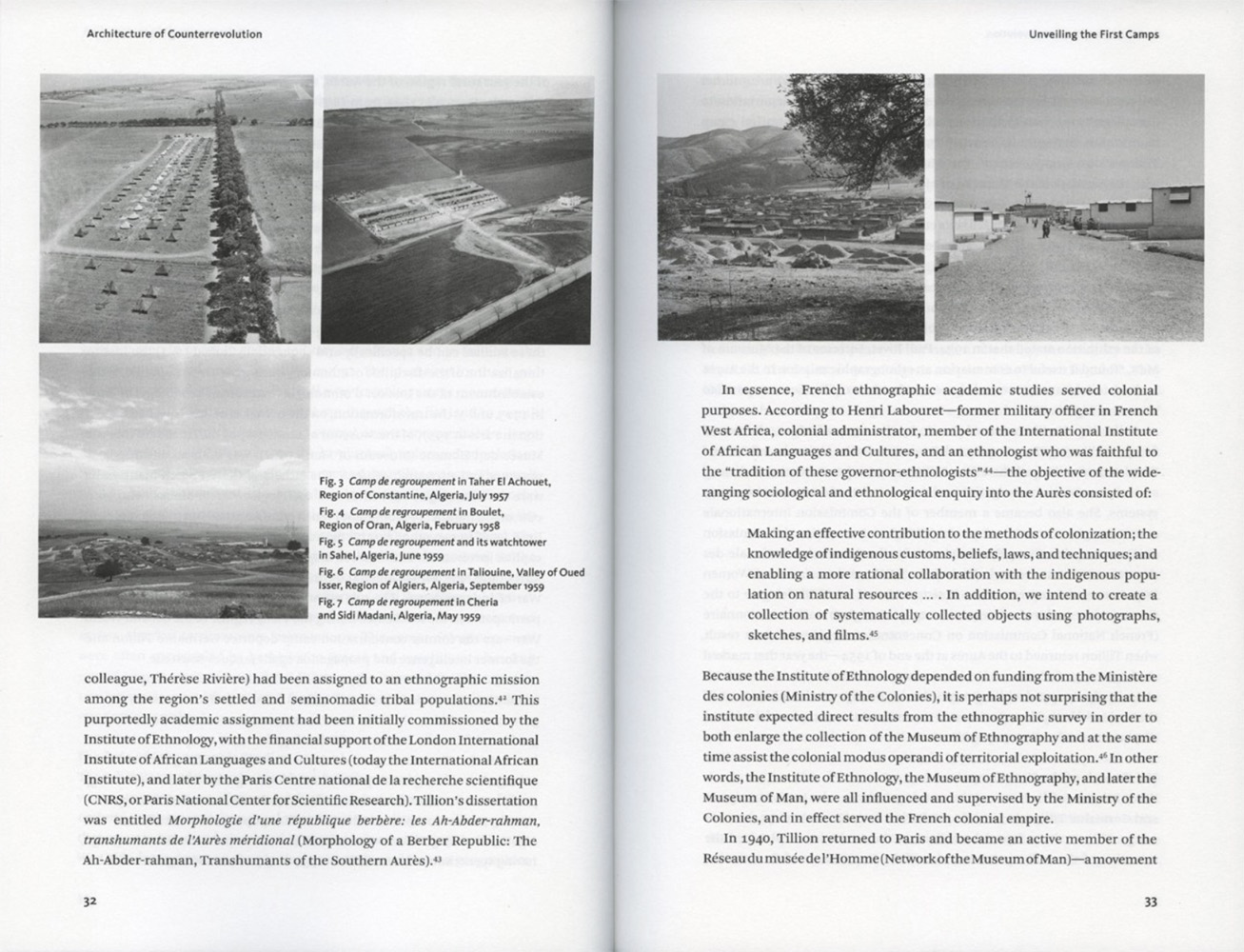
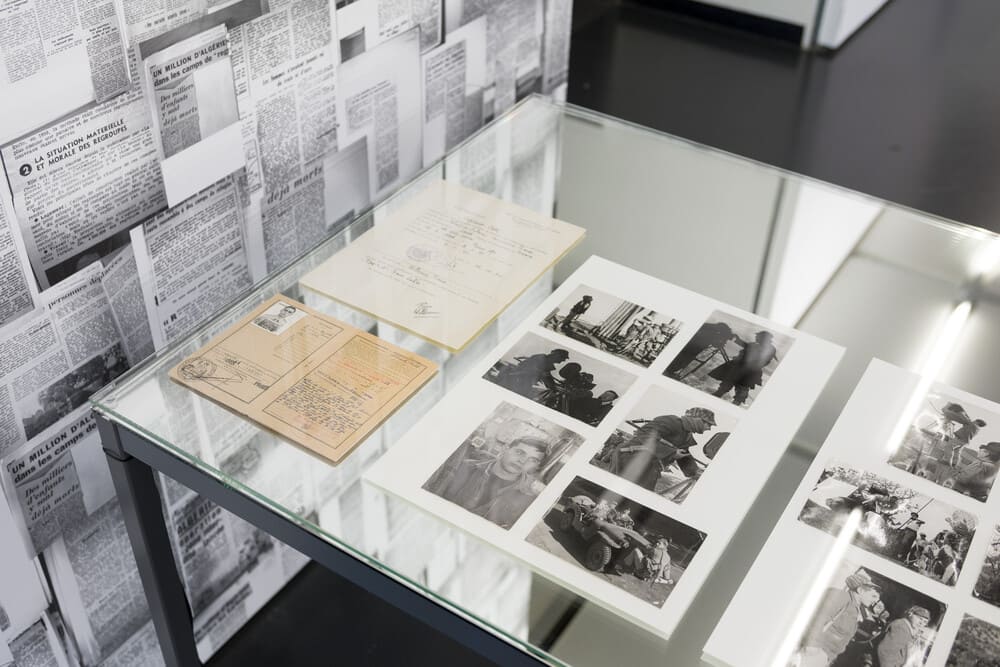
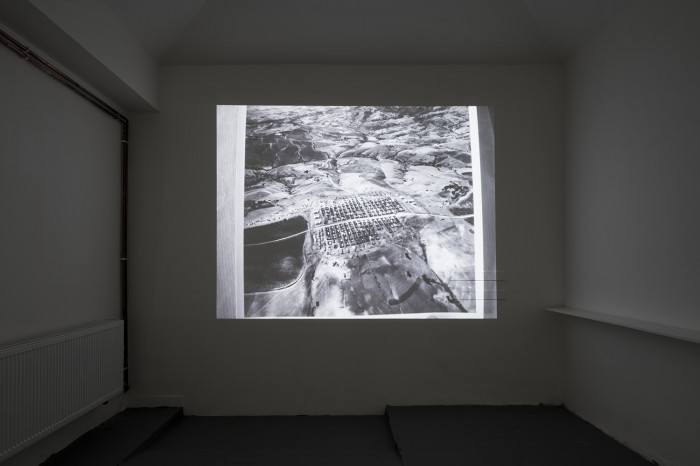
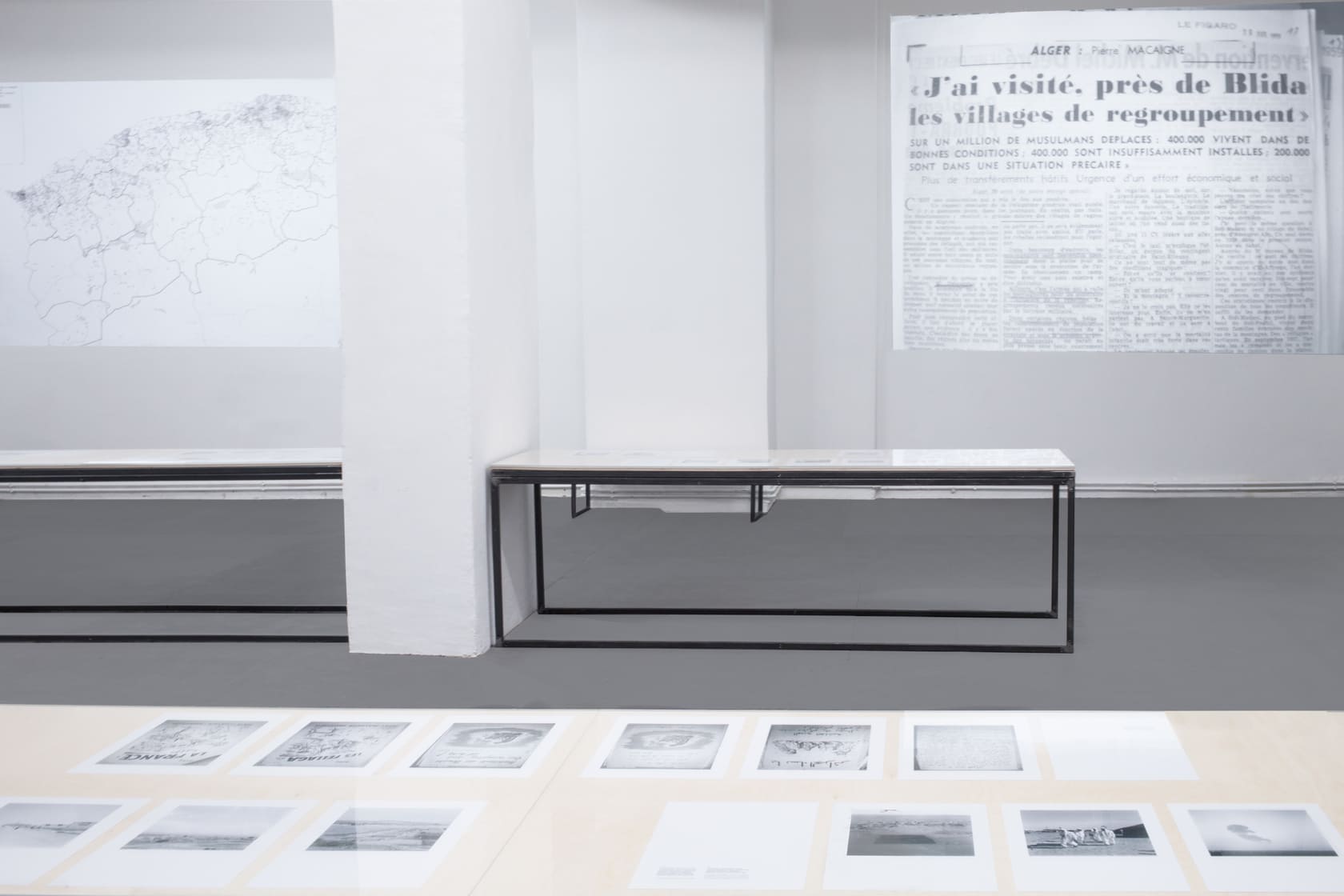
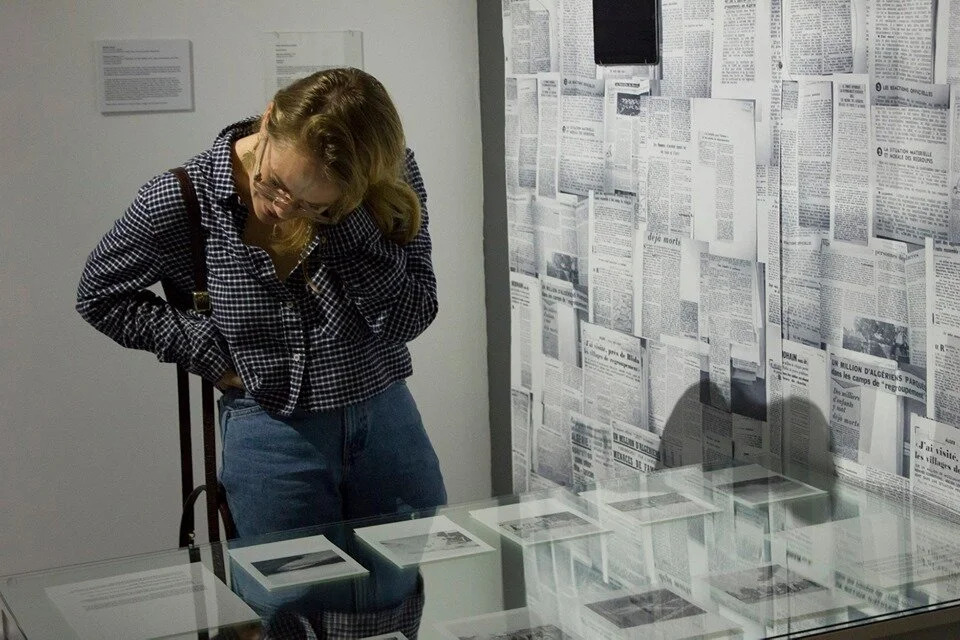
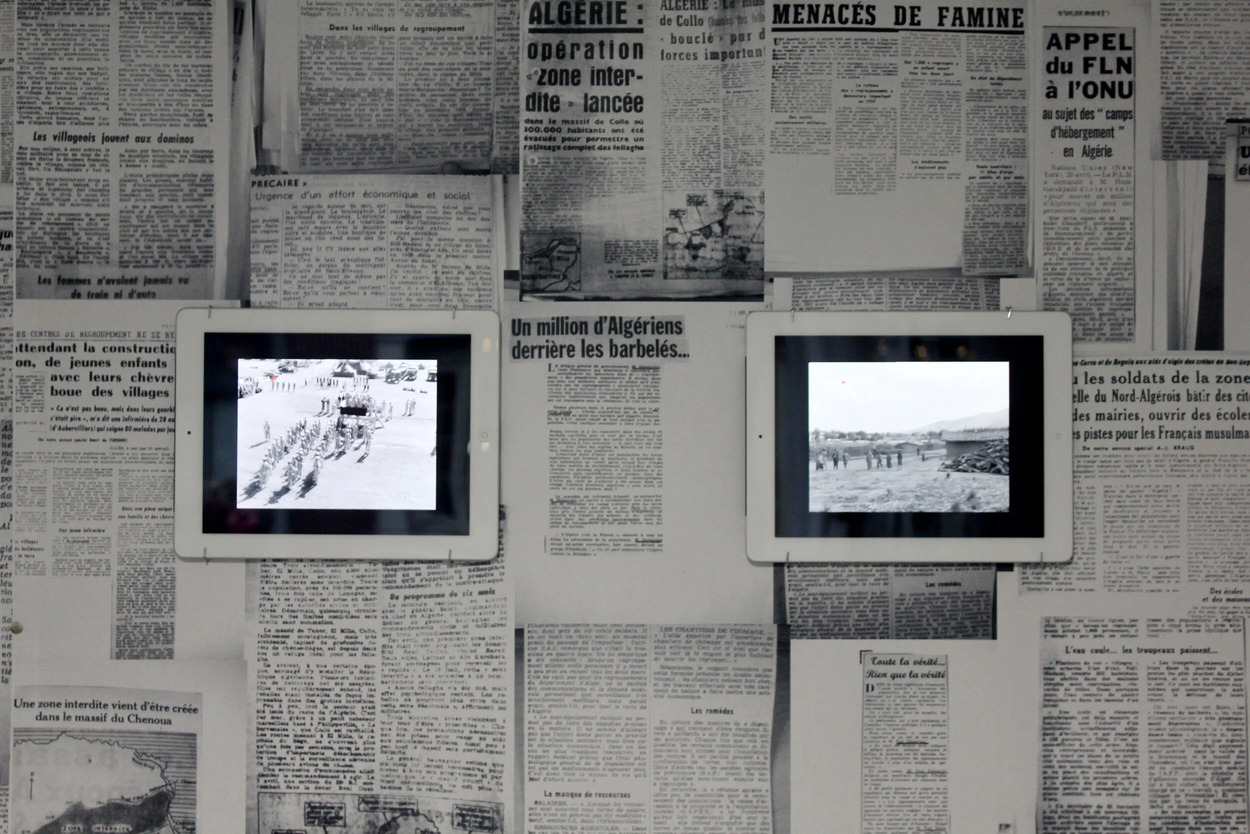
The exhibition features only one aspect of these territorial transformations: the construction of militarily controlled camps dubbed the centres de regroupement in Algeria's rural areas. These spaces resulted from the creation of the forbidden zones (free fire zones) and engendered massive forced relocations of the Algerian population. Special military units called the Sections administratives spécialisées supervised the evacuation of the forbidden zones, the regrouping of the Algerian population, the construction of temporary and permanent camps, the conversion of a number of permanent camps to villages, and monitored the daily life of Algerian civilians. The aim of this regrouping was to isolate the Algerian population from the influence of national liberation fighters and to impede possible psychological and material support.

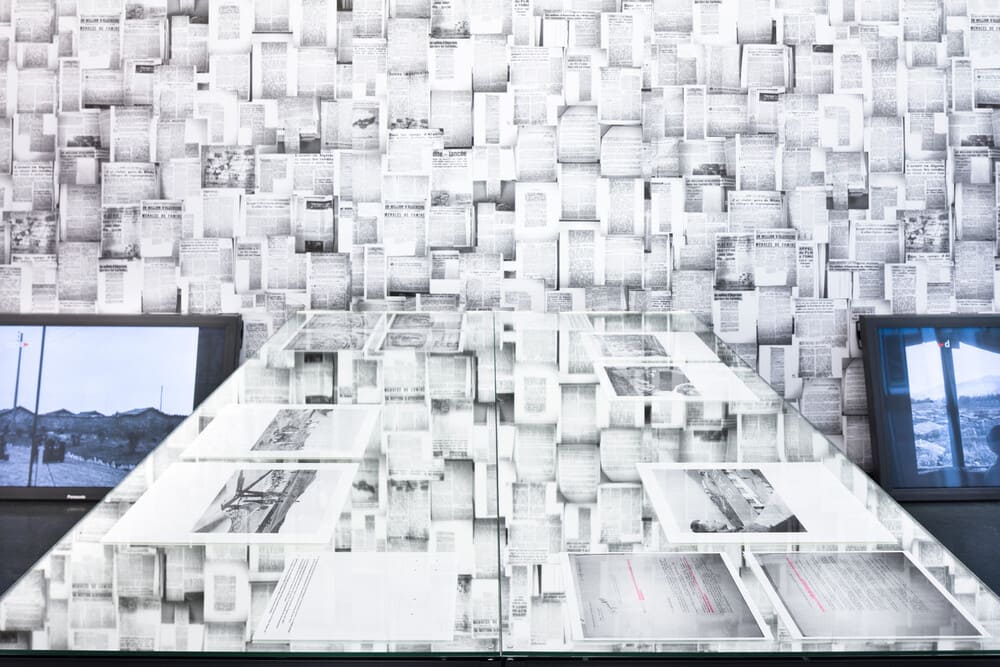
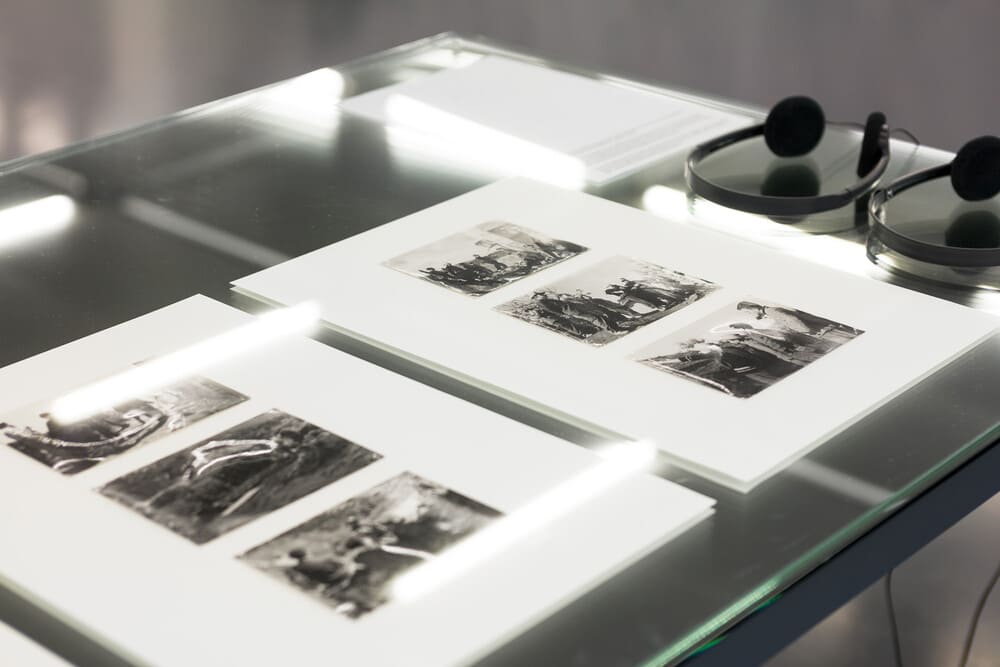
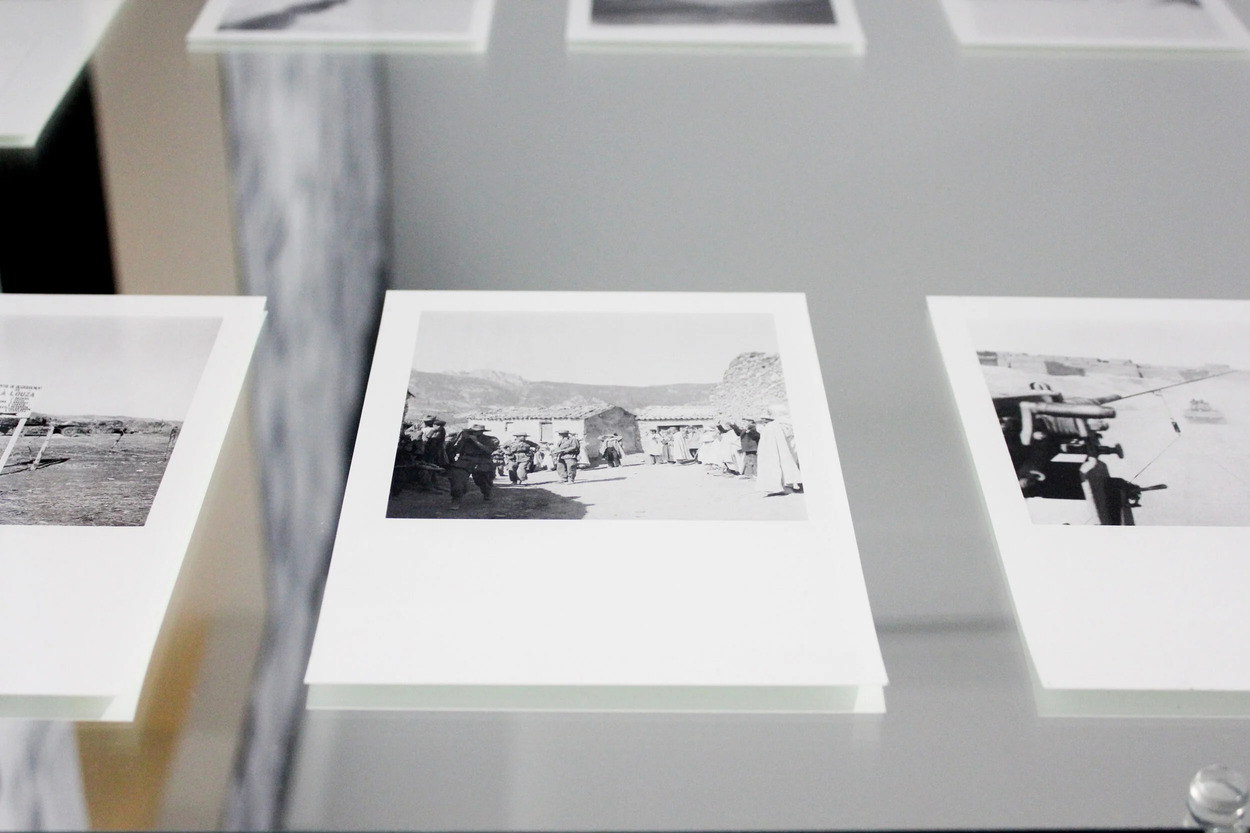
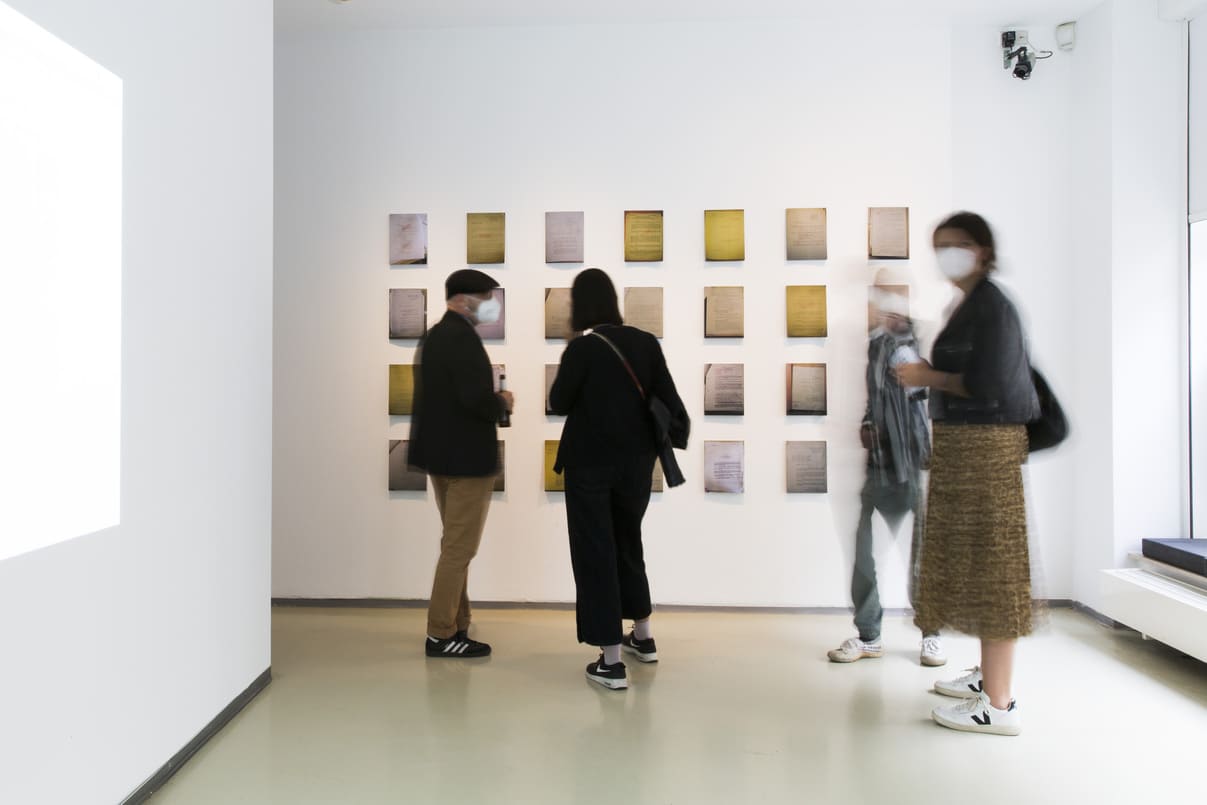
Based on French military photographs and films produced by the propaganda teams of the Service cinématographique des armées (SCA), and other sources, the exhibition Discreet Violence: Architecture and the French War in Algeria features only certain aspects of the evacuation of the Algerian rural population, the building processes of the camps, and the living conditions in the camps. It disclosures the ways with which the French colonial regime attempted to divert the military purpose of the camps in the aftermath of a medial scandal of 1959. The exhibition unfolds the intrinsic relationships between architecture, military measures, colonial policies, and the planned production and distribution of visual records. Today, the SCA is called the établissement de communication et de production audiovisuelle de la défense (ECPAD) and is still active in warzones where the French army is involved.

By Samia Henni
Many thanks to Nadine Attalah, Kader Attia, Guus Beumer, Adrian Brunold, Bruno Sousa Lopes Cancado, Paolo Caffoni, Selin Cebel, Ihwa Choi, Michel Cornaton, Kieran Donaghy, Kevin Dossinger, Luben Dimcheff, Lucas Erin, Patricia Falguieres, Nicolas Ferard, Chiara Figone, Fredi Fischli, Flora van Gaalen, Andre Hafner, Nazim Henni, Alix Hugonnier, Andrea Lee Simitch, Irena Lehkozivova, Lesley Lokko, Rachel M. Marshall, Boitumelo Mazibuko, Lucie Moriceau, Niels Olsen, Ronja Oki, Maria Park, Frank Parish, Lindsay Patrice Lavine, Jana Pavlova, Christopher T. Peppel, Natasa Petresin Bachelez, Lyn C. Pohl, Justine Pontier, Veronique Pontillon, Libby Rosa, Romy Ruegg, Sabine Sarwa, Pascal Schwaighofer, Cagla Sokullu, Joseph Spada, Beth Sprankle, Nadine Schuetz, Daniel Sommer, Barbora Spicakova, Dalila Talhi, Andre Tavares, Philippe Touron, Fred Swart, Philip Ursprung, Damien Vitry, Alexis White, Clement Willemin, Pierre Willemin, Steve Yaros and J. Meejin Yoon.
2022

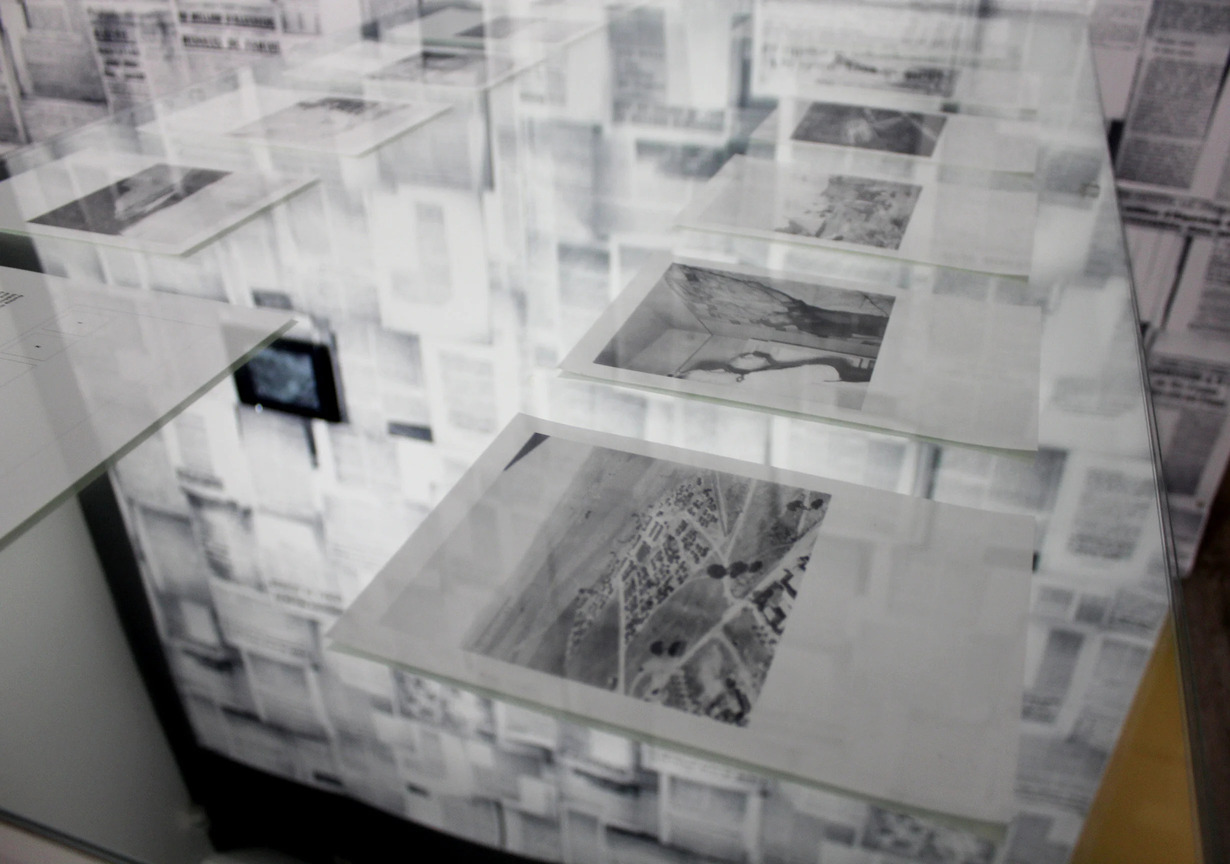
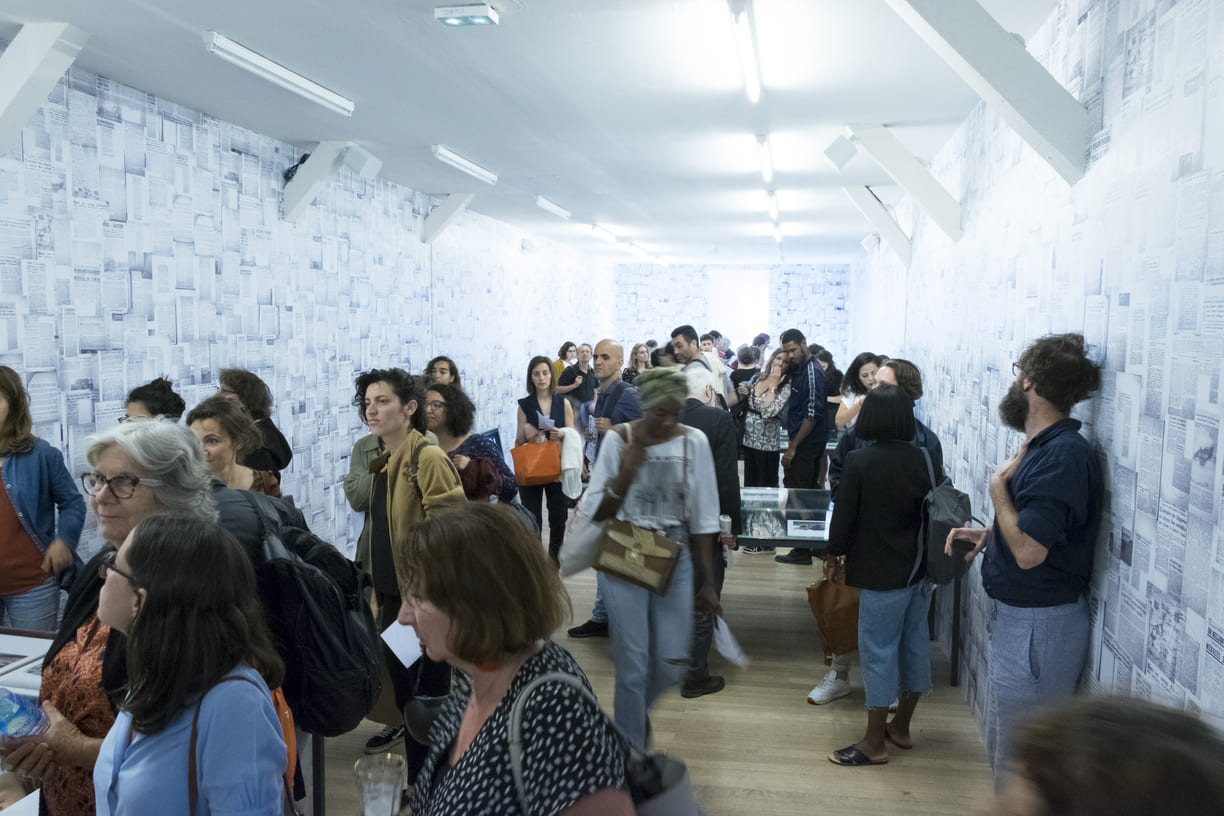
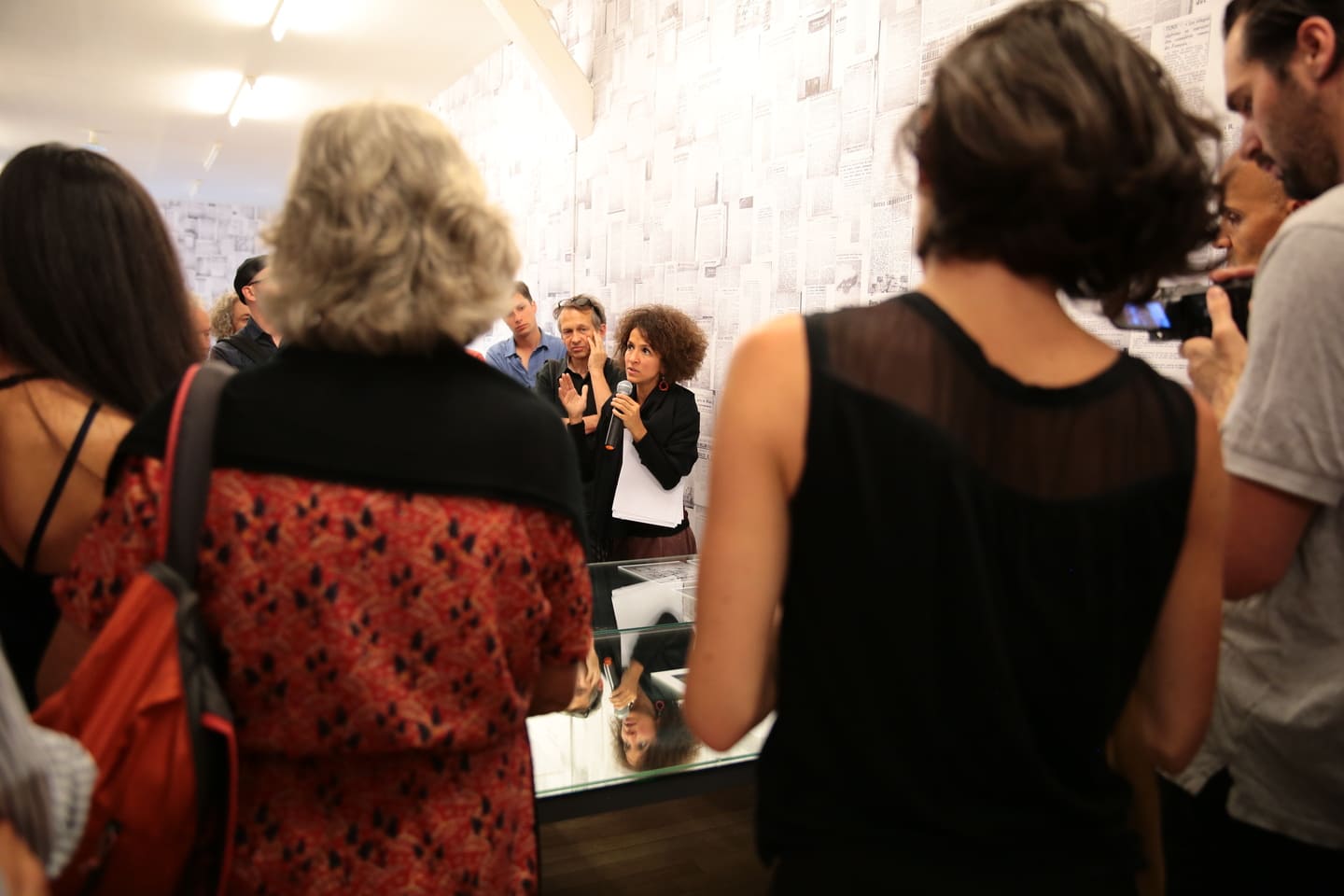
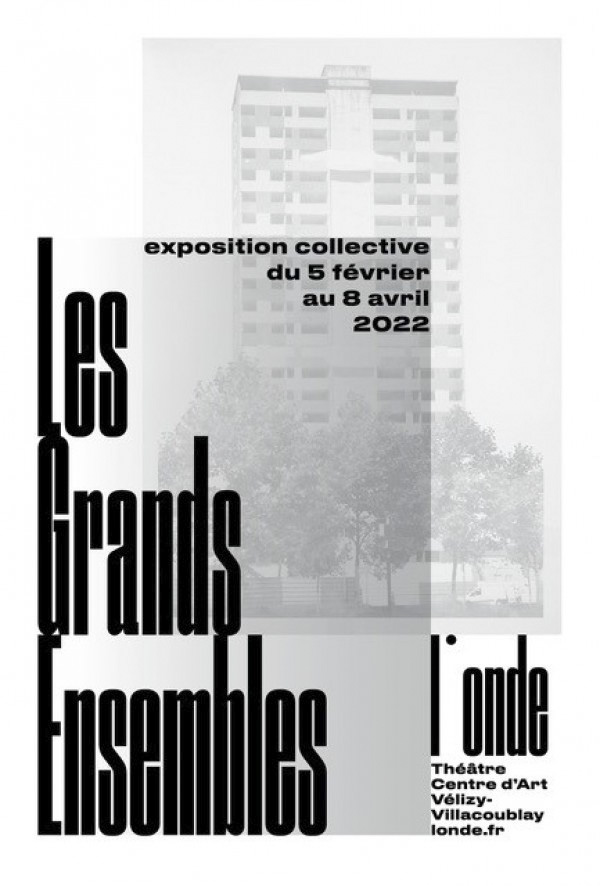
La Pharmacologie du logement

Micro Onde, Centre d'art de l'Onde
Velizy-Villacoublay, France
5 Feb–8 Apr 2022
La Pharmacologie du logement

With Fabienne Albin, Yves Belorgey, Mohamed Bourouissa, Anne-Valerie Gasc, Dan Graham, Samia Henni, Ibai Hernandorena, Thomas Hirschhorn, Valerie Jouve, Bertrand Lamarche, Martha Rosler, Herve Rousseau, SAEIO (1987-2017), Laure Tixier, and the Master students of the Ecole Nationale Superieure d'Architecture de Versailles.

In Les Grands Ensembles
Curated by Leo Guy-Denarcy
2021–22

On Archival Practices

Aargauer Kunsthaus
Aarau, Switzerland
23 Oct 2021–9 Jan 2022

In reaction to the upheavals resulting from the coronavirus pandemic, Art as Connection takes the form of an experimental and open exhibition based on a collective development process.

To open up different perspectives on these unusual times, the curatorial team of the Aargauer Kunsthaus is forming a collective with five artists to develop the exhibition jointly. Together they will reflect the rupture and shock of the crisis and its effects, discuss the significance of art and the structures of the art business, and try out an alternative form of curation. The open form of this project takes account of the uncertainty of our times. A multitude of themes - including isolation, mistrust, authority, globalisation, health, solidarity and community - suggest themselves for further examination in both the art works, most of them newly made and in discussions and events.

With Sabian Baumann and Karin Michalski (An Unhappy Archive Part II with contributions by Paloma Ayala, Sabian Baumann, Dafne Boggeri, Criptonite, Thirza Cuthand, Mirkan Deniz, Feeltank Chicago, Ayoung Kim, Karin Michalski, Naomi Rincon Gallardo, Teatro da Vertigem), Mirkan Deniz, Dreams Come True, Hichmoul Pilon Production and the collective anthropie, Clare Goodwin, Hemauer/Keller, Thomas Hirschhorn, Laura Arminda Kingsley, RELAX (chiarenza & hauser & co), Romy Ruegger (Wunschbibliothek/Wishful Library with contributions by Amal Alhaag, Mohamed Abdelkarim, Noor Abuarafeh, Jasmina Al-Qaisi, Cana Bilir-Meier, Lamin Fofana, Maria Guggenbichler, İpek Hamzaoglu, Samia Henni, Suza Husse, Maria Iorio, Chantal Kueng, Jasmina Metwaly, Miwa Negoro, Maria-Cecilia Quadri, Tina Reden, Kerstin Schroedinger together with Cannach MacBride, Pascal Schwaighofer, Emma Wolf-Haugh), Gregory Stauffer, Max Treier, Rolf Winnewisser.

In Romy Rüegger’s Wishful Library
In Art as Connection, curated by Aargauer Kunsthaus
2021

It Wasn’t a Secret

CIVA
Brussels, Belgium
27 Aug–7 Nov 2021
It Wasn’t a Secret at CIVA

The exhibition Institution Building displays and questions the different elements of a museum - not only the most visible parts (such as the exhibition) but also the less public, often hidden components (such as archive, administration, maintenance). Following a sequential logic of 10 institutional components the exhibition will grow week by week, adding another element and eventually present the institution as a cadavre exquis - a permanently changing organism, constantly on questioning and legitimizing its raison d'etre.

In Institution Building
Curated by Nikolaus Hirsch, Matylda Krzykowski and Cédric Libert
2021

Archive: Secret-Defenses?

ifa Gallery Berlin
Germany
24 Jun–29 Aug 2021

Presented in For the Phoenix to Find its Form in us: On Restitution, Rehabilitation, and Reparation, a collaborative project between SAVVY Contemporary, Jameel Arts Centre Dubai and ifa Gallery Berlin.

At SAVVY Contemporary:
With Basel Abbas & Ruanne Abou-Rahme, Rand Abdul Jabbar, Tanya Aguiniga, Nora Al-Badri, Daniela Zambrano Almidon & Pablo Santacana Lopez, Memory Biwa, Benji Boyadgian, Hamze Bytyci, Nora Chipaumire, Julien Creuzet, Ndidi Dike, Gladys Kalichini, Maurice Mboa, Senzeni Mthwakazi Marasela, Noara Quintana, Michael Rakowitz, Gabriel Rossell Santillan, Akram Zaatari
And Saitabao Kaiyare & Elena Schilling

At ifa Gallery Berlin:
With Pio Abad, Samia Henni, Jumana Manna, Oumar Mbengue Atakosso, Bhavisha Panchia, Michael Rakowitz

Curated by Alya Sebti
In For the Phoenix to Find its Form in us: On Restitution, Rehabilitation, and Reparation, curated by Bonaventure Soh Bejeng Ndikun, Elena Agudio, Arlette-Louise Ndakoze (SAVVY Contemporary), Nora Razian and Rahul Gudipudi (Jameel Arts Centre), Alya Sebti (ifa Gallery Berlin)
Commissioned by ifa Gallery Berlin and SAVVY Contemporary
2021

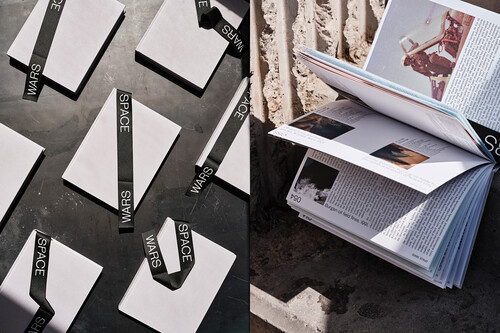
Space War

Kuwait Pavilion
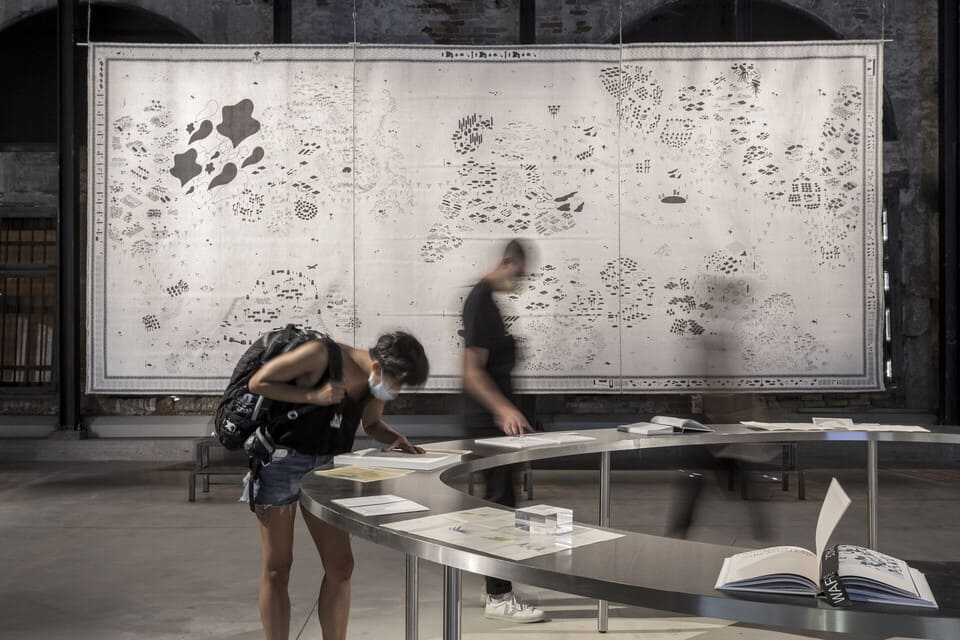
Venice Biennale
21 May–21 Nov 2021

Contribution to the Kuwait Pavilion at the 17th International Architecture Exhibition of La Biennale di Venezia.

Curated by Yousef Awaad, Saphiya Abu Al-Maati, Asaiel Al Saeed and Aseel Al Yaqoub
2020

Unhoused

gta Exhibitions, ETH Zurich
Switzerland
15 Oct–18 Dec 2020

Confinement is a collaborative exhibition taking place both online at e-flux Architecture and on site at ETH Zurich, curated by gta exhibitions (Fredi Fischli, Simona Mele, Niels Olsen, Irma Radoncic, Meghan Rolvien, Sara Sherif, and Jeremy Waterfield) and e-flux Architecture (Nick Axel and Nikolaus Hirsch), featuring contributions by 2A+P/A, David Adjaye, Chino Amobi, Aristide Antonas, Armature Globale, Alessandro Bava and Lydia Ourahmane, Inside Outside / Petra Blaisse, Andrea Branzi, Rebecca Choi and Roland Bedford, Design Earth, Dogma, Pezo von Ellrichshausen, Joana de la Fontaine, Manuel Gnam, Itsuko Hasegawa, Trix & Robert Haussmann, Samia Henni, Andres L. Hernandez, Momoyo Kaijima, Michel Kessler, Semuel Lala, Leopold Lambert and Roanne Moodley, William Leavitt, MAIO, Catherine Malabou, MILLIONS, Freek Persyn, Pedro Pitarch, Space Popular, sub and Celeste Burlina, Emmanuel Pratt, Smiljan Radic, Jack Self, Traumnovelle, Sumayya Vally, Jan de Vylder and Inge Vinck, Jakob Walter, Eyal Weizman, SITE - James Wines, Ilze Wolff, Lydia Xynogala, Alberto Lule, Savannah Ramirez, Rosie Rios, Nathaniel Whitfield and more.

In Confinement
Curated by gta exhibitions (Fredi Fischli, Simona Mele, Niels Olsen, Irma Radoncic, Meghan Rolvien, Sara Sherif, and Jeremy Waterfield) and e-flux Architecture (Nick Axel and Nikolaus Hirsch)
2020

Housing Pharmacology

Museum of Marseille History
Marseille, France
11 Sept–29 Nov 2020

"Pharmacology" is a condition that stipulates both poison and remedy. Drawing on Jacques Derrida's essay, Plato's Pharmacy, which proposed that writing is a pharmakon, Bernard Stiegler theorized and broadened the idea of "pharmacology" to incorporate a political analysis of and intervention into exploitative capitalist systems and the destructive tendencies of consumerist societies. Following from Stiegler, "pharmacology" can thus inform the ethics and politics of care.

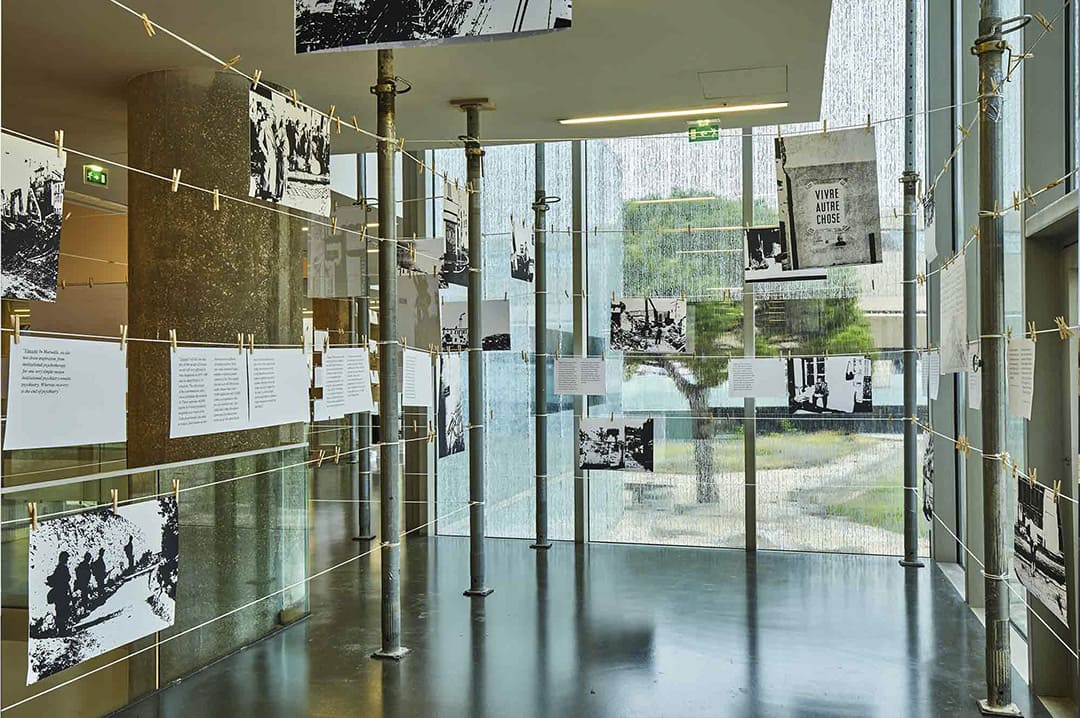
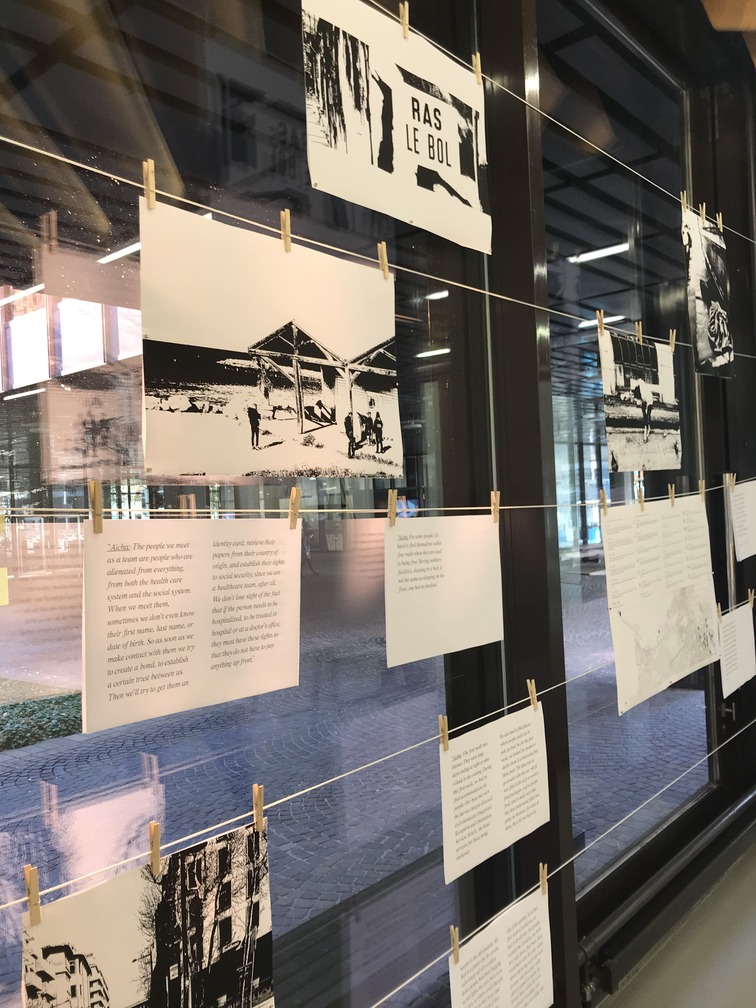
Based on various conversations with Marseille's inhabitants after the lockdown was lifted in France, Housing Pharmacology exposes and juxtaposes the poisons and cures that the presence or absence of dwellings engendered in Marseille's neighbourhoods. It reflects on the histories of the right to housing as well as human lives and deaths, examines the conditions of the unhoused in the streets of Marseille, scrutinises the status of democratic psychiatry and housing environments, questions the role that the built environment plays in guaranteeing self-care and self-subsistence and digs into the housing policies for migrant workers who participated in France's housing construction industry and rapid economic growth during Les Trente Glorieuses (The Glorious Thirty), the thirty years from 1945 to 1975 following the Vichy Regime and World War II.

Housing Pharmacology offers multiple fragments and competing visions about Marseille's spatial inclusions and exclusions through lived experiences, audiovisual records and published sources that interrogate the past and aspire to a more viable future. It ultimately endeavours to create potential traits d'union.s between story-telling and history-writing, between the duties of institutions and the rights of human beings.

Many thanks to Noureddine Abouakil, Monique Blanc, Claire Bonnet, Fathi Bouaroua, Aicha Boutayeb, Fabrice Denise, Thomas Engelbert, Frantz Fanon, Flora Fettah, Vincent Girard, Habib, Hani Henni, Kamar Idir, Lukas Kueng, Marina Otero Verzier, Bernard Nos, David Penaguilla, Police officer, Iris Rennert, Jérome Rieder, Alya Sebti, Laura Spica, Erik Schieweck, Pascal Schwaighofer, Bernard Stiegler, Dalila Talhi, Tatiana Tarrago, and Charlie C. Thomas.

Curated by Alya Sebti
Commissioned by Manifesta 13 Marseille
In Trait.s d’union, Manifesta 13, curated by Alya Sebti, Katerina Chuchalina and Stefan Kalmár
Supported by Ammodo, Drosos Foundation and Pro Helvetia
Voices: Fathi Bouaroua, Aicha Boutayeb, Vincent Girard, Habib, police officer, Laura Spica, Vendredi 13 (Monique Blanc, Bernard Nos)
Audio editing: Samia Henni
Audio postproduction and installation: Iris Rennert
Photographs: Aicha Boutayeb, Samia Henni, Kamar Idir, Vendredi 13, various archives
Publication: Samia Henni (texts editing), Laura Spica (copyediting), Flora Fettah (proofreading), Good and Cheap Art Translators (Translation), Anbar Oreizi-Esfahani (Mapping), ékho studio (Claire Bonnet, Charlie C. Thomas: Graphic concept, typesetting and design)
2020

Right to Housing

Grobet-Labadié Museum
Marseille, France
28 Aug–29 Nov 2020

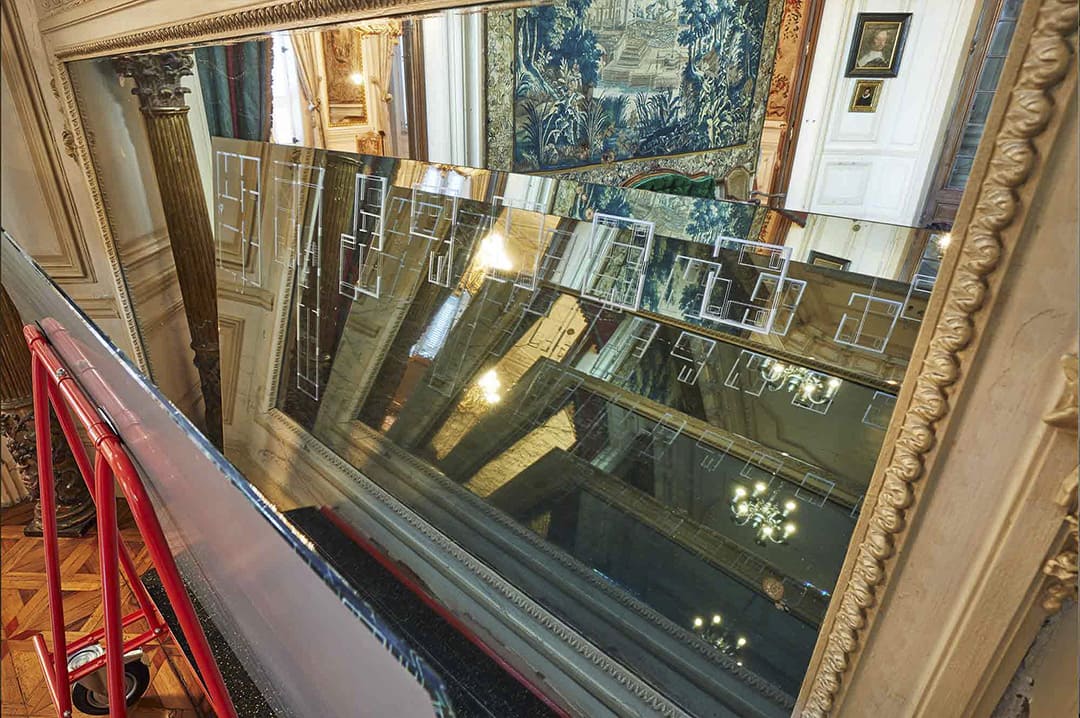
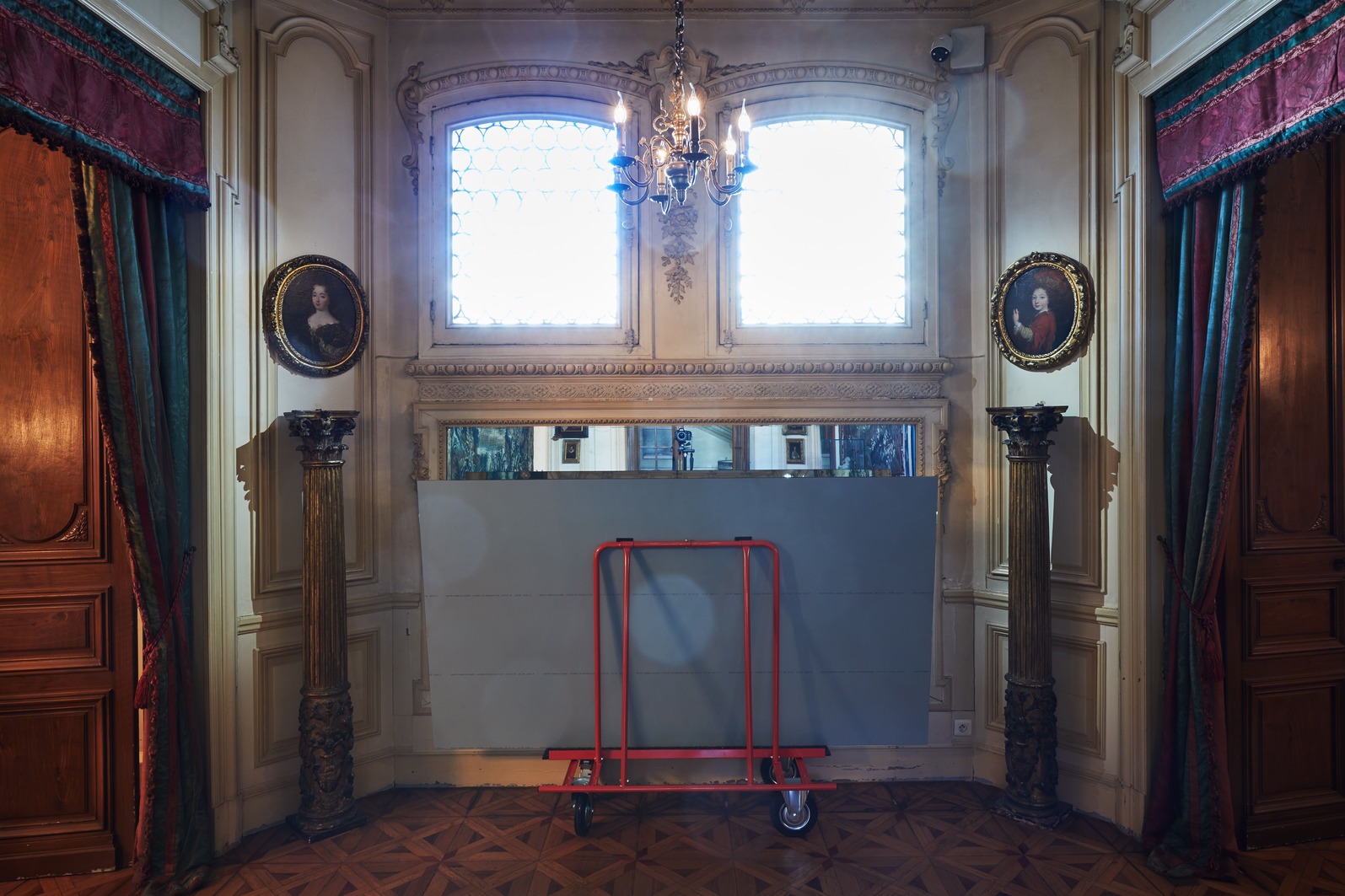
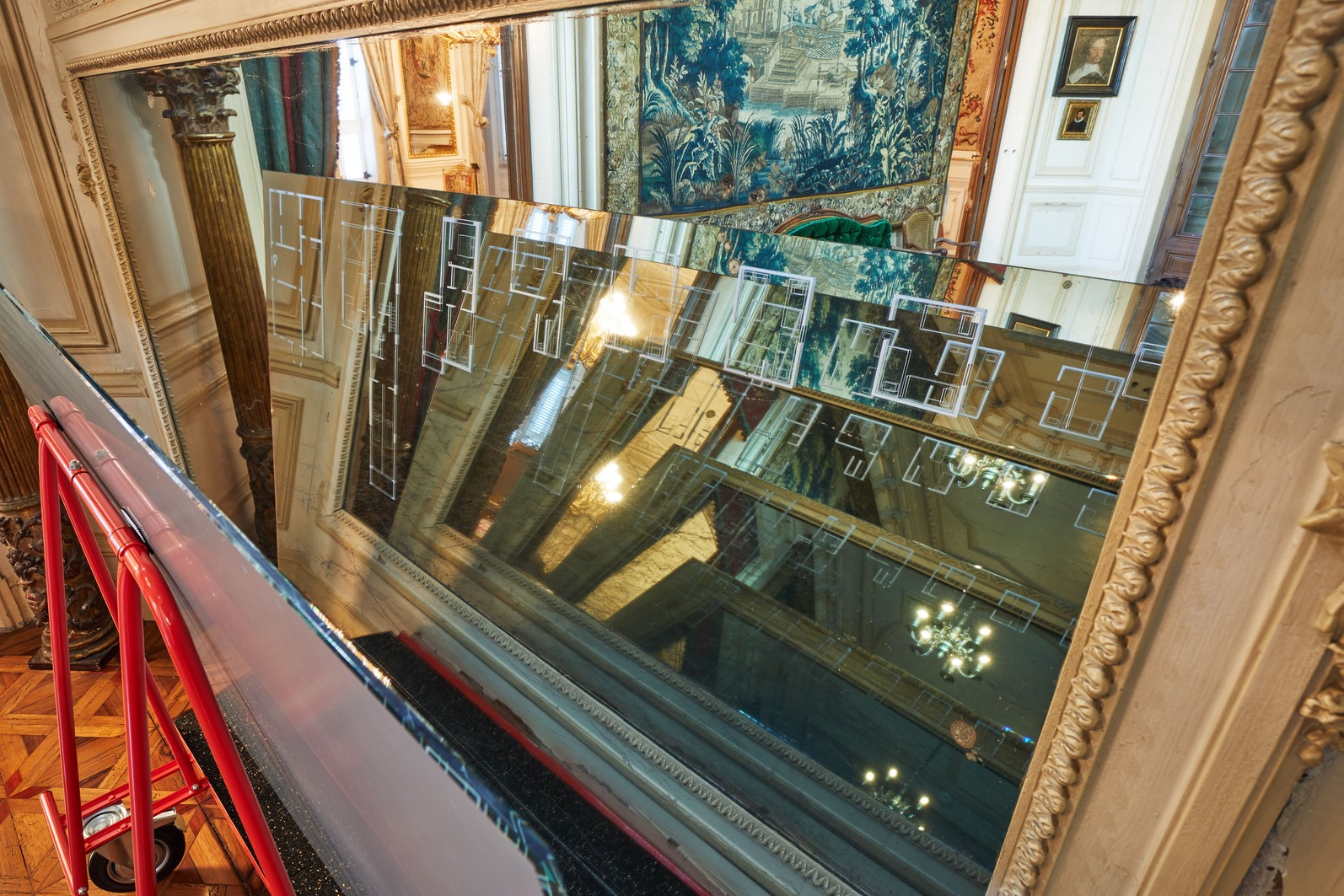
The history of housing in Marseille is intrinsically related to the history of its harbour, colonisation, labour force, migration and the rapid industrialisation and reconstruction efforts that followed World War II. The installation invites visitors to pause and reflect on the various housing typologies of Marseille which are not necessarily displayed in museums or given a forum in public institutions. Henni focuses particularly on shelters that host unhoused, badly housed and rehoused populations. Located in the antechamber of Musée Grobet-Labadié, Right to Housing confronts visitors with their own image, the villa's interior and collections, and the living spaces of those who might have worked for the Grobet-Labadié family. These spaces are presented on a freestanding mirror, infinitely reflecting in the villa's built-in mirror, which testifies to the golden age of the European bourgeoisie.

Curated by Katerina Chuchalina
Commissioned by Manifesta 13 Marseille
In Trait.s d’union, Manifesta 13, curated by Alya Sebti, Katerina Chuchalina and Stefan Kalmár
Supported by Ammodo, Drosos Foundation and Pro Helvetia
Many thanks to Katerina Chuchalina, Flora Fettah, Caroline Laurent, Tifawt Loudaoui, Marina Otero Verzier, Mayura Torii and Francesca Verga
2016

Algerian Pavilion: News from the Past

Kunsthal Aarhus
Aarhus, Denmark
17 Jun–17 Aug 2016
Algerian Pavilion News from the Past

In Something to Generate From.

Curated by Madrassa Collective
Many thanks to Madrassa Collective, Nadine Atallah, Selma Hellal, Sofiane Hadjadj and Yasmina Reggad
2014

Algeria 1961: The Paradigm of Counterinsurgency

Museum of Yugoslav History
Belgrade, Serbia
10 Jun–17 Aug 2014

In Travelling Communiqué.

Curated by Armin Linke, Doreen Mende and Milica Tomić
2013

Project Heracles

European Parliament
Brussels, Belgium
17–20 Dec 2013

Eurafrican Bridge: Linking Africa to Europe across the Strait of Gibraltar.

Curated by Domus Magazine
2011–12

Future Outdoors

Canadian Centre for Architecture
Montréal, Quebec, Canada
25 Oct 2011–4 Jan 2012
Future Outdoors in Imperfect Health

In Imperfect Health, The Medicalization of Architecture.

Curated by Giovanna Borasi and Mirko Zardini
2011–12

Is It Feasible? Ask the “Experts”

Chung-Shan Creative Hub
Taipei, Taiwan
8 Oct 2011–1 Jan 2012

Interviews with Alfredo Brillembourg & Hubert Klumpner, Lieven de Cauter, Kevin Y. C. Chang, Winy Maas, Peter Trummer, Yen-Fen Tseng and Jaap Wiedenhoff.
In The Vertical Village.

Curated by MVRDV
2011

Project Heracles

Gopher Hole
London, United Kingdom
21 Jul–4 Aug 2011

Eurafrican Bridge: Linking Africa to Europe across the Strait of Gibraltar.

Curated by Domus Magazine
2010

Narrating PARAISOPOLIS

ANCB
Berlin, Germany
12–22 Aug 2010

In Re-act Lab: São Paulo Architecture Experiment.

The Aedes Network Campus Berlin / ANCB

LECTURING

4 Mar 2026

Toxicité Coloniale : Documenter le paysage radioactif dans le Sahara

As part of the lecture series Quand les villes se souviennent : paysages urbains et colonialité (in French).

Registration ↗

École des Arts Décoratifs – PSL
Paris, France
3 Mar 2026

Toxicité Coloniale

Meeting with the author of Toxicité Coloniale : Documenter le paysage radioactif dans le Sahara, published by Éditions B42 (in French).

Librairie Le Rideau Rouge
Paris, France
29–30 Jan 2026

Frantz Fanon and Psychocolonial Spaces

In the symposium Frantz Fanon’s Social Therapy: “To Give Body to an Institution”, organized by Camilla Caglioti, Marlon Miguel and Elena Vogman.

Preview ↗

ICI
Berlin, Germany
12 Dec 2025

Architecture of Counterrevolution

In Learning with Africa.

École Nationale Supérieure d’Architecture de Bordeaux
Bordeaux, France
9 Dec 2025

Colonial Toxicity

Preview ↗

École Nationale Supérieure d’Architecture de Saint-Étienne
Saint-Étienne, France
4 Dec 2025

Colonial Toxicity

Preview ↗

École Nationale Supérieure d’Architecture de Saint-Étienne
Saint-Étienne, France
14 Nov 2025

Documenting Colonial Toxicity

Preview ↗

Faculty of Design, Architecture and Building
University of Technology Sydney
12 Nov 2025

Colonial Toxicity: Rehearsing French Radioactive Architecture and Landscape in the Sahara

Online lecture.

School of the Humanities
Hong Kong University
30 Oct 2025

Rehearsing Colonial Toxicity

Dark Opacity Lab, Nazar Theme 2025–2026.

Preview ↗

Department of Art History
Concordia University, Canada
23–24 Oct 2025

Colonial Toxicity

Keynote lecture, Agora III, international symposium organized by Ahmed Elsherif, Ushma Thakrar, Menna Agha and Federica Goffi.

Schedule ↗

Carleton University School of Architecture
Ottawa, Canada
16 Oct 2025

Performing Colonial Toxicity

Academy of Fine Arts
Vienna, Austria
9–10 Oct 2025

Methods of Colonial Toxicity

Keynote lecture in RIVELAZIONI — Metodi e strumenti di ricerca sui luoghi invisibili e negati della contemporaneità.

DiARC, Università di Napoli Federico II
Naples, Italy
26 Sep 2025

Colonial Toxicity

Independent School for the City
Rotterdam, The Netherlands
28 May 2025

Deserts Are Not Empty

Department of Architecture
TU Delft, The Netherlands
15 May 2025

Architecture of Colonial Toxicity

In Twentieth-century Colonial Architectures and Landscapes, organized by Elisa Boeri, Giulia Cazzaniga and Federico Di Cosmo.

Program ↗

MantovArchitettura
Politecnico di Milano, Mantova Campus
6 Apr 2025

Prada Frames: In Transit

In Infrastructures of Power, curated by Formafantasma.

Program ↗

Padiglione Reale and Arlecchino Train
Milan Central Station
31 Mar 2025

Ecologies of Design Lecture Series

Preview ↗

School of Architecture, College of Fine and Applied Arts
University of Illinois Urbana-Champaign
27–28 Mar 2025

Discrepant Circulations

Symposium organized by Craig Buckley, with Ross Exo Adams, Tim Anstey, Francesco Casetti, Swati Chattopadhyay, Keller Easterling, David Gissen, Samia Henni, Francesca Hughes, Kishwar Rizvi and Mark Wasiuta.

Program ↗

Yale School of Architecture
Yale University
24 Mar 2025

Colonial Toxicity

Architecture & Design NOW, with support from the Canada Council for the Arts.

Preview ↗

Department of Art
University of Lethbridge
12 Mar 2025

Architecture of Counterrevolution

In Episodes in the History of Modern Architecture.

Department of Architecture
University of Manitoba
6 Mar 2025

Colonial Toxicity

Department of Space and Design Strategies
University of Arts Linz
3 Mar 2025

Documenting Colonial Toxicity

Chaired by Edward Denison, with responses from Jananne Al-Ani; Crunch Lecture Series.

Details ↗

The Bartlett School of Architecture
11 Feb 2025

Performing and Rehearsing Colonial Toxicity

The Henry M. Jackson Endowed Lectureship in International Relations.

Details ↗

Politics Department
Whitman College, Walla Walla
4 Feb 2025

Toxicité coloniale : récitation de l’architecture et du paysage radioactifs français au Sahara

Réseau Art et Architecture du 19e siècle.

Details ↗

Département d’histoire de l’art
Université du Québec
22 Jan 2025

Toxic Environments: Possible Media

Lecture series Media Environments: Between Capture and Surveillance.

Details ↗

University of Siegen
18 Dec 2024

Toxicité coloniale : récitation de l’architecture et du paysage radioactifs français au Sahara

Seminar Vivant et écologies dans les crises et dans les guerres, organized by Stéphanie Latte Abdallah and Juliette Duclos-Valois.

Details ↗

EHESS / University of Paris 8
13 Dec 2024

Colonial Doctrines

Decolonize the City, Cantiere Milano, Giovani palestinesi d’Italia, Architetti senza Frontiere Italia and Archives.

Milan, Italy
6 Dec 2024

Discreet Violence

Online panel Future Archives with Massinissa Selmani, organized by Natasha Marie Llorens on the occasion of Selmani’s exhibition 1000 Villages.

Exhibition Details ↗

Index
Stockholm, Sweden
5 Dec 2024

Documenting Colonial Toxicity

Lecture series organized by CARAH — Collective for Anti-Racist Art History.

Art History Institute
University of Zurich
29–30 Nov 2024

Towards a Nomadic Critique of Architecture

Parlement de la recherche
Couvent de la Tourette, France
25–27 Nov 2024

Documenting Colonial Toxicity

In the international meeting Disrupting Conjurations.

Museum Habitat, Ateneu Barcelonès
Barcelona, Spain
6 Nov 2024

Colonial Toxicity

Colloquium in Architecture & Urbanism.

University of California, Berkeley
17 Oct 2024

Toxicity, Forced Migration and the Resistance of the Earth

Convened and moderated by Ariella Aïsha Azoulay, with Al-Wah’at, Samia Henni, Jumana Manna and Sherena Razek; Elemental Media Conference.

Program ↗

Brown University
27 Sep 2024

Debt of Settler Colonialism and Climate Catastrophe

With Nataša Petrešin-Bachelez, Samia Henni, Marie-Hélène Villierme, Mililani Ganivet and Olivier Marboeuf, in Climate Forum II.

Program ↗

Colonial Toxicity, the Climate Movement and Art Institutions
24–25 May 2024

Saharan Wind

Wind Tunnel Festival 2024: Swirling Winds Won’t Center.

Program ↗

Toni-Areal
Zurich, Switzerland
13 May 2024

Architecture of Counterrevolution

Keynote lecture, The Future of Humanitarian Design Symposium.

Program ↗

The Graduate Institute, HEAD and University of Copenhagen
HEAD Geneva
25 Mar 2024

Colonial Toxicity: Rehearsing French Radioactive Architecture and Landscape in the Sahara

e-flux Architecture Lectures.

Register Here ↗

e-flux
New York, USA
21 Feb 2024

Colonial Legacies

Loudreaders #47, organized by Nathalie Frankowski and Cruz Garcia.

Online
2 Feb 2024

Designing for the Atomic Age

Program ↗

Klimahouse Congress
Bolzano Fair
24 Jan 2024

Climate Regimes

Conversation with Rob Nixon, Affirmations 6; responses by Keller Easterling and Reinhold Martin.

Columbia GSAPP
11–13 Oct 2023

Rehearsing Colonial Toxicity

Keynote lecture, The Third Ecology, EAHN Thematic Conference Reykjavik 2023.

Program ↗

MoMA x Iceland University of the Arts
Listaháskóli Íslands, Iceland
26 Sep 2023

On Performing Colonial Toxicity

CCA Research Network Annual Online Lecture, in conversation with Jay Pather.

Online
7–9 Jun 2023

Wars, Built and Destroyed Environments

Keynote lecture, The Skopje Project Conference.

Program ↗

Faculty of Architecture, University SS. Cyril and Methodius
Skopje, North Macedonia
24 May 2023

Against the Regime of Emptiness

Aga Khan Program in Islamic Architecture
MIT
11 May 2023

Histoire(s) des environnements bâtis, détruits et imaginés

Cycle D’autres reliefs.

Summary ↗

École d’architecture Paris-Malaquais
24 Mar 2023

Colonial Toxicity or Toxic Coloniality?

Militant Ecologies Seminar: Terrains of Struggle.

Amsterdam School for Cultural Analysis
University of Amsterdam
16 Mar 2023

Mapping French Radioactive Geologies in the Sahara

Geography Seminar Series.

Trinity College Dublin
7 Mar 2023

Colonial Toxicity: France’s Plutopia in the Sahara

Poster ↗

Peter Guo-hua Fu School of Architecture
McGill University
22 Feb 2023

Deserts Are Not Empty

OCEAN / UNI, Imagine the Ocean Dry as Lavender: Mediterranean as hotspot for climate change and adaptation.

Online
19 Jan 2023

Colonial Toxicity or Toxic Coloniality?

Keynote lecture, II International Congress on Colonial and Postcolonial Landscapes: Architecture, Colonialism and War.

Preview ↗

Calouste Gulbenkian Foundation
Lisbon, Portugal
11 Jul 2022

Architecture of Colonial Uprooting: France’s Military Operations in Algeria

Theories of Transculturality Lecture Series.

Heinrich-Heine-Universität Düsseldorf
27 Jun 2022

Performing Colonial Toxicity

If I Can’t Dance inaugural symposium, Edition IX: Bodies and Technologies.

Amsterdam, The Netherlands
7 Jun 2022

La bombe nucléaire : un aspect méconnu du fait impérial

Keynote lecture, Mars Imperium, Histoire et mémoires (post)coloniales XIXe–XXIe siècles.

Preview ↗

MMSH
Aix-en-Provence, France
26 Apr 2022

Colonial Toxicity: France’s Nuclear Heritage in the Sahara

The Eleanore Pettersen Lecture.

Preview ↗

Irwin S. Chanin School of Architecture
The Cooper Union
5 Apr 2022

Colonial Impositions and Their Non-Effects: The Problem of French Domestic Norms and Forms in Colonized Algeria

Preview ↗

Institut für Zeitgenössische Kunst
TU Graz
1 Apr 2022

Colonial Toxicity: France’s Architecture of Ecocide in the Sahara

In Settler Colonialism and Architecture, organized by graduate students.

University of California, Berkeley
28–29 Mar 2022

Repair and Reparation in Contrast to Refusal

Goethe-Institut
London, UK
15 Mar 2022

Architecture toxique au Sahara

Register ↗

École nationale supérieure d’architecture Paris-Est
15 Feb 2022

Architecture of Ecocide: France’s Toxic Wastes in the Sahara

Register ↗

Dipartimento di Architettura e Design
Politecnico di Torino
10 Feb 2022

Illegal or Secret? On France’s Classification of Declassified Archives

Architecture/Archive/Activism Lecture Series.

Center for Critical Studies in Architecture
Goethe-Universität Frankfurt
21 Nov 2021

Sur la libération

In Croire en la liberté, Rencontres d’Averroès: Penser la Méditerranée des deux rives.

Preview ↗

Théâtre de La Criée
Marseille, France
2 Nov 2021

How to Depict Toxicity? On France’s Radioactive Remnants in the Sahara

Register ↗

Yale Architecture Forum
21 Aug 2021

Archives: Secret Défense?

In For the Phoenix to Find its Form in us, curated by Bonaventure Soh Bejeng Ndikung, Elena Agudio, Arlette-Louise Ndakoze and Alya Sebti.

Program ↗

SAVVY Contemporary
Berlin, Germany
3 Jul 2021

Ways of Publishing #4: Architecture de la contre-révolution

Conversation between Samia Henni and Léopold Lambert.

Preview ↗

Bétonsalon, Centre d’art et de recherche
Paris, France
28 May 2021

Archival Violence

Doctoral school Unearthing Traces, co-organized by Denise Bertschi and Julien Lafontaine Carboni.

Program ↗

EPFL
Lausanne, Switzerland
28 Apr 2021

Toxic Architecture

Faculty of Architecture, University SS. Cyril and Methodius
Skopje, North Macedonia
27 Apr 2021

Sahara Testing

Entanglements: Samia Henni and Nora Akawi.

Register ↗

Irwin S. Chanin School of Architecture
The Cooper Union
10 Mar 2021

Desert Toxic Modernism

School of Architecture and Landscape Architecture
Edinburgh College of Art
26 Mar 2020

What is Intersectional Feminist Practice?

Panel discussion curated and moderated by Samia Henni, with Valeria Dani, Maria Gonzalez Pendas, Anooradha Iyer Siddiqi and Bryony Roberts.

Register ↗

Bard Graduate Center
New York, USA
13 Mar 2020

War Zones

Book launch.

Department of Architecture, AAP College
Cornell University, Ithaca
12 Feb 2020

Architecture of Counterrevolution

Counterculture Lecture Series.

Preview ↗

School of Architecture and Planning
University at Buffalo
8 Jan 2020

Architecture de la contre-révolution

Book panel with Zineb Sedira.

Preview ↗

Lafayette Anticipations
Paris, France
28 Nov 2019

Anticolonial Commitments

AA New Canonical Histories.

Architectural Association
London, UK
6 Nov 2019

Architecture de la contre-révolution

Book launch.

Preview ↗

Librairie Volume
Paris, France
5 Nov 2019

À Mansourah, tu nous as séparés

Film panel discussion with Karima Lazali and Fabien Sacriste around Dorothée-Myriam Kellou’s film.

Preview ↗

Institut du Monde Arabe
Paris, France
25 Oct 2019

Architecture of Counterrevolution

In Spaces of Conflict.

College of Architecture & Environmental Design
Kent State University
3–4 Oct 2019

French Colonial Approaches to Domesticity and Religion

Workshop Time, Space, Memory.

Institute for Religion, Culture and Public Life
Columbia University
30 May 2019

France’s Nuclear Weapon Tests in the Algerian Sahara

In Perspectives on French Colonial and Late Ottoman Cultural History, honoring Professor Zeynep Çelik.

UCLA Center for Near Eastern Studies
Los Angeles, USA
21 May 2019

Architecture of Counterrevolution

Lectures from the Garage.

Garagem Sul
Lisbon, Portugal
26–27 Apr 2019

Teaching the Global Workshop

Organized by Ana María León at the Society of Architectural Historians 72nd Annual International Conference.

Providence, Rhode Island
19–20 Apr 2019

Blackness and the Visual Symposium

Organized by Naminata Diabate.

Program ↗

Department of Comparative Literature
Cornell University
10 Apr 2019

Colonial and Contemporary Landscapes of Violence

Panel with Nick Estes, Samia Henni and Madiha Tahir, moderated by Rema Hammami.

Palestine Festival of Literature
Palestinian Museum, Birzeit
10 Apr 2019

The Weaponized Space of Colonialism in Algeria, Turtle Island and Palestine

Organized by Léopold Lambert / The Funambulist.

Palestine Festival of Literature
An-Najah University, Nablus
3 Apr 2019

Architecture of Counterrevolution

Department of Architecture
Iowa State University, Ames
12 Mar 2019

The Coloniality of Counterrevolution

Pembroke Seminar Research Lecture, organized by Ariella Aïsha Azoulay; conversation with Houria Bouteldja.

Brown University
26 Feb 2019

Croiser l’analyse esthétique et l’approche sociopolitique : un défi continu

Conversation with Nadine Atallah.

Laboratoire InVisu, CNRS/INHA
Paris, France
14 Feb 2019

Migration and Colonial Modernities

Chaired by Anooradha Iyer Siddiqi and Hollyamber Kennedy.

College Art Association Annual Conference
New York, USA
17 Jan 2019

Colonial Spatiality in African Saharan Regions

Chaired session, International Congress on Colonial and Postcolonial Landscapes.

Lisbon, Portugal
19 Dec 2018

Racialized Spaces

Master of Arts in Public Spheres
École Cantonale d’Art du Valais, Sierre
9 Nov 2018

Building Camps, Unbuilding Violence

Faculty of Stage Design
Academy of Fine Arts, Dresden
8 Nov 2018

Architecture of Counterrevolution / Discreet Violence

Book panel and exhibition guided tour.

VI PER Gallery
Prague, Czech Republic
8 Oct 2018

Algiers 1958 / Paris 1968

In 1968/2018 Cities on the Edge, with Sheila Kohler.

Abstract ↗

Princeton Mellon Initiative in Architecture, Urbanism & the Humanities
19 Apr 2018

Architecture of Counterrevolution

Graduate School of Architecture
University of Johannesburg
5 Apr 2018

Planning Instabilities: Monnet, Marshall, and Constantine Plans

In Structural Instabilities: History, Environment, and Risk in Architecture.

Program ↗

PennDesign
University of Pennsylvania
2 Apr 2018

From Counterrevolution to Counterinsurgency

Intra-Disciplinary Seminar, organized by Leslie Hewitt and Omar Berrada.

Abstract ↗

The Cooper Union
9 Mar 2018

Designing for the “milieu féminin”: France’s Attempts to Keep Algerian Women Away from Islamic Customs

Aga Khan Program Lecture.

Harvard University Graduate School of Design
27 Feb 2018

France’s Trans-Mediterranean Oppressions: Migration, Death and Architecture

In Crossing the Mediterranean: Migration, Death and Culture, organized and moderated by Esra Akcan.

Program ↗

Cornell Institute for European Studies
18–21 Dec 2017

Architecture of Counterrevolution

Book presentations.

ETH Zurich; Archive Kabinett, Berlin; EHESS, Paris; The New Institute, Rotterdam
14 Nov 2017

The End of Theory?

History/Theory, a collaboration between gta Institute, ETH Zurich and e-flux Architecture.

e-flux
New York, USA
7–11 Jun 2017

Camps de Regroupement: French Military Forced Displacements in Algeria, 1954–1962

Society of Architectural Historians Annual International Conference, session Spaces of Displacement.

University of Strathclyde
Glasgow, Scotland
25 Apr 2017

How to Work with Propaganda Photographs? Architecture and the French Army in Algeria

Accademia di Architettura di Mendrisio
Università della Svizzera Italiana
21 Mar 2017

Vers une dé-propagande des archives militaires : mais où se trouve donc l’architecture ?

Laboratoire InVisu, CNRS/INHA
Paris, France
23 Sep 2016

From Camps, Homes, Borders, and Laws

In Sorry We’re Open, organized by the Side Room.

Teatro Munganga
Amsterdam, The Netherlands
17 Jun 2016

Why Does Algeria Need a Pavilion More Than Ever?

Public program of Something to Generate From, curated by Madrassa Collective.

Kunsthal Aarhus
Denmark
2–4 Jun 2016

French Planning Bureaucrats in Algeria: de Gaulle’s Mass Housing Regulations, 1959–1963

European Architectural History Network, Fourth International Meeting.

Dublin, Ireland
6–10 Apr 2016

From Habitat Musulman to de Gaulle’s Cells in French Algeria

Society of Architectural Historians Annual International Conference.

Pasadena / Los Angeles, USA
4 Oct 2015

Migration and Housing in Postwar France

Institute of Landscape Architecture
ETH Zurich
30 Sep 2015

Interview with Maristella Casciato on Planning Chandigarh

Organized by gta Archives and moderated by Laurent Stalder.

Centre Le Corbusier
Zurich, Switzerland
4 Mar 2015

Introduction to La Haine, directed by Mathieu Kassovitz (1995)

Film series on mass housing organized by doctoral fellows.

gta, D-ARCH, ETH Zurich
26 Jun 2014

Press Architecture: Unclassified Buildings in Algeria (1958–1962)

The Mosaic Rooms
London, UK
27 May 2014

How Did General de Gaulle Express His Spatial “Resurrection” in French Algeria?

Doctoral Colloquium.

gta, D-ARCH, ETH Zurich
8 May 2014

On the Spatial Order of Military Laws: The Case of the French Army in Algeria

Seminar Law and Order in Architecture.

Chair of Andreas Tönnesmann
gta, D-ARCH, ETH Zurich
2 May 2014

On and Around Research: Question, Questioning, and Questionability

Curatorial/Knowledge Seminar
Goldsmiths, London
13 Mar 2014

French Versus Spanish Colonial Spaces and Powers in North Africa

With Leire Vergara.

Curatorial/Knowledge Seminar
Goldsmiths, London
7–8 Jan 2014

On the Architecture of Modern Warfare

Roaming Research Academy / Travelling Communiqué: From Belgrade, September 5, 1961, by Doreen Mende.

Dutch Art Institute
Arnhem, The Netherlands
2 Dec 2013

Two Vocabularies in Contact: An Inventory of Terms and Images that Interrupt Each Other

With Leire Vergara.

Arteypensamiento, Sobre Capital y Territorio
International University of Andalucía, Seville

TEACHING

Samia Henni teaches classes (lectures, seminars and workshops) that critically analyze and discuss the temporal and spatial manifestations of imperialism, colonialism, wars, resource extraction, deserts' transformation, forced displacement, and gender dynamics.

In 2024, Samia was awarded the ETH Golden Owl for excellence in teaching. With this distinguished award, the Association of Students at ETH Zurich (VSETH) honors dedicated lecturers. One lecturer in each department is selected by students each year. In their nomination text, the students wrote:
"She teaches with great passion, precision and commitment. In her courses, she creates an atmosphere in which every perspective is heard, and every student is taken seriously." Read more here ↗

She was an invited visiting professor (2023-24) at the Institute for the History and Theory of Architecture (gta), ETH Zurich. In the summer of 2023, she was an invited tutor at the first-ever Biennale College Architettura 2023 at the 18th International Architecture Exhibition at Venice Architecture Biennale curated by Lesley Lokko. She co-taught a unit that we titled: "Practice" in which we search for possible forms of practices of (de)colonization and (de)carbonization.

She was an invited visiting professor (fall 2021) at the Institute of Art History at the University of Zurich; and an invited Geddes Fellow (spring 2021) at Edinburgh School of Architecture and Landscape Architecture, Edinburgh University. Between 2021 and 2025, she co-chaired the University Seminar "Beyond France" at Columbia University, New York.

In the last years, she taught and advised undergraduate, graduate, and PhD students in various academic institutions, including Princeton University, Princeton, New Jersey; Cornell University, Ithaca, New York; McGill University, Montreal, Quebec; ETH Zurich, The University of Zurich, and the Geneva University of Art and Design (HEAD) in Switzerland.
CONVENING

26–27 Mar 2026

Space in African Studies

African Studies Program
McGill University
Montréal, Canada
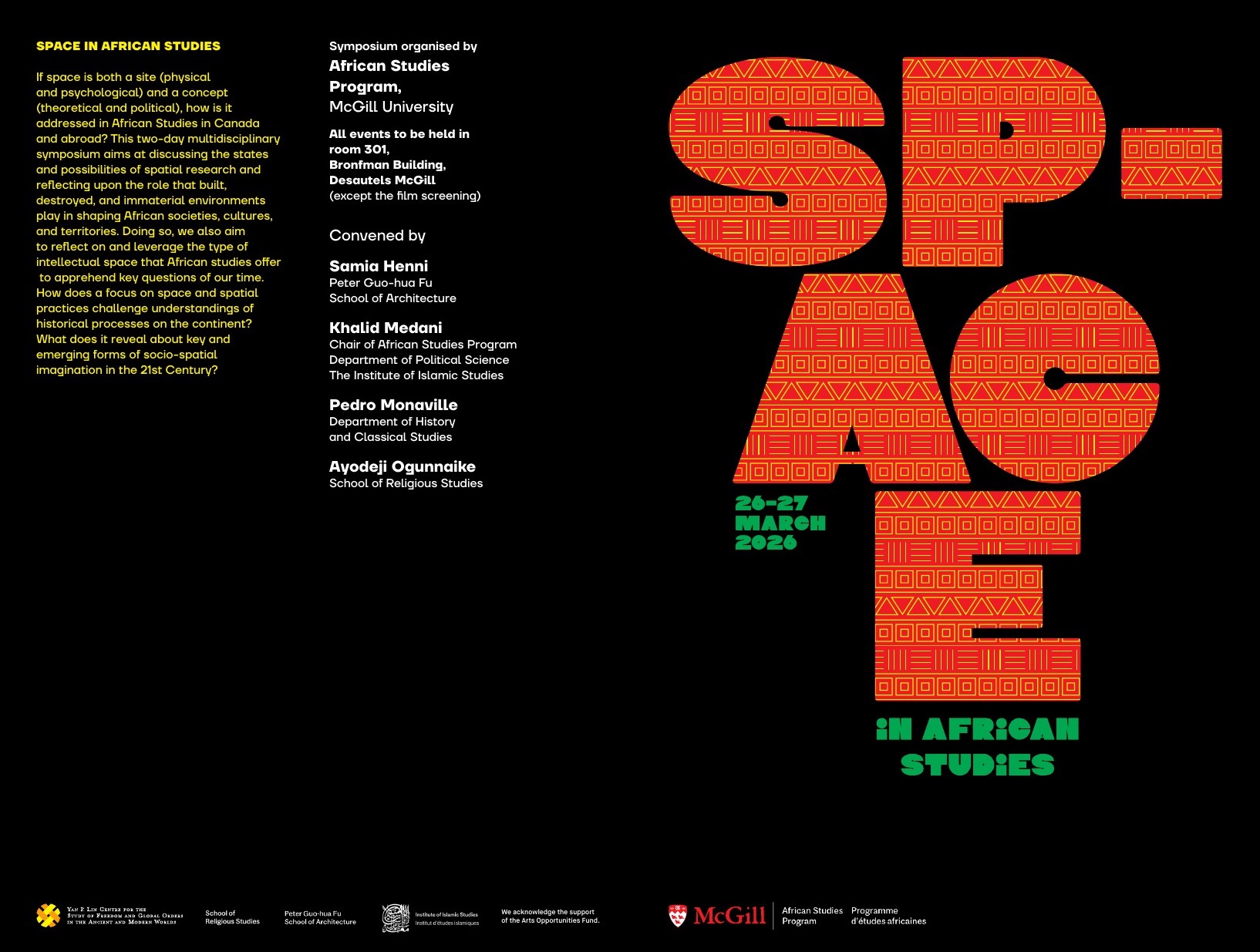
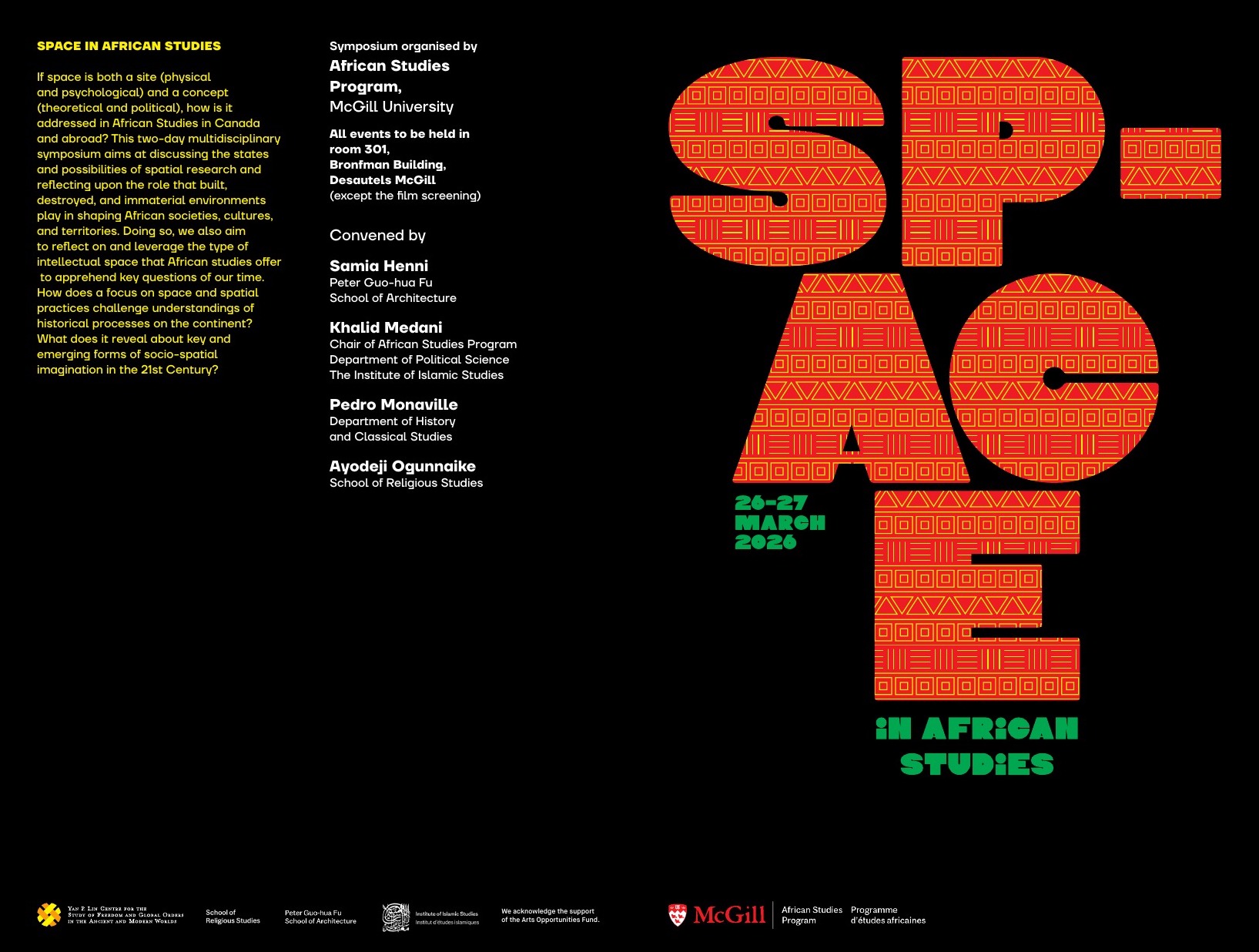
Space in African Studies symposium poster

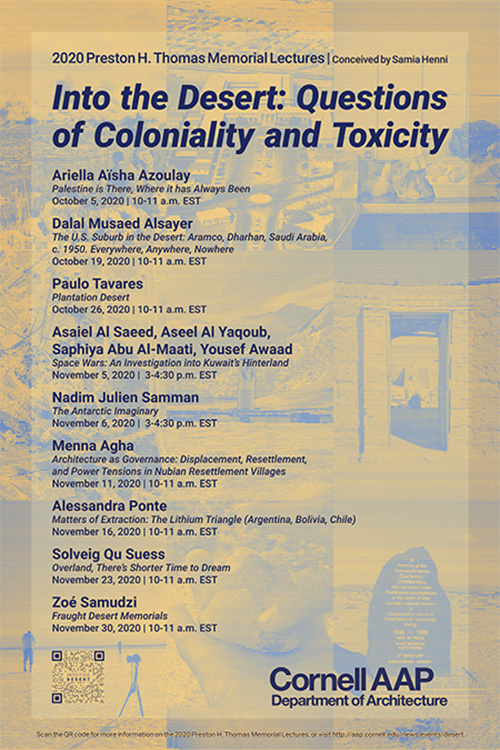
If space is both a site (physical and psychological) and a concept (theoretical and political), how is it addressed in African Studies in Canada and abroad? This two-day multidisciplinary symposium aims at discussing the states and possibilities of spatial research and reflecting upon the role that built, destroyed, and immaterial environments play in shaping African societies, cultures, and territories. Doing so, we also aim to reflect on and leverage the type of intellectual space that African studies offer to apprehend key questions of our time. How does a focus on space and spatial practices challenge understandings of historical processes on the continent? What does it reveal about key and emerging forms of socio-spatial imagination in the 21st Century

Convened by Samia Henni (Peter Guo-hua Fu School of Architecture), Khalid Medani (Chair of African Studies Program Department of Political Science The Institute of Islamic Studies), Pedro Monaville (Department of History and Classical Studies) and Ayodeji Ogunnaike (School of Religious Studies).

Thursday 26 March
10am–12pm
Pan-African Spatial Research and Practices, chaired by Samia Henni, with a response by Menna Agha and contributions by Omar Degan, Albert Ferré and Qianye Yu.
1–3pm
The City Contested: Urban Planning and Popular Resourcefulness, chaired by Pedro Monaville, with Heritier Mesa, Aurélie Maketa Mawete and Eric Ross.
3:30–5pm
Keynote lecture by Moridja Kitenge Banza.
Friday 27 March
9:30–11am
(Im)materialities and Diasporic Spaces: Architectural and Philosophical Perspectives, chaired by Ayodeji Ogunnaike, with Adedoyin Teriba and Nadia Yala Kisukidi.
11:30am–1pm
Urban Dynamics of Heritage in Khartoum, chaired by Khalid Medani, with Mai Abusalih and Zainab Gaafar.
2:30–5pm
Screening of Khartoum (2025), followed by a Q&A and conversation with co-director Timeea Mohamed.
African Studies Program
McGill University
Montréal, Canada
Space in African Studies symposium poster
26 Apr 2024

Architecture and…

ETH Hönggerberg
Zurich, Switzerland
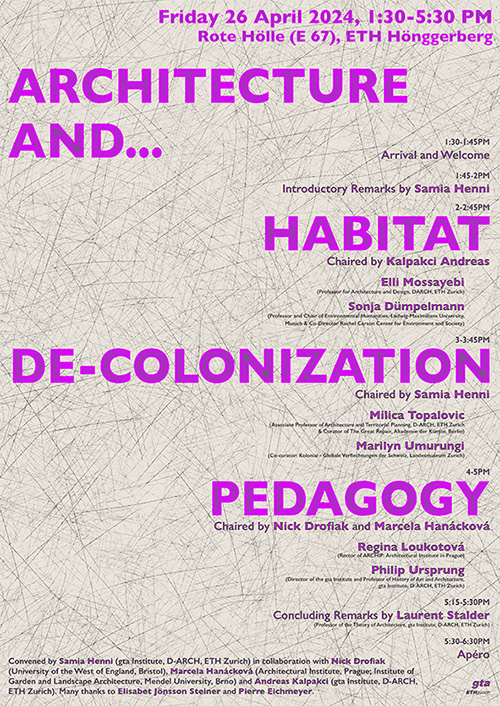
Architecture and… symposium poster

Convened by Samia Henni (Visiting Professor, gta Institute, D-ARCH, ETH Zurich) in collaboration with Nick Drofiak (University of the West of England, Bristol), Marcela Hanáčková (Architectural Institute, Prague; Institute of Garden and Landscape Architecture, Mendel University, Brno) and Andreas Kalpakci (gta Institute, D-ARCH, ETH Zurich).
Panelists: Sonja Dümpelmann, Regina Loukotová, Elli Mosayebi, Laurent Stalder, Milica Topalović, Marilyn Umurungi and Philip Ursprung.

1:30–1:45pm
Arrival and welcome
1:45–2pm
Introductory remarks by Samia Henni
2–2:45pm
Habitat, chaired by Andreas Kalpakci, with Elli Mosayebi (Professor for Architecture and Design, D-ARCH, ETH Zurich) and Sonja Dümpelmann (Professor and Chair of Environmental Humanities, Ludwig-Maximilians University, Munich; Co-Director, Rachel Carson Center for Environment and Society).
3–3:45pm
De-colonization, chaired by Samia Henni, with Milica Topalović (Associate Professor of Architecture and Territorial Planning, D-ARCH, ETH Zurich; Curator of The Great Repair, Akademie der Künste, Berlin) and Marilyn Umurungi (Independent Curator and Art Researcher).
4–5pm
Pedagogy, chaired by Nick Drofiak and Marcela Hanáčková, with Regina Loukotová (Rector of ARCHIP: Architectural Institute in Prague) and Philip Ursprung (Director of the gta Institute and Professor of History of Art and Architecture, gta Institute, D-ARCH, ETH Zurich).
5:15–5:30pm
Concluding remarks by Laurent Stalder (Professor of the Theory of Architecture, gta Institute, D-ARCH, ETH Zurich)
5:30–6:30pm
Apéro
ETH Hönggerberg
Zurich, Switzerland
Jan–Apr 2022

Hirschman Forum 2022

IMéRA
Marseille + online
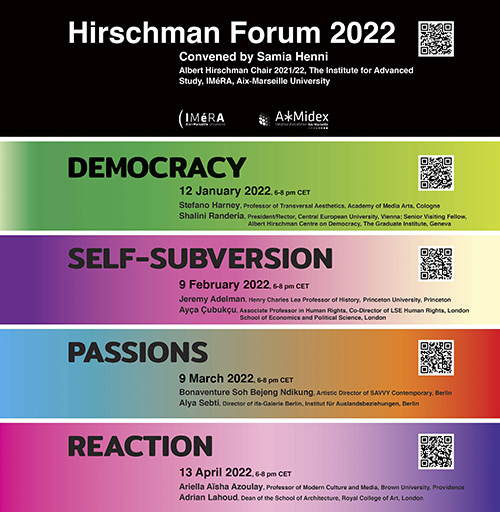
Hirschman Forum 2022 poster

To inaugurate Albert Hirschman Chair for Identity Passions between Europe and the Mediterranean at the Institute for Advanced Study (IMéRA), the first appointed Chair, Samia Henni, is hosting a series of monthly online conversations, named Hirschman Forum 2022. The Forum aims at addressing critical interpretations and interdisciplinary expansions of instigating and disputed themes borrowed from Hirschman, including Democracy, Self-subversion, Passions, Reaction, Interests, and Loyalty. The Forum reflects on "the possibility of an otherwise" in the context of the politics, policies, temporalities, spaces, and economies of societies. Every invited speaker will offer a 25-minute interpretation of a potential "otherwise," which will be discussed with the audience.

All events will be held both online and at IMéRA, at 6-8 pm CET. Online registration is required.
12 Jan
Democracy
Stefano Harney, Professor of Transversal Aesthetics, Academy of Media Arts, Cologne
Shalini Randeria, President/Rector, Central European University, Vienna; Senior Visiting Fellow, Albert Hirschman Centre on Democracy, Graduate Institute of International and Development Studies, Geneva
9 Feb
Self-subversion
Jeremy Adelman, Henry Charles Lea Professor of History, Princeton University
Ayça Çubukçu, Associate Professor in Human Rights and Co-Director of LSE Human Rights, London School of Economics and Political Science
9 Mar
Passions
Bonaventure Soh Bejeng Ndikung, curator, critic, writer, biotechnologist, Founder and Artistic Director of SAVVY Contemporary, Berlin
Alya Sebti, curator and Director of ifa-Galerie Berlin — Institut für Auslandsbeziehungen
13 Apr
Reaction
Ariella Aïsha Azoulay, Professor of Modern Culture and Media, Department of Comparative Literature, Brown University
Adrian Lahoud, Professor of Architecture and Dean of the School of Architecture, Royal College of Art, London
IMéRA
Marseille + online
Hirschman Forum 2022 poster
5 Oct–30 Nov 2020

Into the Desert: Questions of Coloniality and Toxicity

Department of Architecture
AAP, Cornell University
Online
Into the Desert poster

Deserts are not empty as they have long been seen and represented. Deserts (both hot and cold) have often served to search, extract, and transport various natural resources, such as oil and gas, as well as to design and build new cities, infrastructures, tourist complexes, farming systems, solar power plants, climate, and aerospace research centers, chemical weapons testing complexes, nuclear weapon research centers, and testing sites, and other settlements. How were these designs managed and implemented? What were their impacts on nomadic, semi-nomadic, and sedentary populations and their environments? To what extent did these deserts' transformations influence the politico-economic assets of the governments in question?
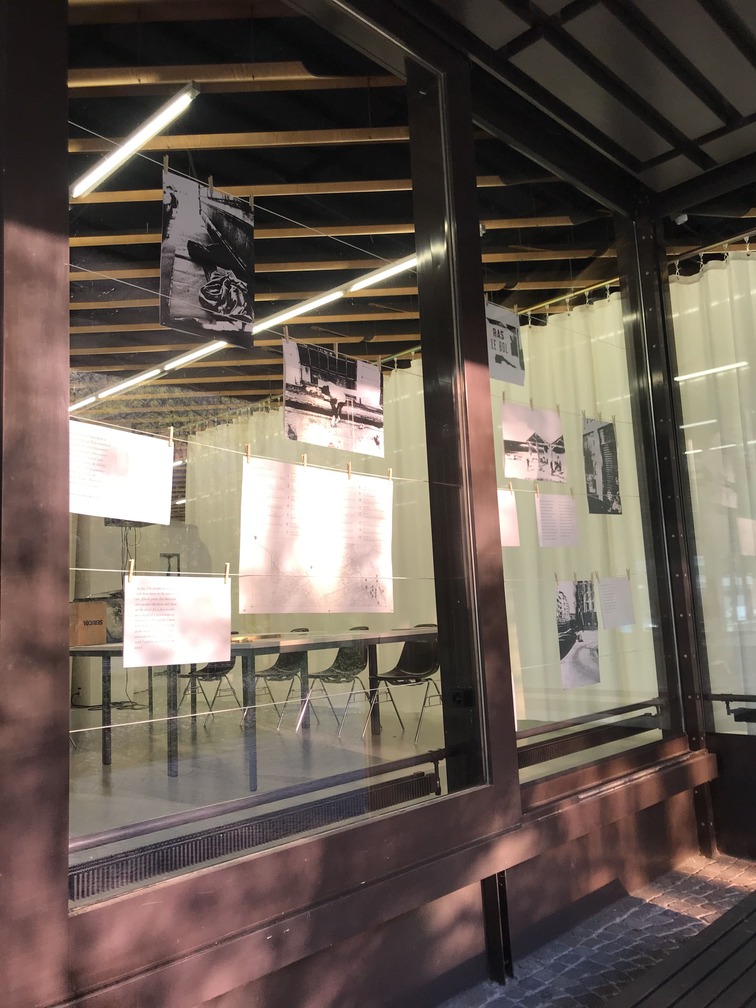
The 2020 Preston H. Thomas Memorial Symposium explored the ways in which politicians, scientists, and architects developed, exploited, colonized, transformed, urbanized, militarized, or polluted the underground or overground territories of a number of deserts in the aftermath of the Second World War.

The symposium featured a series of virtual lectures convened by Samia Henni, who is working on a book project on French nuclear testing sites and military bases in the Sahara Desert. Occurring weekly, scholars, curators, artists, and architects will each approach the topic from a different perspective and discuss one of their current research projects.

The aim of the series was to offer a multiplicity of readings of the desert. Each speaker introduced the spatial possibilities or limitations of the desert under study. Taken all together, the lectures staged an intersectional understanding of the spaces and places of the desert.

5 Oct
Ariella Aïsha Azoulay — Palestine is There, Where it Has Always Been
19 Oct
Dalal Musaed Alsayer — The U.S. Suburb in the Desert: Aramco, Dhahran, Saudi Arabia
26 Oct
Paulo Tavares — Plantation Deserts
5 Nov
Asaiel Al Saeed, Aseel AlYaqoub, Saphiya Abu Al-Maati and Yousef Awaad — Space Wars: An Investigation into Kuwait’s Hinterland
6 Nov
Nadim Samman — The Antarctic Imaginary
9 Nov
Menna Agha — Architecture as Governance: Displacement, Resettlement, and Power Tensions in Nubian Resettlement Villages
16 Nov
Alessandra Ponte — Matters of Extraction: The Lithium Triangle (Argentina, Bolivia, Chile)
23 Nov
Solveig Suess — Overland, There’s Shorter Time to Dream
30 Nov
Zoé Samudzi — Fraught Desert Memorials
Department of Architecture
AAP, Cornell University
Online
Into the Desert poster
9 Dec 2020

Unlearning

Central New York Humanities Corridor
Online
Unlearning workshop poster

A workshop organized by Urban Humanities.
Working Group: Peter Christensen, Lawrence Chua, Samia Henni, and Lisa Trivedi.

The events that occurred during Ariella Aisha Azoulay's lecture, "Palestine is There Where it has Always Been," convened by Samia Henni on October 5, 2020, as part of the Preston H. Thomas Memorial Lectures, "Into the Desert: Questions of Coloniality and Toxicity," at the Department of Architecture, Cornell University, call for a reconsideration of the roles of institutions, pedagogies, and sources in academic practice.

Borrowing the term unlearning from the titles of several publications, including Swati Chattopadhyay's Unlearning the City (2012), Azoulay's Potential History, Unlearning Imperialism (2019), and the Black Faculty of Columbia University's Graduate School of Architecture, Planning and Preservation's statement, Unlearning Whiteness (2020), this workshop seeks to engage in a collective and scholarly exchange about normative roles and our agency as historians of architecture and the built environment in the processes and mechanisms of acting conscientiously and correctively as researchers, teachers, and members of academic communities.

The Central New York Humanities Corridor's Working Group: Urban Humanities, which includes Peter Christensen (University of Rochester), Lawrence Chua (Syracuse University), Samia Henni (Cornell University), and Lisa Trivedi (Hamilton College), is pleased to host this workshop. We have invited Swati Chattopadhyay (University of California, Santa Barbara), Charles Davis II (University of Buffalo), Ana Maria Leon (University of Michigan), Lesley Lokko (City College of New York), Victoria Young (University of St. Thomas), and Mabel O. Wilson (Columbia University) to share their experiences, concerns, and hopes in an era of institutional change that promises the prioritization of diversity, equity, inclusion, in pursuit of justice.

1pm
Welcome and introduction by Samia Henni.
1:05pm
Unlearning Sources, chaired by Peter Christensen, with Swati Chattopadhyay and Mabel O. Wilson.
1:35pm
Unlearning Pedagogy, chaired by Lawrence Chua, with Ana María León and Charles Davis II.
2:05pm
Unlearning Institutions, chaired by Samia Henni, with Lesley Lokko and Victoria Young.
2:35pm
Q&A moderated by Lisa Trivedi.
Supported by Central New York Humanities Corridor.
Preview ↗
Central New York Humanities Corridor
Online
Unlearning workshop poster
Supported by Central New York Humanities Corridor.
Preview ↗
2–3 Jun 2017

Architecture and Wars: Forms of Construction and Destruction in War Zones

gta Institute
ETH Zurich
Zurich, Switzerland

Architecture and Wars poster

In everyday parlance, a war zone suggests a region in which a war is being waged. In the context of international law, a war zone refers to a demarcated area, on land or at sea, within which the right of neutrality is not respected by belligerent nations. After the end of the Second World War and the beginning of the Cold War, theaters of war became gradually blurred and often undeclared, and the very form of warfare changed significantly. Wars implied not only conventional symmetric models – armed conflicts between two or more military authorities in a defined battlefield – but also asymmetric conflicts and in some cases total wars. Whereas an asymmetric war is an armed struggle among state or non-state powers whose respective military resources are unequal, a total war mobilizes all civilian-associated means and ends. However, symmetric, asymmetric, and total wars do not exclude one another; they frequently interact or coexist.

In recent decades, critics and historians of the built environment have paid particular attention to the implications of the Second World War and the declared and undeclared war zones of the post-Second World War era in the design of infrastructures and buildings; in the execution of extrajudicial territorial occupations; in the urbanization of warfare; in the mechanisms of destruction, surveillance, and security; in the "Global War on Terror; and in the mapping of discontinuities and differences among various military schools. The conference aimed at highlighting the legacies connecting nineteenth- and twentieth-century colonial wars and twenty-first-century counterinsurgency and disclosing the intersections between the history of the built environment, colonial practices, and military operations.

Supported by the Swiss National Science Foundation, the Chair for the History of Art and Architecture Prof. Dr. Philip Ursprung, the Chair for the Theory of Architecture Prof. Dr. Laurent Stalder, and the Institute for the History and Theory of Architecture (gta), ETH Zurich.
Preview ↗
gta Institute
ETH Zurich
Zurich, Switzerland

Architecture and Wars poster
Supported by the Swiss National Science Foundation, the Chair for the History of Art and Architecture Prof. Dr. Philip Ursprung, the Chair for the Theory of Architecture Prof. Dr. Laurent Stalder, and the Institute for the History and Theory of Architecture (gta), ETH Zurich.
Preview ↗

MENTORING

In the last years, Samia Henni has mentored many people in-person and remotely. Given the multiple requests from students and professionals, Samia offers ad-hoc remunerated sessions for architects, artists, curators, editors, educators, historians, writers, or any interested students or professionals. Mentoring sessions include research, archival, architectural, artistic, writing, publishing, or curatorial practices. They can center around research methodologies, contents, writing styles, or transmission strategies. Sessions can be held in Arabic, English, French, or Italian.

If you are interested in obtaining more information and/or booking sessions, please reach out to arch(at)samiahenni.com. A first introductory session is offered. No commitment is required after the first session. Please include your curriculum vitae and the following details:

First name
Last name
Email address
Highest academic degree
Profession(s)
Field(s)
Time zone
Mentoring needs
Mentoring expectations

NEWS

The afikra Podcast - "France's Nuclear Toxicity in the Algerian Sahara" with Samia Henni, September 7, 2026.

Watch the recording of Samia Henni's "Frantz Fanon and Psychocolonial Spaces", from the symposium Frantz Fanon’s Social Therapy: ‘To Give Body to an Institution’. The symposium was organised by Camilla Caglioti, Marlon Miguel, and Elena Vogman as part of the research project Madness, Media, Milieus. It took place on January 29–30, 2026 at ICI Berlin.

World Congress of Architects, Barcelona
UIA 2026: Becoming. Architectures for a planet in transition

"Spatial Politics, Memory, and Resistance"
With Samia Henni, Estudio Teddy Cruz + Fonna Forman, and Malkit Shosha

Language: English
Simultaneous Translation: French, Spanish, Catalan
Tuesday, June 30, 13:45h 15:10h
Location: CCIB -Stage 1

Conversation with Samia Henni and Federica Martini at Collège Saint-Michel (Freiburg, Switzerland), June 28, 2026.

Guided tour with Samia Henni of Performing Colonial Toxicity at Belluard Bollwerk (Freiburg, Switzerland), June 25, 2026.

Performing Colonial Toxicity is on view at Belluard Bollwerk (Freiburg, Switzerland) from June 25 to July 4, 2026.

Ramificaciones coloniales
Lugo / A Coruña: Bartlebooth, 2026
108 pages
ISBN 979-13-991735-1-2
Text in Spanish

Space in African Studies, a two-day multidisciplinary symposium, March 26-27, 2026, McGill University.
The symposium aims at discussing models of spatial research and the role that built, destroyed, and immaterial environments play in shaping African societies, cultures, and territories.

Performing Colonial Toxicity is on view at Centre de design de l’UQAM (Montréal, Québec, Canada) from February 19 to April 12, 2026.